
Ramayana: Part 1
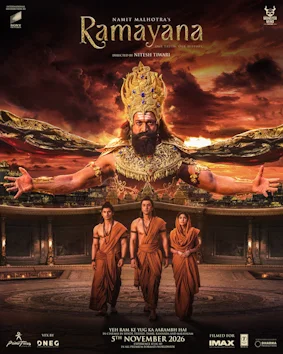
Table of Contents
Quick Facts
Plot
Ramayana: Part 1 is the first half of Nitesh Tiwari’s two-part retelling of Valmiki’s epic, and it follows Prince Rama from his early years in Ayodhya to the moment his world breaks apart. Mentored by the sage Vishvamitra, the young prince proves his worth by defeating the demoness Tataka, then wins the hand of Princess Sita by stringing the divine bow Pinaka at her swayamvara in Mithila. It is a story of duty fulfilled with grace, and the film takes its time letting the audience live inside that golden, ordered world before it is taken away.
The peace does not last. Queen Kaikeyi invokes two old boons and demands that Rama be denied the throne and sent into fourteen years of exile, and Rama accepts without protest, bound by his father’s word and his own dharma. Sita and his brother Lakshmana walk beside him into the Dandaka forest, and there the film turns darker: Ravana, the king of Lanka, sets his trap with the golden deer, and Sita is carried away. The first part ends on that severance, with Rama and Lakshmana beginning the long search that the second film will continue.
Performance
Ranbir Kapoor carries the film as Rama, and the role asks him to be still rather than showy: a prince whose strength shows in restraint, in the way he accepts exile without bitterness and keeps his word when it costs him everything. It is a different kind of heroism from the one Kapoor usually plays, and the quieter register suits the character, giving Rama a dignity that does not need to raise its voice.
Yash, as Ravana, is the film’s other pole, and the trailers deliberately open on him: a king whose power was earned through a boon and corrupted by ego, played with a grandeur that makes him feel like a genuine threat rather than a stock villain. Sai Pallavi brings warmth and steel to Sita, Sunny Deol lends weight to Hanuman, and Ravi Dubey, as Lakshmana, gives the brothers’ bond its emotional anchor. The ensemble is one of the largest ever assembled for an Indian film, and the casting across industries is part of the point: this is an epic meant to belong to the whole country.
Screenplay and Direction
Nitesh Tiwari, who co-wrote the screenplay with Shridhar Raghavan, approaches the epic as a traditional adaptation rather than a reinvention. Scholars and pandits were consulted during the writing, and the film keeps the spine of Valmiki’s story intact: the boons, the exile, the abduction. The scale, though, is entirely modern, with DNEG handling visual effects on a production reported to be the most expensive Indian film ever made, and the action staged for IMAX screens.
The risk of a project this size is that spectacle swallows character, and the first part mostly avoids it by keeping its focus on choices: Kaikeyi’s choice, Rama’s choice, Ravana’s choice. Where the film will be judged is in its second half, which must carry the weight of Sita’s abduction without rushing it, and in whether Part 2 can pay off a story that deliberately ends in loss. As an opening chapter, though, it does what an opening chapter should: it makes the audience care about the people before it tests them.
Music
The score is a genuine event in itself: Hans Zimmer, working on his first Indian film, composes alongside A. R. Rahman, with Sanskrit verses added to Zimmer’s themes and lyrics by Kumar Vishwas. The songs released ahead of the film, including Jai Jai Ram and Ravana Tandav, show the two composers working in different registers, one cosmic and orchestral, the other rooted in Indian devotional music, and the combination gives the film a sound unlike anything else in Hindi cinema.
Music here is not decoration; it is how the film marks the shift between worlds, from the order of Ayodhya to the wildness of the forest and the menace of Lanka. In a film built on scale, the score is the thread that keeps the emotion audible beneath the effects, and it is one of the strongest reasons to experience the film on the biggest screen available.
Themes
At its heart, Ramayana: Part 1 is about dharma as a lived choice rather than a slogan. Rama does not keep his word because it is easy; he keeps it when it costs him a kingdom, and the film asks the audience to sit with how hard that actually is. Kaikeyi, meanwhile, is not a cartoon villain but a mother acting on an old promise, which makes the tragedy sharper: everyone in this story is bound by something, and freedom comes only at a price.
The film also speaks to why this story endures. It is not really about gods and demons; it is about a family breaking apart over a promise, a marriage tested by exile, and a man who chooses duty over desire. Told at this scale, with this cast, it becomes a reminder that the oldest stories survive because they are about the newest feelings: loyalty, loss, and the hope that what was taken can still be found.
Conclusion
Ramayana: Part 1 arrives in cinemas worldwide on 5 November 2026, ahead of Diwali, with the second part planned for Diwali 2027. It is the most ambitious Indian film ever attempted, and whether it fully earns that ambition will only be clear when the story is complete. As a first chapter, however, it delivers a handsome, sincere and often stirring retelling, carried by strong central performances and a score of rare scale.
For viewers who grew up with the epic, and for those meeting it for the first time, this is essential big-screen viewing: a film that treats its source with respect, its audience with intelligence, and its own promise seriously. Watch it in IMAX if you can, and stay for the second part, because the story this film starts is only half told.