
Tu Hai Meri Kiran
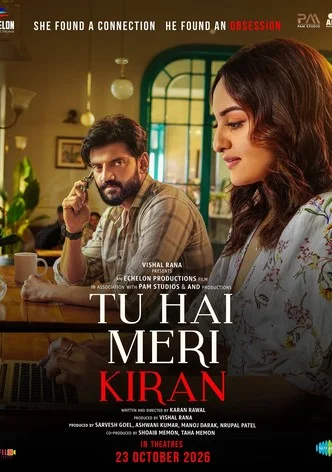
Table of Contents
Quick Facts
Plot
Tu Hai Meri Kiran is a psychological romantic thriller with a time-twisting hook. Sonakshi Sinha plays Kiran Mittal, a bestselling author living in 2026, who moves into a new house with her husband Riyaan, played by Ankit Gupta, and discovers a mysterious old flip phone. Through that phone she connects with Samar, played by Zaheer Iqbal, a stranger who is living ten years in the past, in 2016, and what begins as an intriguing cross-time connection soon turns dark.
Samar realises that Kiran knows the future, and his fascination curdles into a dangerous, manipulative obsession with possessing her at any cost, altering events in the past that begin to unravel Kiran’s present life. The film, written and directed by Karan Rawal in his feature debut, asks where love ends and obsession begins, and its title, borrowed from the famous song in Darr, is a deliberate warning: this is a story about a man who cannot let go.
Performance
Sonakshi Sinha and Zaheer Iqbal, a real-life couple playing a fictional one, are the film’s centre, and critics praised both performances even where they were divided on the film. Sinha plays Kiran as a woman whose confidence as a writer hides a growing fear, and her scenes alone with the phone, listening to a voice from another decade, carry the film’s tension. Iqbal, as Samar, has the harder job: making obsession feel human before it turns frightening, and the early reviews singled out his work as a strength.
Ankit Gupta, as the husband caught between his wife and a stranger she cannot explain, gives the film its grounding, while Sherlin Seth, Zarina Wahab and Purnendu Bhattacharya fill out the world around the central triangle. The film’s first half, which critics generally praised for its premise and performances, works because the three leads play the strangeness straight, letting the audience believe in the phone before it starts to frighten them.
Screenplay and Direction
Karan Rawal, making his feature directorial debut after assistant work on The Dirty Picture and Veere Di Wedding, builds the film around a single strong idea: two timelines, one phone, and a love that crosses a decade in the wrong direction. The first half, which follows Kiran’s discovery and the growing connection, was widely praised for its intrigue, and the film’s central question, coincidence versus fate, gives the thriller a philosophical edge that lifts it above a standard stalker story.
Where critics were divided was the second half, where the time-travel rules grow tangled and some plot questions are left unanswered. That is a common risk for a premise this ambitious, and it is fair to say the film’s idea is stronger than its execution in places. Even so, a debut director attempting a story this unusual, and landing its first half as well as Rawal does, is worth noting, and the film’s mixed reception reflects ambition as much as failure.
Music
The film’s songs are composed by OAFF and Savera, with the background score by Advait Nemlekar and Shalom Benjamin, and the soundtrack, released by Saregama, includes tracks such as Humsafar, sung by Vishal Mishra, and Na Roko. For a thriller, the music’s job is mood: the romance in the early phone calls needs warmth, and the later obsession needs a chill, and the composers handle that shift with a light touch.
The title itself is a song, and the film knows it: the Darr connection is not just a name but a promise of the territory the story enters, where a beloved melody becomes a warning. The score does not overpower the performances, which is the right choice for a film whose horror is psychological rather than visual, and the songs give the romance a tenderness that makes its corruption feel sharper.
Themes
Tu Hai Meri Kiran is about the difference between love and possession. Samar does not simply love Kiran; he wants to own her future, to rewrite her life from the past, and the film’s horror lies in how reasonable that desire sounds at first. It asks the audience to notice the moment affection becomes control, and to feel how quickly a connection can become a cage when one person holds knowledge the other cannot check.
It is also a film about time as a kind of power. Knowing the future, the film suggests, is not a gift but a weapon, and Samar’s tragedy is that he uses it to trap rather than to free. Kiran’s fight, in turn, is not just against a man but against a timeline: she must protect a present that someone else is trying to edit, and that makes the thriller’s stakes feel personal rather than abstract.
Conclusion
Tu Hai Meri Kiran released in cinemas on 23 October 2026, and it divided critics: praised for its performances and its unusual premise, criticised for a second half that does not fully resolve its time-travel puzzle. Its box-office run was slow, but the film’s idea, and its two lead performances, have kept it in conversation.
For viewers who like thrillers with a twist, for Sonakshi Sinha and Zaheer Iqbal fans, and for anyone who enjoys a love story that turns dark, Tu Hai Meri Kiran is worth a watch, with the caveat that its first half is stronger than its second. Go for the premise and the performances, and judge the ending for yourself.