
Drishyam: The Conclusion
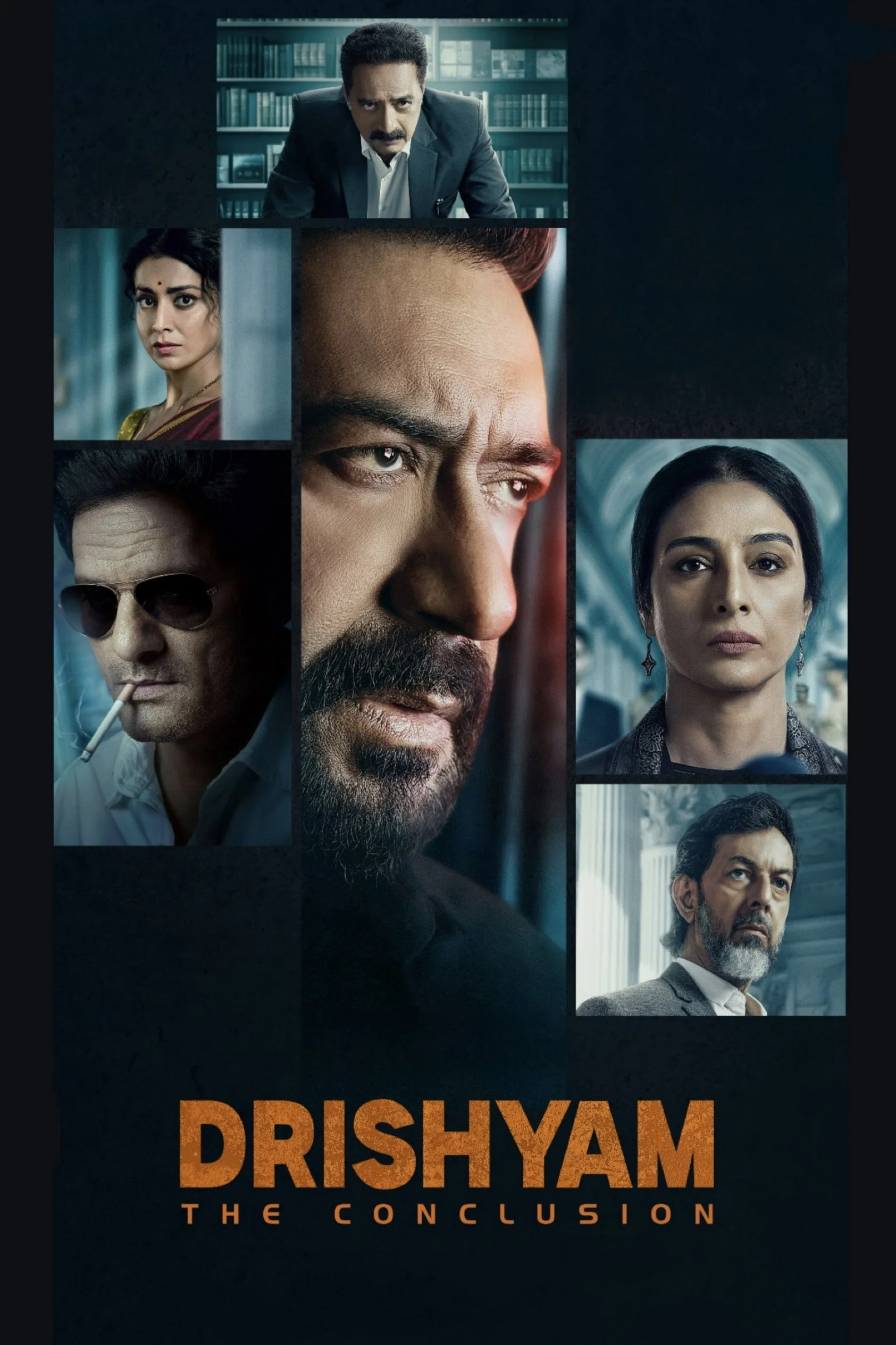
Table of Contents
Quick Facts
Plot
Few Hindi franchises have gripped audiences like Drishyam. What began in 2015 as the story of Vijay Salgaonkar — a humble cable-television operator in Goa — has become modern Hindi cinema’s definitive cat-and-mouse saga. In the first film, Vijay’s family was accidentally entangled in a terrible crime, and engineered a cover-up of staggering cleverness, built on the one thing he knew best: the logic of movies. The police, led by a grief-stricken IG Meera Deshmukh, could never quite catch him. Part two picked up years later, with the past threatening to surface — literally — and Vijay forced to bury not just evidence, but the ground beneath a police station.
Drishyam: The Conclusion is what the title says: the final chapter. The Salgaonkars still live in the shadow of what they did and hid. The trailer teases the noose tightening once more. Meera Deshmukh is back, still driven by a loss she cannot put down, and this time two formidable new faces join the pursuit: Jaideep Ahlawat and Prakash Raj. The film keeps their game hidden, offering only flashes of interrogation rooms, courtrooms and Vijay’s now-famous impassive stare.
Performance
Ajay Devgn has played Vijay Salgaonkar long enough now that the performance is less acting and more inhabiting. Across two films he built a man whose greatest weapon is calm — slow-spoken, never raising his voice, his stillness in an interrogation room telling you exactly how much he is calculating. In a finale, that stillness carries heavier weight; every held glance feels like it might be the last. Devgn never shows the machinery working; you see only the ordinary, devoted family man — which is precisely what makes the cover-up believable.
Tabu returns as Meera Deshmukh, and her presence alone changes the temperature of every scene she walks into. Earlier she played grief as anger — the raw fury of a mother and officer who knows the truth but cannot prove it. Years on, grief has hardened into obsession, and Tabu shows the difference in small, precise ways. Shriya Saran’s Nandini remains the family’s emotional centre — the character through whom the audience feels the cost of Vijay’s schemes.
Screenplay and Direction
Abhishek Pathak returns to direct after handling Drishyam 2, — a sensible choice for a finale. He understands the franchise’s peculiar rhythm: long, quiet domestic stretches where the audience slowly realises everything is happening, punctuated by sudden, surgical reveals. The Drishyam films live or die on their screenplay architecture — the layering of misdirection, the planting of innocent-looking details that turn out to be load-bearing. Part two’s celebrated twist depended on exactly that kind of construction, and the conclusion has to outbuild it while still honouring everything that came before.
The central challenge is narrative exhaustion. By the third film the audience is as clever as Vijay — they know his tricks and watch for the feints. The screenplay has to find a way to make the familiar unfamiliar again — perhaps by letting Vijay’s own family turn the pressure back on him. The addition of two new pursuers in Ahlawat and Prakash Raj suggests the script is doing exactly that: changing the hunters rather than repeating the hunt.
Music
The Drishyam franchise was never a musical showcase, and it is better for it. A song here would feel like an interruption — the tension is the music, and the silence around it matters. The soundtrack duties for the conclusion are split between Ravi Basrur, Rochak Kohli and Karma on songs, with Amar Mohile composing the background score. That split signals the priorities: songs serve the story’s moments, the score carries the suspense.
Amar Mohile’s background score is the element to watch here. In a thriller built on patience, the score tells the audience when to lean in and when to be afraid. The earlier films used low, pulsing motifs that crawled under interrogation scenes and family dinners alike, making the ordinary feel threatening. Expect a similar approach — music that does not decorate the film but stalks it. This is the last outing for the family’s theme, and the score must give it the weight of a farewell.
Themes
At its core, Drishyam has always been about a single question: how far can a good man go to protect the people he loves before he stops being a good man? Vijay Salgaonkar committed himself to a lie in the first film, and every instalment since has been about the compounding interest on that lie. The franchise asks the audience to root for the obstruction of justice — to admire a cover-up’s ingenuity and feel relief when the police are fooled. That moral tightrope is the series’ whole engine.
The conclusion brings with it the heaviest theme of all: the impossibility of outrunning the past. The family has aged in real time; the original crime has had a decade to ferment. Guilt, in the Drishyam universe, is not a moment — it is a condition you learn to live inside. The finale must confront its central paradox: if Vijay is never caught, the story is a triumph of cunning; if he is, a tragedy. There is no clean answer.
Conclusion
Drishyam: The Conclusion carries one of the heaviest burdens in Hindi cinema: ending a story loved for over a decade without betraying it. Pathak directing, Devgn and Tabu returning, Ahlawat and Prakash Raj joining the hunt — everything about the packaging suggests a film that understands what is at stake. It released on 2 October 2026, right in the festive season’s thick, and it is positioning itself as the definitive full stop on the Salgaonkar saga.
It must deliver not another twist for its own sake, but an ending honouring the franchise’s moral complexity. Vijay cannot simply win again — a repeat, not a resolution. Nor can he be destroyed without cost — that would waste a decade of loyalty. The narrow path between those two outcomes is where the best version of this film lives.