
Eetha
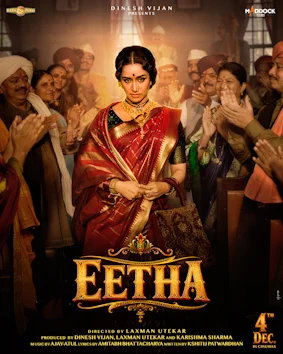
Table of Contents
Quick Facts
Plot
Eetha is the story of Vithabai Bhau Mang Narayangaonkar, the legendary Tamasha and Lavani performer who rose from humble beginnings to become one of Maharashtra’s most celebrated folk artists, and Shraddha Kapoor plays her in what may be the most demanding role of her career. The film follows Vithabai from her early days, through struggle, betrayal and hardship, to the stage where she became a legend, and the trailer, released on 30 October 2026, shows that journey in full colour: dance, defiance, and a woman refusing to let society dictate the course of her life.
Randeep Hooda plays Merchant, Vithabai’s husband, with Mohammed Zeeshan Ayyub, Siddharth Jadhav, Anant Joshi and Nana Patekar in key roles, and the story is built around the world of Tamasha itself: the travelling theatre, the music, the crowds, and the price a woman artist paid for fame in a world that wanted her talent but judged her life. It is a biopic, but it is also a musical, and the film’s energy comes from that combination.
Performance
Shraddha Kapoor’s transformation is the film’s headline, and the trailer shows why: she dances as Vithabai with a commitment that goes beyond imitation, capturing both the performer’s fire on stage and the woman’s vulnerability off it. This is a return to theatres for Kapoor after a long gap, and the role asks her to carry a film almost entirely on her own shoulders, through dance, emotion and sheer presence.
Randeep Hooda, as Merchant, gives the film its grounding, playing a husband caught between pride in his wife and the pressures of the world around them, while Nana Patekar, in one of his final screen appearances, adds gravitas to the ensemble. The supporting cast, including Mohammed Zeeshan Ayyub and Siddharth Jadhav, fills out the Tamasha world with the kind of lived-in detail that makes a biopic feel real rather than reverent.
Screenplay and Direction
Laxman Utekar, who co-wrote the film with Kshitij Patwardhan, directs a biopic that refuses to be a dry retelling. Shot across Bhor and Pune, with a grand montage song featuring 800 people, the film treats Vithabai’s life as a stage production in itself: big, musical, and emotional, with the camera moving between the intimacy of her struggles and the spectacle of her performances. Utekar, who directed Kapoor before in Chhaava’s world of historical drama, clearly trusts his lead to hold the centre.
The film was originally planned for August 2026 but moved to December to avoid clashing with Khosla Ka Ghosla 2 and Toxic, a decision that suggests confidence: December is a prestige slot, and Eetha is being positioned as one of the year’s important films rather than a quick release. If the finished film balances its music with its drama, it could be one of the most affecting biopics in recent Hindi cinema.
Music
Ajay–Atul compose the music, and for a film about a Lavani legend, that choice is everything. The duo’s score must do two things at once: recreate the sound of Tamasha, with its drums, its call-and-response and its raw energy, and give Vithabai’s inner life a melody the audience can carry. With lyrics by Amitabh Bhattacharya and choreography by Vaibhavi Merchant, the songs are built to be performances in their own right, not just background.
The trailer already shows the music working as storytelling: dance numbers that mark the stages of Vithabai’s rise, and quieter moments where the music falls away and lets her face do the work. For a musical biopic, the soundtrack is the test, and Ajay–Atul’s involvement is the strongest sign that Eetha takes that test seriously.
Themes
Eetha is about a woman who built her own identity in a world that wanted to define her. Vithabai’s story is one of art as resistance: she danced, she performed, she refused to be small, and the price she paid for that refusal is the film’s emotional core. It asks what it costs a woman to be famous for her talent in a society that judges her for it, and it answers with her life, not with speeches.
It is also a film about folk art itself, and about Maharashtra’s Tamasha tradition as a living, breathing culture rather than a museum piece. By telling Vithabai’s story through music and dance, the film argues that her art was not separate from her life; it was her life, and preserving it is a form of respect. That is why the film matters beyond its star: it keeps a tradition visible.
Conclusion
Eetha releases in cinemas on 4 December 2026, and it arrives as one of the most significant Hindi films of the year: a biopic of a folk legend, a musical, and a showcase for Shraddha Kapoor in a career-defining role. It will share its weekend with Bokshi and Ranger, but its appeal is distinct, and its subject deserves the big screen.
For lovers of biopics, for fans of Lavani and Tamasha, and for anyone who wants to see a great performer play a great performer, Eetha is essential viewing. Go for the music, and stay for the woman at its centre, because Vithabai’s story is one Hindi cinema has waited too long to tell.