
Jana Nayagan
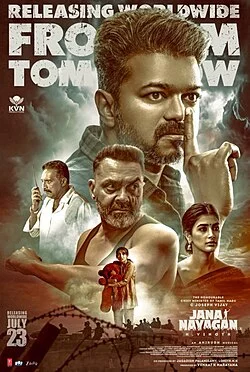
Table of Contents
Quick Facts
Plot
Vetri Kondan is a former IPS officer who has walked away from the uniform and now lives a quiet life, looking after Viji, the young daughter of a late friend. He wants nothing more than to help her chase her dream of joining the Indian Army, and for a while the film lets that gentle, protective bond breathe.
That peace does not last. Vetri crosses paths with Amrish Pujari, a former police officer turned powerful political operator, and old scores resurface. What begins as a personal duty soon grows into a public fight, as Vetri finds himself standing up for ordinary people against a system that has learned to look the other way.
The film also gives Vetri a personal stake that goes beyond politics. Viji is not a symbol to him; she is a child he promised to protect, and that promise is what keeps his fight human even when the stakes grow larger and the crowds grow louder.
Performance
Vijay carries the film the way only he can, and this being his farewell film gives every mass moment an extra charge. His screen presence is effortless, his humour lands softly, and when the action arrives he still moves with the confidence of a star who has owned the big screen for three decades.
Pooja Hegde brings warmth to the female lead, while Bobby Deol makes for a suitably cold and menacing antagonist. Prakash Raj, Gautham Vasudev Menon, Priyamani, Narain and Mamitha Baiju fill out the world well, so the film never feels like a one-man show even when Vijay is clearly its centre.
What makes Vijay’s farewell work is restraint. He does not play every scene as a goodbye, and that restraint makes the moments that do feel like one land much harder with an audience that has grown up with him.
Screenplay and Direction
H. Vinoth directs with a clear sense of occasion, balancing the political message with the commercial beats a Vijay film demands. The first half builds the characters patiently, and the second half leans into confrontation, crowd-pleasing dialogue and large-scale action.
The film is not without its excesses. At three hours it carries more subplots than it needs, and some of the political messaging is laid on thick. Yet Vinoth keeps the emotional thread of Vetri and Viji visible throughout, which stops the film from becoming only a series of speeches and set pieces.
Vinoth’s experience with grounded action dramas shows in the way the confrontations are staged. The fights feel physical and earned, and the quieter scenes between Vetri and Viji are given room to breathe before the noise returns.
Music
Anirudh Ravichander delivers a score that understands exactly what this film means to its audience. The mass themes arrive with a roar, the emotional passages stay restrained, and the songs, including the much-loved Thalapathy Kacheri, became part of the farewell celebrations around the release.
The background score does a lot of the heavy lifting in the action blocks, lifting ordinary confrontations into theatre moments. Even viewers who come for the story alone will find the music shaping how they remember the film.
The songs also serve as a farewell tour in themselves, with the audio launch and the concert in Kuala Lumpur becoming part of the film’s story before it even released. Anirudh’s work here is inseparable from the event around the film.
Themes
At its heart, Jana Nayagan is about responsibility: what a man owes to the people around him once he has seen injustice up close. Vetri is not chasing power; he is answering a debt to a dead friend and, by extension, to everyone who has no one to speak for them.
The film also works as a farewell and a passing of the torch. It celebrates the idea that a hero is not the man with the loudest dialogue but the one who stands his ground when standing costs something. That sincerity is what keeps the film watchable beyond its star power.
The film also touches on the idea of legacy. Vetri’s story asks what a public figure leaves behind when the applause fades, and it answers that what lasts is not the speech but the person who was helped along the way.
Conclusion
Jana Nayagan is big, emotional and unashamedly a star vehicle, and it knows its audience. Fans will celebrate it, newcomers will find a solid political action drama, and everyone will feel the weight of watching Vijay take his final bow.
It is not a perfect film, but it is a memorable one. For the scale, the music and the farewell alone, it earns its place among the most talked-about Tamil films of 2026.
After its big theatrical run, Jana Nayagan moved to ZEE5, where it is now streaming for viewers who missed the farewell on the big screen. It is a film best watched with the sound up and the crowd around you, even at home.
For fans, the film is a celebration; for others, it is a solid political drama with a strong central performance. Either way, it is a fitting final chapter, and it closes a remarkable career with the noise and emotion it deserves.