
Ghilli
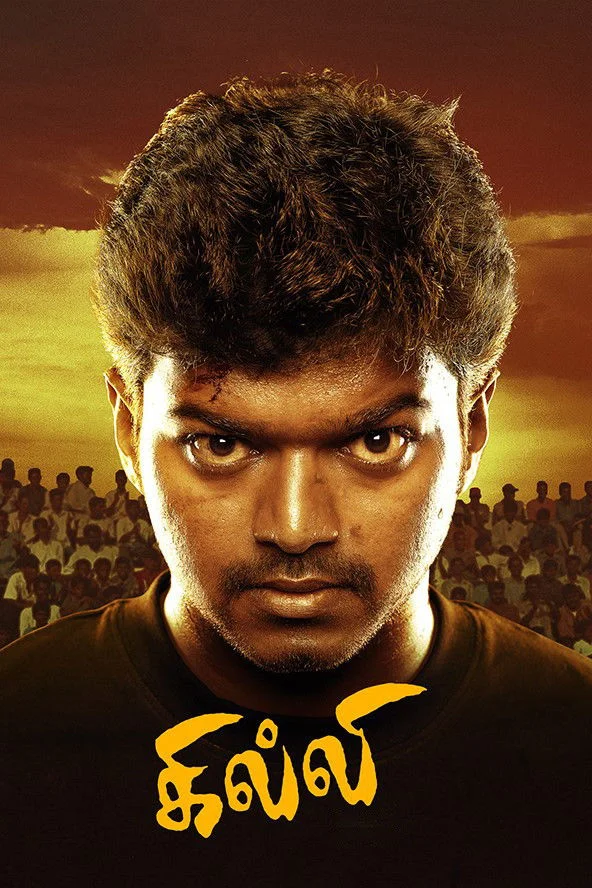
Table of Contents
Quick Facts
Ghilli is a Tamil sports action film directed by Dharani, starring Vijay, Trisha, Prakash Raj and Ashish Vidyarthi. Released on 17 April 2004, it went on to become the highest-grossing Tamil film of that year and the film that permanently converted Vijay from a romantic hero into a full-blown mass action star. Twenty years later, its 4K remastered re-release in 2024 drew packed houses all over again — a rare second life that says everything about how deeply this film is wired into Tamil cinema’s memory.
The film is currently streaming on Sun NXT. It is a remake of the Telugu hit Okkadu (2003), with Prakash Raj reprising his own role from the original, and it completes Dharani’s hat-trick of action blockbusters after Dhill and Dhool. If you have ever wondered where the Vijay “Thalapathy” era truly began, this is the film.
Plot
Saravanavelu, known to everyone as Velu, is a state-level Kabaddi player from Chennai who would rather be on the mat than in a classroom — much to the irritation of his father, DCP Sivasubramaniam, a strict police officer who constantly berates him for neglecting his education. Velu’s mother Janaki dotes on him, and his mischievous younger sister Bhuvi adores him even as she keeps landing him in trouble. When Velu is sent to a relative’s wedding in Trichy, he does what any devoted athlete would do: he skips the wedding and sneaks off to Madurai to play an exhibition Kabaddi match for his team, Ghilli.
In Madurai, Velu crosses paths with Dhanalakshmi, a young woman fleeing for her life. A local gang leader named Muthupandi has decided he will marry her, and he has already murdered both her brothers for standing in his way. Her terrified father has given her money and her university certificates and asked her to escape to her uncle in the United States. When Muthupandi catches her mid-escape, Velu steps in, thrashes the gangster and his men, and takes Dhanalakshmi with him to Chennai.
Velu hides Dhanalakshmi in his own room without his family’s knowledge. Meanwhile Muthupandi and his father, the Home Minister Rajapandi, pressure Sivasubramaniam to track down the “kidnapper”. Velu arranges a passport and flight tickets for Dhanalakshmi, and somewhere between the hiding and the planning, she begins to fall for him. When his father discovers his son is the fugitive everyone is hunting, Velu and Dhanalakshmi go on the run — taking shelter in a lighthouse — before Velu makes it back in time for the Kabaddi final against Punjab. He plays the match as a wanted man, spots Dhanalakshmi in the crowd mid-game, and finds his fire again. The final confrontation with Muthupandi ends in a brutal showdown in which the villain is electrocuted to death by his own aruval when a floodlight shattered in the fight falls on it.
Performance
Vijay is the whole engine of Ghilli, and it is not hard to see why this film redrew his career. Velu is cheerful, boyish and easy to like in the first half, and then, when the stakes turn serious, Vijay switches into a mode Tamil audiences had only glimpsed before — the one-man army who takes on an entire gang with a mix of fury and wit. His comic timing with Dhamu and his sidekicks keeps the film light even in its tensest stretches, and his physicality in the Kabaddi sequences and the interval-block fights feels completely committed. This was the performance that moved him decisively from romance to action, and he never really looked back.
Prakash Raj is magnificent as Muthupandi — and he had an advantage few remake actors get, because he had already played the same character in the Telugu original. He leans into the role’s terrifying charisma: a gangster who treats murder as courtship and genuinely cannot understand why the woman he wants will not have him. Trisha, in her first pairing with Vijay, brings warmth and vulnerability to Dhanalakshmi, and the easy chemistry between the two leads became one of Tamil cinema’s most beloved pairings. Ashish Vidyarthi gives the stern father real gravitas, and the supporting cast — Janaki Sabesh as the doting mother, Mayilsamy, Dhamu, Ponnambalam and even Brahmanandam in a small role — fills out the film’s world with colour.
Screenplay and Direction
Dharani directs with the confidence of a filmmaker who knows exactly what his audience wants. The screenplay, adapted from Gunasekhar’s Okkadu with Dharani’s own changes — most notably making Velu’s father a disapproving DCP, which adds a whole second layer of tension — moves at a relentless clip. The film is essentially one long chase stretched across Chennai and Madurai, and Dharani keeps the energy up through inventive set pieces: the interval chase around the Meenakshi Amman Temple area, the lighthouse hideout, the race to the airport, and a climax staged before a real crowd of a hundred thousand people during the Vinayagar Chaturthi celebrations.
What elevates Ghilli above a standard remake is how Dharani localises it. The Kabaddi backdrop is not decoration — it shapes Velu’s character, his team loyalty and the film’s entire final act. The comedy track never derails the tension, and the father-son conflict gives the action an emotional anchor that the original did not quite have. Critics at the time praised the screenplay’s freshness and the overall treatment, and two decades on, the film’s pacing still holds up remarkably well.
Music
Vidyasagar’s soundtrack is one of the great Tamil albums of the 2000s. “Appadi Podu”, sung by KK and Anuradha Sriram with lyrics by Pa. Vijay, became nothing short of a national rage — a song that outgrew the film and became a permanent fixture at celebrations across South India. The pulsating “Kabaddi” theme music later got a new life when Anirudh Ravichander remixed it for Master, and songs like “Arjunaru Villu”, “Sha La La”, “Kokkarakko” and “Kadhala Kadhala” all landed with audiences. This was Vidyasagar’s fourth collaboration with both Dharani and Vijay, and you can hear the comfort level: the music knows exactly when to pump up a mass moment and when to step back for the romance.
The cinematography by S. Gopinath gives the film a bright, energetic look, with the Madurai sequences in particular carrying a dusty, lived-in texture. When Gopinath was injured during the shoot, K. V. Anand stepped in to film the “Appadi Podu” number — a bit of trivia that shows the depth of talent circling this production.
Themes
At its heart, Ghilli is about what a young man is willing to risk for someone who cannot protect herself. Velu starts the film as a carefree sportsman whose biggest worry is his father’s scolding; by the end he has chosen, without hesitation, to put his life, his career and his family on the line for a stranger. The film also quietly contrasts two kinds of masculinity: Muthupandi’s possessive, violent entitlement versus Velu’s protective, selfless courage. And running underneath it all is the father-son thread — a strict policeman forced to hunt his own son, and a son who keeps his father’s honour intact even while defying him. The Kabaddi finale is not just a sports set piece; it is Velu proving, in the arena he loves, that the values the game taught him — teamwork, courage, never giving up — are the same ones that carried him through the fight.
Conclusion
Ghilli is that rare remake that eclipsed its source material in popular memory. It ran for more than 200 days, finished as the biggest Tamil hit of 2004, and then did something almost unheard of: it got remade in Kannada, Bengali and Hindi, and its 4K re-release in 2024 became the highest-grossing re-release in Indian cinema at the time. But beyond the numbers, it is simply a tremendously entertaining film — fast, funny, emotional and carried by a star performance that changed Vijay’s trajectory forever. Whether you are watching it for the first time or the fiftieth, the Appadi Podu beat still hits the same way.
Watch the official trailer: