
Aadukalam
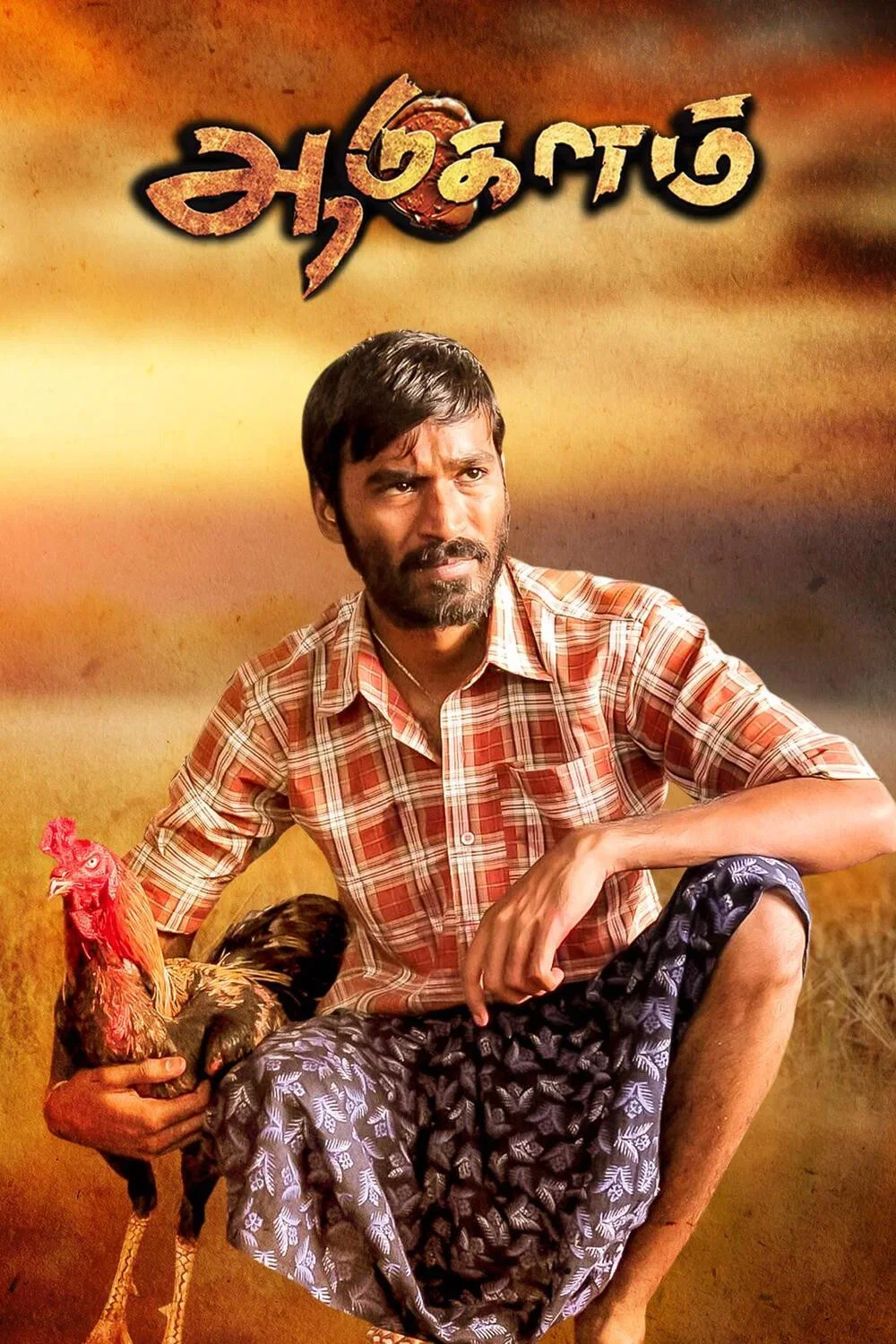
Table of Contents
Quick Facts
Aadukalam is a Tamil action drama directed by Vetrimaaran, starring Dhanush as Karuppu, a rooster-fight trainer’s aide caught in a web of rivalry, betrayal and honour in Madurai. Released on 14 January 2011 for Pongal, it swept six National Film Awards — including Best Actor for Dhanush, Best Director and Best Screenplay — and is regarded as one of the greatest Tamil films of the modern era.
The film is now streaming on Sun NXT. What makes it a masterpiece is its authenticity: Vetrimaaran immerses you so completely in the world of Madurai’s rooster fights — its codes, its pride, its casual cruelty — that the film feels less watched than lived.
Plot
Karuppu is the loyal aide of Pettaikaran, Madurai’s most respected rooster-fight trainer. When Pettaikaran’s champion rooster falls ill before a major bout against his bitter rival Rathnasamy, Karuppu steps in with his own bird — and wins. The victory should be a triumph, but it plants a seed of jealousy in Pettaikaran’s heart that Rathnasamy is only too happy to water.
As Karuppu’s star rises, his mentor’s resentment curdles into betrayal. Meanwhile Karuppu falls for Irene, an Anglo-Indian medical student whose modern outlook clashes with his traditional world. Rathnasamy manipulates the rift between master and protege, and the rooster-fight arena — with its strict codes of honour — becomes the stage for a human tragedy. The film’s final act, in which Karuppu must fight not for pride but for survival, is shattering.
Vetrimaaran builds the story with the patience of a novelist, letting the relationships breathe before the betrayals detonate. When the violence comes, it feels inevitable — the only possible outcome of the pride and jealousy the film has so carefully documented.
Performance
Dhanush won the National Film Award for Best Actor, and it is easy to see why. His Karuppu is a marvel of understatement — a young man of few words whose face registers every shift in loyalty and fortune. Dhanush spent months learning the rooster-fighters’ body language, and it shows: he moves like a man of that world, not an actor visiting it. The scenes where Karuppu realises his mentor has turned against him are played with a stillness that is devastating.
V. I. S. Jayapalan, a poet and political commentator making his acting debut as Pettaikaran, is extraordinary — his portrayal of wounded pride curdling into cruelty is the film’s dark heart. Taapsee Pannu brings freshness and spirit to Irene in her Tamil debut, Kishore is solid as Karuppu’s friend, and Naren is menacing as the manipulative Rathnasamy. Every performance feels discovered rather than directed.
Screenplay and Direction
Vetrimaaran’s direction is a triumph of realism. He shot in real locations around Madurai with non-professional actors in supporting roles, and cinematographer Velraj captures the region’s harsh beauty — the dusty arenas, the crowded streets, the unforgiving sun. The rooster-fight sequences are filmed with a visceral intensity that never glorifies the bloodshed; you feel the cruelty of the sport even as you understand its cultural weight.
The screenplay, which won the National Award, is a model of construction. Every detail of the rooster-fighting world introduced in the first half — the training, the betting, the honour codes — becomes dramatically essential in the second. The film runs nearly three hours but never feels long, because Vetrimaaran understands that character is plot: Karuppu’s fate is sealed not by coincidence but by who he and Pettaikaran are.
Music
G. V. Prakash Kumar’s score is rooted in the folk traditions of the region. “Yathe Yathe” became a massive hit, its raw energy perfectly capturing the film’s spirit, while “Otha Sollaala” and “Ayyayo” showcase the composer’s gift for melody grounded in local idiom. The background score is sparingly used — Vetrimaaran often lets the ambient sounds of Madurai carry scenes — which makes the musical moments land harder.
The use of traditional percussion in the fight sequences gives them a ritualistic quality, as if the bouts were religious ceremonies — which, in this world, they are.
Themes
Aadukalam — “arena” — is about pride as a prison. Every major character is trapped by honour: Pettaikaran cannot bear to be surpassed by his student, Karuppu cannot abandon his loyalty even when it destroys him, Rathnasamy cannot let an old defeat rest. The roosters, bred and trained to fight to the death for their masters’ pride, are the film’s central metaphor — the men are no freer than the birds. It is also about modernity colliding with tradition: Irene represents a world Karuppu can glimpse but never enter.
Conclusion
Aadukalam is a modern classic — six National Awards, a career-defining performance from Dhanush, and a director operating at the peak of his powers. It takes a world most viewers knew nothing about and makes it universal, finding in the rooster-fight arenas of Madurai a tragedy worthy of Shakespeare. If you watch one Tamil film from the last twenty years, make it this one.
Watch the official trailer: