
Karuppu
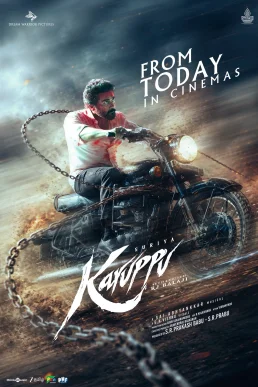
Table of Contents
Quick Facts
Plot
In a small town where court cases drag on for years, an elderly man and his young granddaughter keep returning to court, hoping for justice that never seems to arrive. Their lawyer, Baby Kannan, played by RJ Balaji, is part of the very system that keeps failing them, a sharp operator who has learned to bend the law to his own advantage.
When their faith is nearly broken, help arrives in an unexpected form. Saravanan, played by Suriya, enters their lives as the human face of Karuppusamy, the guardian deity worshipped for punishing the wicked. What follows is a battle that moves between the courtroom and the streets, as divine fury meets very human corruption.
The courtroom setting matters because it is where ordinary people feel smallest. The film understands that world well: the waiting, the adjournments, the small humiliations, and the way hope wears thin over years of hearings.
Performance
Suriya is the film’s greatest strength. He plays Saravanan with a mix of calm authority and explosive energy, and his entry sequences are built to bring the roof down. Even when the writing wobbles, his conviction never does, and he makes the fantasy premise feel grounded and personal.
Trisha Krishnan brings dignity to her role as a lawyer fighting from inside the system, while RJ Balaji is genuinely unsettling as the antagonist. Indrans and Anagha Maya Ravi give the emotional core its weight, and Yogi Babu provides welcome relief in the lighter stretches.
Suriya’s physical transformation and screen presence are central to the film’s appeal. He plays a deity made human without turning the role into caricature, keeping the character’s warmth visible beneath the fury.
Screenplay and Direction
RJ Balaji directs his first large-scale action film with obvious ambition. The first half works well, setting up the injustice, the characters and the mythology with patience, and the courtroom portions have a satisfying bite.
The second half is less steady. The film sometimes tries to do too much at once, mixing mythology, social commentary and mass action until the balance tips. Still, Balaji’s sincerity shows, and the big moments land often enough to carry the film through its weaker passages.
The film’s folk roots also give it a visual identity of its own. Temple imagery, festival colour and village atmosphere run through the film, and Balaji uses them to make the fantasy feel like part of everyday Tamil life.
Music
Sai Abhyankkar’s music leans into the film’s devotional and mass roots. The background score swells at exactly the right moments, giving Suriya’s arrival the weight of a temple festival, and the songs, including the popular Raathu Raasan, add colour to the proceedings.
The score is at its best when it stays simple: drums, chant-like refrains and a rising pulse that mirrors the hero’s anger. It is music designed for the theatre, and it works best there.
The songs also connect the film to its folk tradition, with rhythms that feel rooted in temple festivals rather than borrowed from generic mass-movie templates. That rootedness is part of why the music works.
Themes
Karuppu is, at its core, a film about justice delayed and denied. It asks what happens when the courts fail the poor, and whether faith can fill the gap left by a broken system. The deity here is not distant; he walks among people and settles accounts himself.
The film also celebrates the Tamil folk tradition of guardian deities, treating it with respect rather than as mere decoration. That cultural rootedness is what separates Karuppu from a generic action film and gives its fantasy its emotional charge.
The film also suggests that justice is not only a legal idea but a moral one. When institutions fail, people turn to faith, and Karuppu treats that faith seriously instead of using it as decoration.
Conclusion
Karuppu is an ambitious, flawed and hugely entertaining film. Its first half and its star performance are excellent, its second half less so, but the overall experience is one of a big Tamil entertainer that dares to mix mythology with a message.
For Suriya fans it is essential viewing, and for everyone else it is a fascinating example of how Tamil cinema turns folk belief into mass spectacle. Watch it for the star, stay for the idea.
After its strong theatrical run, Karuppu premiered on Amazon Prime Video, where it continues to find new viewers. It is best watched on the biggest screen available, with the sound turned up for the mass sequences.
Despite its uneven second half, Karuppu remains one of the year’s most distinctive Tamil releases. It is a film with a big star, a bigger idea, and enough memorable moments to make it worth the watch.