
Anbe Sivam
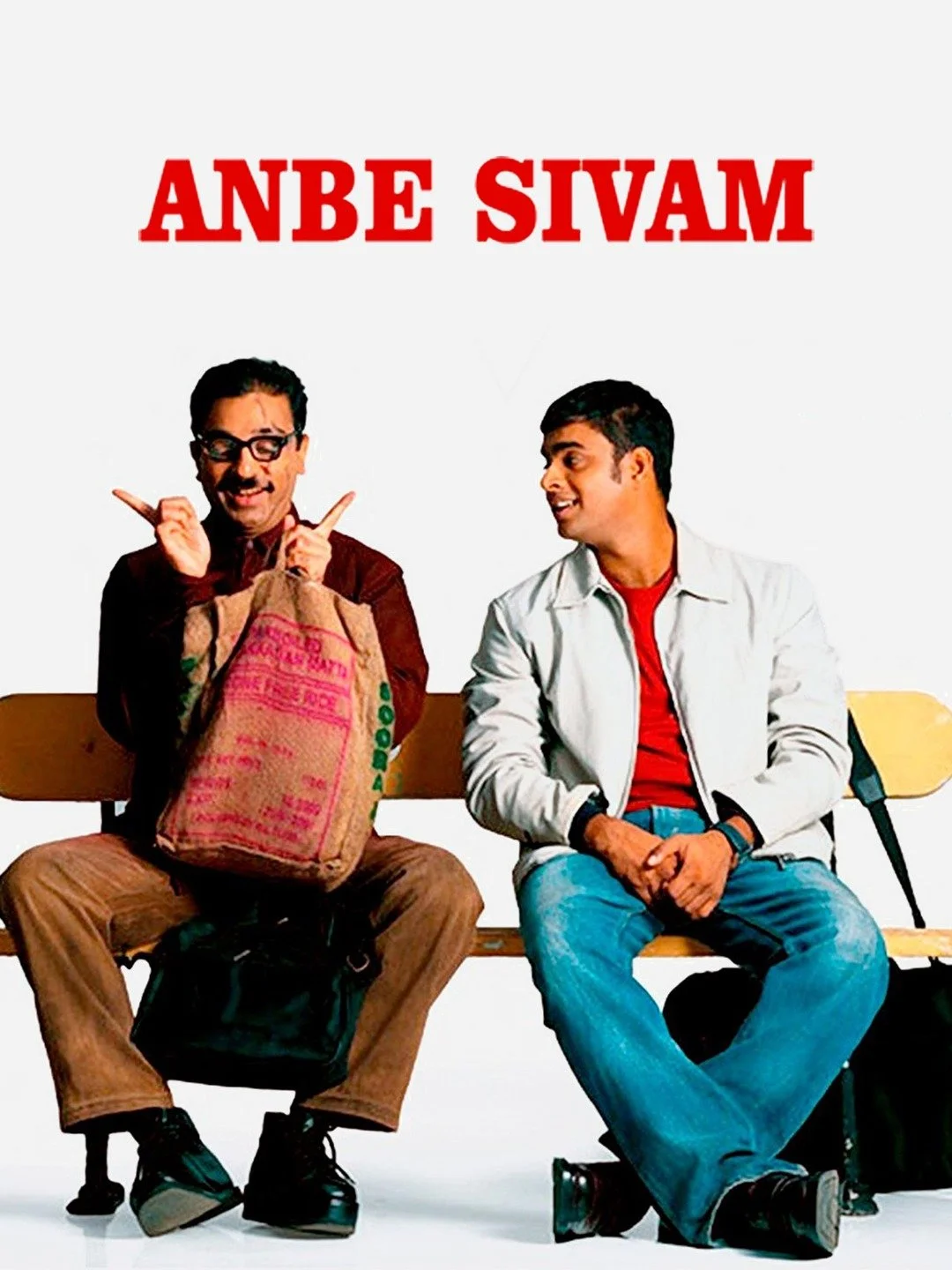
Table of Contents
Quick Facts
Anbe Sivam is a Tamil comedy drama directed by Sundar C and written by Kamal Haasan, starring Kamal as Nalla Sivam, a disfigured idealist, and Madhavan as Anbarasu, the cynic he reforms on a chaotic journey home. Released on 15 January 2003, it underperformed at the box office on release but has since been recognised as one of the finest Tamil films of its decade — a humanist fable whose title translates to “Love is God”.
The film is now streaming on Sun NXT. What makes it extraordinary is its tonal daring: it is genuinely funny for long stretches, then quietly devastating, and it wears its philosophy — communism, atheism, radical compassion — on its sleeve without ever preaching.
Plot
Anbarasu, a successful advertising filmmaker, is stranded at Bhubaneswar airport when his flight to Chennai is cancelled. There he runs into Nalla Sivam — talkative, limping, his face scarred by old burns — a man whose cheerfulness Anbarasu finds insufferable. Through a series of mishaps the two end up travelling together by train and bus, and the journey becomes a collision of worldviews: Anbarasu believes in money, success and looking out for himself; Nalla believes, with almost embarrassing sincerity, that love is the only god worth worshipping.
Along the way, Nalla’s past unfolds in flashback: a union leader who loved a woman named Bala, whose face was destroyed when he tried to stop an industrial disaster, and who lost everything except his convictions. Anbarasu, who begins the journey mocking Nalla, slowly finds his cynicism cracking — until a crisis at the journey’s end forces him to decide what kind of man he actually wants to be.
The film’s structure — two mismatched travellers, a road full of detours — recalls Planes, Trains and Automobiles, but its soul is entirely its own. The final scenes reframe everything that came before, revealing that Nalla’s journey was never really about reaching Chennai at all.
Performance
Kamal Haasan disappears into Nalla Sivam — the prosthetic scarring, the limp, the slightly lisping speech — yet the performance is never about the makeup. It is in the eyes: Nalla’s boundless warmth, his refusal to be bitter about a life that gave him every reason for bitterness. Kamal plays him as a holy fool, and the comedy he wrings from the character in the first half makes the revelations of the second half hit all the harder.
Madhavan is the film’s secret weapon. As Anbarasu he has the harder job — playing the audience surrogate, the man who must be unlikeable enough to need changing but likeable enough to follow. His slow thaw, from irritation to reluctant affection to genuine love for Nalla, is beautifully calibrated. Kiran Rathod brings tenderness to Bala in the flashback portions, and Nassar is solid as Nalla’s old friend.
Screenplay and Direction
Kamal Haasan’s screenplay is a marvel of construction. Every comic set-piece in the first half — the missed flights, the bus breakdowns, the bickering — plants something that pays off emotionally later. Sundar C, known for broad comedies, directs with surprising restraint, letting the humour arise from character rather than gags. The flashback sequences are shot with a golden, romantic glow that contrasts sharply with the harsh daylight of the present-day journey.
The film’s courage lies in its ideas. A mainstream Tamil film in 2003 openly championing atheism and communism, arguing that acts of love matter more than temples, was a genuine risk — and the film makes its case not through speeches but through Nalla’s lived example.
Music
Vidyasagar’s soundtrack is gentle and memorable. The title song “Anbe Sivam”, sung by Kamal Haasan himself, is the film’s beating heart — a simple, soaring melody about love as divinity. “Mouname” and “Poovaasam” are lovely romantic numbers, and the background score underplays the emotion, trusting the performances to carry it.
Vairamuthu’s lyrics deserve special mention: they articulate the film’s philosophy in lines that audiences still quote, giving the film’s ideas a poetic form that outlives the viewing.
Themes
Anbe Sivam is about the radical proposition that kindness is not weakness. Nalla has every reason to hate the world — it scarred his face, killed his love, destroyed his cause — and he chooses love anyway, not as naivety but as defiance. The film contrasts two responses to suffering: Anbarasu’s self-protective cynicism and Nalla’s open-hearted generosity, and argues quietly but firmly that only one of them is a way to live.
Conclusion
Anbe Sivam is that rare thing: a philosophical film that is also a crowd-pleaser, a comedy that earns its tears, a star vehicle that subverts stardom itself. It failed commercially because audiences in 2003 did not know what to make of it; it endures because it is, quite simply, about the best things human beings are capable of. Watch it with someone you love — and be prepared to call them afterwards.
No official trailer is available for this film on a studio or rights-holder channel, so no video is embedded here. We would rather leave the space empty than link to a fan-made upload.