
Ikkis
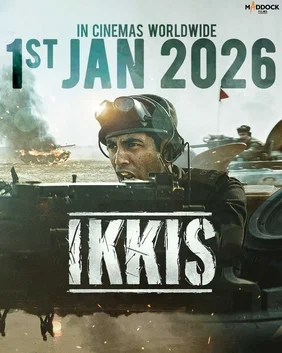
Table of Contents
Quick Facts
Plot
Ikkis — the title is the number twenty-one — tells the story of Second Lieutenant Arun Khetarpal, the youngest recipient of India’s Param Vir Chakra, who died at twenty-one during the Battle of Basantar in the 1971 India-Pakistan War. Directed by Sriram Raghavan and produced by Maddock Films, the film follows Khetarpal from his commissioning into the 17 Poona Horse regiment after graduating from the Indian Military Academy to the tank battle in which he destroyed enemy tanks before his own was hit and set ablaze.
Agastya Nanda plays Khetarpal in his first theatrical release, with the late Dharmendra as his father, Brigadier M. L. Khetarpal (Retd.), and Simar Bhatia as Kiran. Jaideep Ahlawat, Sikander Kher, Rahul Dev, Suhasini Mulay and Vivaan Shah fill out the ensemble. The film is not a jingoistic war spectacle; it is a quiet, human story about a young officer, his family, and the price of courage — and it carries the added weight of being Dharmendra’s final screen appearance.
Performance
Agastya Nanda’s performance is the film’s revelation. Playing a real, revered figure at the start of his career is a daunting assignment, and Nanda meets it with sincerity rather than imitation: his Khetarpal is earnest, a little nervous, and fiercely determined, and the audience believes him because he believes in the character. His scenes with Dharmendra, as father and son, are the film’s emotional spine.
Dharmendra, in his swan song, is devastating in his restraint. As the father who has already lost a son to war in spirit long before the telegram arrives, he plays grief as dignity — a man holding himself together for his family. Jaideep Ahlawat brings his usual authority to a Pakistani brigadier, and Simar Bhatia makes a confident debut as Kiran. The ensemble’s restraint is the point: nobody here is performing heroism; they are living with it.
Screenplay and Direction
Sriram Raghavan directs against the grain of the war biopic. Where most films in the genre build to a single rousing battle, Raghavan builds to a family — long stretches of training, letters, home leave and quiet conversations, so that when the Battle of Basantar arrives, the audience feels the loss personally rather than patriotically. Cinematographer Anil Mehta recreates the 1970s military world with care, and the battle sequences are staged for clarity and dread rather than glory.
That restraint is also the film’s risk. Viewers expecting a rousing, flag-waving war film may find Ikkis slow, and its box office — a modest opening against bigger blockbusters — reflected that divide. But critics largely praised the film’s refusal to turn Khetarpal’s death into a slogan. Raghavan trusts the story’s inherent power, and for audiences willing to meet him halfway, that trust pays off deeply.
Music
Sachin-Jigar’s music is used sparingly, and that sparing use is a strength. The film’s most talked-about musical moment is not a new song but the classic Zindagi Ek Safar Hai Suhana, woven into the trailer and the film as a reminder of what a soldier’s journey costs. The original songs, including tracks by White Noise Collectives, are gentle and unobtrusive, designed to sit under the story rather than above it.
The background score follows the same philosophy: quiet, restrained, and absent when silence says more. In a film about a young man’s death, the music’s refusal to manipulate the audience is itself a form of respect. It is a soundtrack that knows when to step back, and that restraint is rare in this genre.
Themes
Ikkis is a film about what twenty-one means: old enough to command men in battle, young enough that your parents still worry about you like a child. The film’s title is not a number but an age — the age at which Khetarpal died, and the age at which his father must learn to live without him. That double perspective, son and father, is the film’s real subject.
It is also a film about memory as duty. Khetarpal’s story has been told in textbooks and regimental histories; the film’s job is to make it human again, to remind audiences that heroes are not born brave but become brave in a few terrible minutes. In that, it succeeds quietly and completely.
Conclusion
Ikkis opened on 1 January 2026 — the first day of the year, and a fitting date for a film about new beginnings cut short — and found its wider audience on Prime Video, where it became available to rent in February and to members later that month. It is Dharmendra’s final film, Agastya Nanda’s first, and Sriram Raghavan’s most humane work in years.
Watch it for the performances, for the restraint, and for a story that deserves to be remembered as a life, not just a medal. It is a film that earns its tears honestly, and it will stay with you long after the credits.