
Taare Zameen Par (2007) – Movie Info, Cast, Trailer & Where to Watch
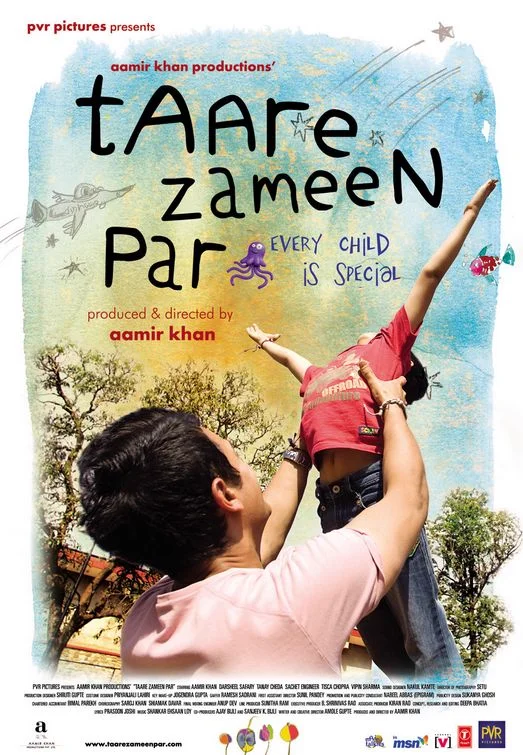
Table of Contents
Quick Facts
Taare Zameen Par is a 2007 Hindi drama directed by Aamir Khan, starring Darsheel Safary, Aamir Khan, Tisca Chopra, Vipin Sharma and Tanay Chheda. Released on 21 December 2007, it is that rare film that genuinely changed how a country talked about its children — and how its children were seen by their parents and teachers.
The film won the Filmfare Awards for Best Film and Best Director — a remarkable result for a directorial debut — and went on to become one of the most beloved Hindi films ever made. It is currently streaming on Netflix.
Plot
Eight-year-old Ishaan Awasthi (Darsheel Safary) lives in a world of colours, fish, dogs and kites — a world no adult around him seems to appreciate. What looks like laziness and defiance is something his parents and teachers cannot see: Ishaan has dyslexia, and letters dance and swap places for him. His report cards are a disaster, his notebooks are a mess, and his exhausted parents, played by Tisca Chopra and Vipin Sharma, make the decision many real parents have made: pack him off to a boarding school to be “disciplined”.
At the boarding school, things get worse before they get better. Ishaan retreats into himself, stops drawing — his one great joy — and begins to disappear. Then a new art teacher arrives: Ram Shankar Nikumbh (Aamir Khan), a cheerful, rule-breaking eccentric who notices what nobody else has bothered to notice. Studying Ishaan’s notebooks, Nikumbh recognises the signs for what they are, and tells Ishaan’s parents the truth: their son is dyslexic, not lazy, not stupid.
The rest of the film follows Nikumbh’s patient, joyful campaign to bring Ishaan back to himself — teaching him to read, defending him to a baffled system, and rebuilding the confidence the world knocked out of him. It culminates in the school’s annual art competition, where Ishaan finally gets to show everyone what he has always seen.
Performance
Darsheel Safary’s performance as Ishaan is one of the great child performances in Indian cinema — natural, unmannered, and devastating in the quiet scenes. His eyes do most of the acting: bewildered, hurt, then slowly lighting up again. Casting an unknown child was a gamble, and it pays off in every frame.
Aamir Khan, as Nikumbh, does something remarkable for a superstar: he steps back. His performance is all warmth and mischief, a teacher who is part clown, part crusader, and he lets Safary own the film. Tisca Chopra is quietly heartbreaking as the mother who loves her son but does not understand him — the song “Maa” is the film’s emotional gut-punch. Vipin Sharma, as the stern father, and Tanay Chheda, as Ishaan’s boarding-school friend Rajan, complete a cast without a false note.
Screenplay and Direction
This was Aamir Khan’s directorial debut — written by Amole Gupte, with concept and editing by Deepa Bhatia — and it shows the instincts of a filmmaker who trusts the audience. The boarding school feels real, the classroom scenes have the texture of lived experience, and the famous animated sequence explaining dyslexia through history’s great minds is a masterstroke of popular education. Satyajit Pande’s cinematography keeps everything warm and painterly, befitting a film about a child who sees the world in colour.
If the film has a flaw, it is that it occasionally lectures — Nikumbh’s big speech to the parents goes on a beat too long, and some of the school sequences are schematic. But the emotions are earned, never manipulated, and the pacing across its 164 minutes holds. For a debut, it is astonishingly assured.
Music
Shankar–Ehsaan–Loy’s soundtrack is among their finest. “Maa”, sung by Shankar Mahadevan to Prasoon Joshi’s devastating lyrics, is the rare film song that makes grown men cry in theatres; the title track is pure wonder; “Bum Bum Bole” is joyous chaos; and “Kholo Kholo” captures the film’s philosophy of opening doors. The background score is used sparingly and precisely — the film knows when to let silence do the work.
Joshi’s lyrics are the quiet hero of the album — simple words, enormous feeling. The songs are not numbers grafted onto the story; they are the story, carrying Ishaan’s inner life when dialogue cannot.
Themes
Taare Zameen Par’s great subject is the cruelty of a one-size-fits-all education system — and, more broadly, the way adults measure children only by marks. Its tagline, “Every child is special”, became a slogan for inclusive education in India, and the film is credited with raising real awareness about dyslexia and learning disabilities. Underneath the issue, though, is a simpler and more universal story: a child who needs to be seen, and the teacher who finally sees him.
Conclusion
Few films earn their tears as honestly as this one. Taare Zameen Par is gentle, wise and quietly radical — a mainstream Hindi film that treated a learning disability with dignity and changed dinner-table conversations across India. If you have children, watch it with them. If you were once a child who struggled, it will find you anyway.
Watch the official trailer: