
Pink (2016) – Movie Info, Cast, Trailer & Where to Watch
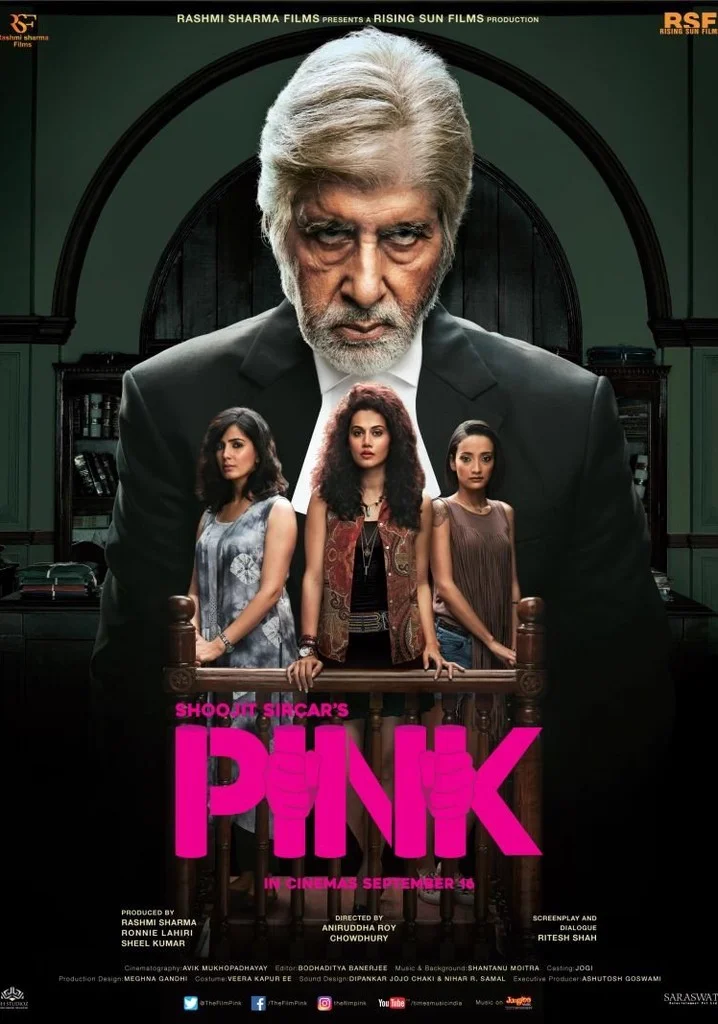
Table of Contents
Quick Facts
Pink is a 2016 Hindi legal thriller directed by Aniruddha Roy Chowdhury and produced by Shoojit Sircar, starring Amitabh Bachchan, Taapsee Pannu, Kirti Kulhari and Andrea Tariang. Released on 16 September 2016, it takes one of the oldest genres in Indian cinema — the courtroom drama — and turns it into something startlingly contemporary: a film about consent, argued not with melodrama but with cold, devastating logic. It won the National Film Award for Best Film on Other Social Issues, grossing an estimated ₹157 crore worldwide.
The film is streaming in India on Prime Video and JioHotstar. What makes Pink endure is not just its courtroom fireworks, but the fact that it arrived exactly when the country was having a long-overdue conversation about how it treats its women — and it refused to let anyone off the hook.
Plot
Minal Arora, Falak Ali and Andrea — three young working women from different corners of India — share a flat in a posh South Delhi neighbourhood and live exactly as they please. One night out at a resort with three young men they have just met goes horribly wrong. Rajveer Singh, the well-connected nephew of a politician, forces himself on Minal; in a moment of panic she smashes a bottle on his head and the three women flee. What follows is the part of the story nobody warns you about: instead of the men facing consequences, the women are charged with attempted murder and extortion, and the machinery of power closes ranks around the influential young men.
Their only hope is their reclusive neighbour, Deepak Sehgal — a once-great lawyer now living in the shadow of his own past, battling bipolar disorder and haunted by a case that destroyed his family. Watching the injustice unfold next door, Sehgal reluctantly agrees to defend the three women, and the film settles into a long, gripping courtroom battle. Against him stands a ruthless prosecution lawyer who tries every trick in the book: the women’s clothes, their lifestyles, their friendships with men, even their virginity are dragged into open court as evidence of bad character.
Sehgal’s defence builds toward the film’s thunderous central argument: that a woman’s “no” means no — whether she is a wife, a friend, or a stranger; whether it is said with words or silence. The verdict lands with real force, and the courtroom feels less like a set and more like a mirror held up to the country.
Performance
Amitabh Bachchan gives one of the finest performances of his later career as Deepak Sehgal. He plays the retired lawyer not as a swaggering hero but as a fragile, trembling man whose mind betrays him — His delivery of the “no means no” speech is justly famous, but it is the quieter moments — his hands shaking as he pours water, the exhaustion in his eyes — that make the performance unforgettable.
Taapsee Pannu is a revelation as Minal, carrying the film’s heaviest scenes with a rawness that changed the course of her career. Kirti Kulhari is superb as Falak, the steadiest of the three friends, and Andrea Tariang brings quiet dignity to her role. Piyush Mishra is deliciously loathsome as the prosecution lawyer, Angad Bedi makes Rajveer genuinely menacing, and Dhritiman Chatterjee lends the judge a weary authority. There is not a weak link in the ensemble.
Screenplay and Direction
Ritesh Shah’s screenplay — which won the Filmfare Award for Best Dialogue — is the film’s backbone. It is meticulously constructed: every cross-examination lands like a chess move, and the courtroom exchanges crackle without ever feeling theatrical for its own sake. The writing trusts the audience’s intelligence, letting the moral argument emerge from procedure and evidence rather than speeches alone — a discipline rare in Hindi courtroom dramas.
Aniruddha Roy Chowdhury, the acclaimed Bengali filmmaker behind Antaheen, made his Hindi debut here, and his outsider’s eye serves the material beautifully. He shoots Delhi with unglamorous realism — cramped police stations, fluorescent-lit courtrooms — and keeps the camera still during the trial, letting the performances do the heavy lifting. He resists every temptation to sensationalise what is already sensational enough.
Music
One of Pink’s smartest decisions is how little music it uses. Shantanu Moitra’s background score is deliberately spare — a low, uneasy pulse under the courtroom scenes, long stretches of near-silence elsewhere — because this is a film that understands tension does not need an orchestra. The restraint keeps the focus exactly where it belongs: on the words being spoken and the faces speaking them.
The songs by Anupam Roy, including the aching “Tujhse Hi Hai Roshni” and the defiant “Jeenay De Mujhe”, are woven in gently rather than staged as set pieces. None of it interrupts the film’s momentum — sometimes the bravest musical choice is to get out of the story’s way.
Themes
At its core, Pink is about consent — plain, unqualified, non-negotiable consent — and about everything a patriarchal society invents to avoid granting it. The film dissects victim-blaming with surgical precision: the idea that a woman who drinks, who has male friends, who lives on her own terms has somehow forfeited her right to say no. It also shows how wealth and political connections bend the police and the press, turning the legal system into a weapon against the vulnerable. The film’s most radical suggestion is also its simplest: women do not owe the world an explanation for how they live.
Conclusion
Pink is that rare thing — a mainstream Hindi film that changed the national conversation. “No means no” entered everyday language; the film was remade in Tamil as Nerkonda Paarvai (2019) and in Telugu as Vakeel Saab (2021), carrying its argument to new audiences. Bachchan is magnificent, Taapsee is career-defining, and the writing is razor-sharp. It remains essential viewing — not because it flatters us, but because it refuses to.
Watch the official trailer: