
Main Vaapas Aaunga
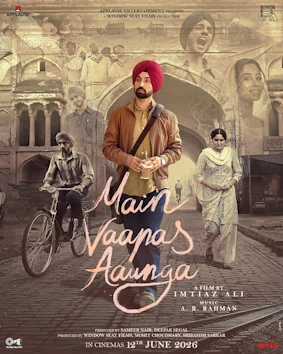
Table of Contents
Quick Facts
Plot
Imtiaz Ali has always made films about people searching — for love, for identity, for a place to belong — and Main Vaapas Aaunga is his most tender version of that search. The film follows 95-year-old Ishar Singh Grewal, played by Naseeruddin Shah, who clings to life while longing to return to his ancestral home and to a lost love from the 1947 Partition. His grandson Nirvair, played by Diljit Dosanjh, becomes the keeper of that longing, travelling — literally and emotionally — to uncover his grandfather’s past.
In flashback, the young Ishar — played by Vedang Raina as Keenu — falls in love with Afsana, known as Jiya, played by Sharvari, in pre-Partition India. Their romance, full of stolen glances and handwritten letters, is torn apart by Partition, leaving only a promise: main vaapas aaunga, I will return. Decades later, that promise is the one thing the old man will not let go of, and his grandson’s journey to honour it becomes the film’s spine.
Performance
Naseeruddin Shah is extraordinary as the old Ishar. He plays dementia not as confusion but as a man whose memories are more real to him than the present, and every frame he occupies carries weight. His performance is the film’s anchor: funny, heartbreaking and dignified by turns, and it gives the film’s sentimentality a backbone of truth.
Diljit Dosanjh, as Nirvair, provides warmth and quiet humour, playing a grandson who learns his grandfather’s story by listening rather than by fixing. Vedang Raina and Sharvari, as the young lovers, have a radiant, innocent chemistry that makes the Partition’s cruelty land harder — their romance is the film’s light, and losing it is its darkness. Rajat Kapoor, Banita Sandhu and the supporting cast complete a fine ensemble.
Screenplay and Direction
Imtiaz Ali directs with the patience his subject demands. The film moves between timelines without hurry, letting the past and present rhyme with each other — a train journey here, a letter there, a song that belongs to both eras. The screenplay, by Ali and Nayanika Mahtani, uses a clever device: the old man’s coded, dementia-shaped speech, full of Martians and moons and Hitlers, which only makes sense once his memories unfold. It is a risky device, and it mostly works because Shah’s performance sells it.
The film’s weakness is its length. At two hours and forty-six minutes, the first half stretches, and some of the modern-day scenes repeat beats the flashbacks have already made. Yet the film’s sincerity carries it through those stretches. Ali is not chasing a twist; he is chasing a feeling, and for most viewers that feeling arrives in full by the climax.
Music
A. R. Rahman, with lyrics by Irshad Kamil, delivers a soundtrack that is integral to the film rather than decorative. Songs like Maskara and Kya Kamaal Hai are woven into the story as memories themselves — the kind of songs characters would actually remember across decades — and Rahman’s score gives the Partition sequences a ache that dialogue cannot reach. The music is the film’s second narrator.
The songs work because they are not trying to be hits first and story second. They are trying to be true to the characters’ inner lives, and in a film about memory, that is exactly right. Rahman’s collaboration with Ali and Kamil has produced some of Hindi cinema’s most beloved soundtracks, and this one belongs in that company.
Themes
Main Vaapas Aaunga is a film about what borders cannot kill: love, memory and the idea of home. Partition drew a line on a map, but the film argues that the line never quite reached the people who lived on either side of it — their songs, their letters and their promises kept crossing it for decades. The film’s title is both a lover’s promise and a migrant’s prayer.
It is also a film about generations. Nirvair does not just learn his grandfather’s story; he inherits it, and the film suggests that inheritance is how cultures survive catastrophe — not through monuments but through grandchildren who listen. That is a hopeful idea, and the film earns it without sentimentality.
Conclusion
Main Vaapas Aaunga opened quietly on 12 June 2026, with a modest first day, and then grew by word of mouth into a sleeper hit, collecting close to ₹98 crore worldwide before its Netflix premiere on 7 August 2026. It is Imtiaz Ali’s second collaboration with Diljit Dosanjh after Amar Singh Chamkila, and it may be his most heartfelt film in years.
Watch it for Naseeruddin Shah, for A. R. Rahman, and for a love story that survives history itself. It is a film that will make you call your grandparents afterwards — and that, more than any box-office number, is its real success.