
Mirzapur: The Movie
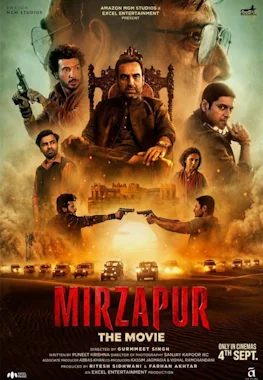
Table of Contents
Quick Facts
Plot
Few Indian streaming properties have burrowed into the culture the way Mirzapur has. Since 2018, the saga of Kaleen Bhaiya’s empire — the guns, the carpet business that was never about carpets, the Tripathi family tearing itself apart — has been appointment viewing. Mirzapur: The Movie, released theatrically on 4 September 2026, takes that saga where its scale always belonged: the big screen. Directed by Gurmmeet Singh and produced by Excel Entertainment, it is a continuation of the series’ story, built for cinemas rather than episodes.
The official trailer picks up the threads the series left hanging. Guddu Pandit, Kaleen Bhaiya, and the rest of the surviving players are back in the game for control of Mirzapur — a game that has never had rules, only winners and bodies. The trailer promises the franchise’s signatures at cinematic scale: power struggles, betrayals, the sudden violence the series made its trademark. New faces join the fray alongside the returning cast, suggesting the film is expanding the canvas rather than simply replaying the show’s greatest hits.
Performance
Pankaj Tripathi’s Kaleen Bhaiya is one of the defining screen creations of the streaming era — a gangster played not with swagger but with stillness, a man whose politeness is more frightening than anyone else’s rage. Bringing that performance to the big screen is the film’s centre of gravity. Tripathi has the rare ability to dominate a scene without raising his voice, and on a cinema screen, that quiet menace should be enormous. Every fan knows the walk, the pause, the half-smile. The film knows it too.
Ali Fazal’s Guddu Pandit has been the series’ engine of transformation — ambitious nobody to scarred survivor to claimant of the throne — and Fazal has grown with the part. Divyenndu, whose Munna Tripathi became a cultural phenomenon, returns to a character the audience loves to hate. Around them the ensemble is deep: Rasika Dugal and Shweta Tripathi give the series its emotional core as the women surviving the men’s wars; Ravi Kishan and Abhishek Banerjee bring heft; Jitendra Kumar signals new blood.
Screenplay and Direction
Gurmmeet Singh directing is continuity the project needed. He has been inside the Mirzapur machine and understands its peculiar alchemy: the Purvanchal dialect as music, the violence as punctuation, the family drama underneath the crime saga. A series-to-film adaptation has one structural problem — seasons sprawl, films must focus — and the screenplay must find the single story worth feature length, not compress a season into two hours. The trailer suggests the film has found it: the endgame of the Mirzapur throne, played as a single sustained confrontation.
Excel Entertainment producing adds another layer of assurance. The banner practically invented the modern Hindi crime epic, and it knows how to mount violence with style without losing the story underneath. Expect the film to look bigger than the series — wider compositions, more elaborate set pieces, the texture of a theatrical production — while keeping the writing’s ear for dialogue. Mirzapur’s lines have always been half the show; a film version that fumbles the dialogue would lose the audience in the first twenty minutes.
Music
The songs come from Sourav Ray, Junaid Kumar and Anand Bhaskar, with John Stewart Eduri composing the background score — a division that reflects how the Mirzapur franchise has always used music. The series’ sound was never about chartbusters; it was about atmosphere. The folk-inflected tracks, the raw Purvanchal textures, the songs that sounded like they rose out of the soil of the setting — that is the musical identity the film inherits — to be scaled up for theatres without polishing away the grit.
Eduri’s background score carries particular weight here. Mirzapur’s tension has always been musical as much as dramatic — the low drones under a standoff, the sudden silence before violence, the themes that tell you which character has just walked into the room. On a cinema sound system, that score becomes a physical experience. The trailer already leans on it: the familiar motifs return, bigger and more ominous, telling the audience before a single line of dialogue that they are home.
Themes
Mirzapur has always been about power — not as an abstraction but as a local, personal, bloody thing. The throne of Mirzapur is not a metaphor; it is a chair in a room, and men kill each other to sit in it. The film continues the series’ central inquiry: what does the pursuit of power do to the people pursuing it, and to everyone standing near them? Every season has answered with more bodies. The movie, the saga’s biggest chapter, must give the definitive answer — or the most spectacular one.
Underneath the crime saga, though, Mirzapur has always been a family story. The Tripathis, the Pandits — these are families first and criminal enterprises second, and the series’ most devastating moments have been domestic: fathers and sons, husbands and wives, the people who love the monsters. The women — Beena, Golu and the others — have carried its moral weight, surviving a world built by men and slowly claiming power of their own. A theatrical chapter that honours that thread would be the richest version of the film.
Conclusion
Mirzapur: The Movie released on 4 September 2026 as one of the boldest experiments in recent Indian cinema: taking one of streaming’s biggest franchises and giving it the theatrical treatment it always deserved. With Singh directing, Excel producing and the full returning cast behind it, the film has the pedigree to pull it off. The trailer promises the saga at its biggest and bloodiest.
For the fans, this is the chapter they have been waiting for since the last season ended — the fight for Mirzapur, finally, on the biggest screen available. For newcomers, it is a crime epic that does not require homework, only a taste for power struggles played at full volume. The Prime Video streaming date has not been announced yet, so theatres are currently the only way to watch.