
Hera Pheri
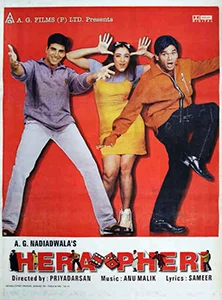
Table of Contents
Quick Facts
Hera Pheri, released on 31 March 2000, is quite simply the funniest Hindi film ever made — or at least, that is what two generations of fans will tell you, loudly, quoting every other line. Directed by Priyadarshan and starring Akshay Kumar, Suniel Shetty and Paresh Rawal as three broke men sharing a cramped Mumbai chawl, it is a comedy of errors so perfectly constructed that it feels like a Swiss watch that tells jokes. Baburao Ganpatrao Apte is not just a character; he is a national treasure.
Streaming on Amazon Prime Video, the film has grown from a modest hit into a full-blown cult phenomenon — its dialogues (“Utha le re baba,” “25 din mein paisa double”) are part of everyday Indian speech, and its memes keep it alive for audiences who weren’t born when it released. It is the rare comedy that gets funnier with every viewing.
Plot
Raju (Akshay Kumar) is a smooth-talking schemer drowning in debt; Shyam (Suniel Shetty) is an earnest bank clerk looking for work and love; Baburao (Paresh Rawal) is their garishly bespectacled landlord, perpetually drunk and perpetually broke. The three share a run-down garage apartment, bickering constantly — until a wrong-number phone call changes everything: a kidnapper, dialling the wrong number, demands ransom from a wealthy businessman, and the trio realise they can intercept the call and the money.
What follows is a masterclass in escalating chaos. The trio’s plan to double-cross the kidnappers goes wrong in every conceivable way — mistaken identities, botched handovers, and Baburao’s gloriously mangled attempts at criminal sophistication. Tabu appears as Anuradha, the bank worker Shyam falls for, adding a sweet romantic thread to the madness. The climax, involving the ransom money, the real kidnappers and our heroes’ increasingly desperate improvisations, is one of the great comic finales in Indian cinema.
The plot is adapted from a Malayalam original, but Priyadarshan and writer Neeraj Vora rebuilt it so thoroughly for Hindi audiences that it feels entirely its own. Every coincidence is set up, every payoff lands, and the whole thing hums with the logic of a farce done right.
Performance
Paresh Rawal’s Baburao is one of the immortal comic performances in world cinema — the squint, the dhoti, the mangled English, the volcanic temper that erupts at the slightest provocation. It is a masterclass in physical and verbal comedy, and Rawal plays it with total commitment. Akshay Kumar is perfect as Raju, the fast-talking hustler whose schemes always collapse; his timing is razor-sharp, and this film reinvented him as a comic star.
Suniel Shetty brings surprising warmth and sincerity to Shyam, the straight man who grounds the madness — his earnestness makes the trio’s dynamic work. Tabu is charming as Anuradha, and the supporting cast of goons and neighbours is uniformly excellent. But make no mistake: this is Baburao’s film, and Rawal’s.
Screenplay and Direction
Priyadarshan, the master of the ensemble farce, directs with clockwork precision. Every scene is built on misunderstandings that compound beautifully, and the pacing never lets up — the film is essentially a two-and-a-half-hour sprint. The dialogue by Neeraj Vora is legendary: quotable, character-specific, and funnier on the tenth hearing than the first. Lines like “Baburao ka style hai” and “yeh baburao ka style hai” have outlived the film’s era entirely.
The direction’s genius is in its control — farce this frantic could easily spin into noise, but Priyadarshan keeps every thread visible and every character’s motivation clear. The songs are the only slight drag on the momentum, but they are brief enough to forgive. This is commercial comedy direction at its absolute peak.
Music
Anu Malik’s soundtrack is serviceable rather than spectacular — “Tun Tunak Tun” energy aside, the songs are the one department where the film coasts. The real musical hero is the background score’s comic timing, which punctuates gags with perfect precision. Nobody watches Hera Pheri for the songs, and nobody minds.
Visually, the film is deliberately unglamorous — the cramped garage, the chaotic streets — which only makes the comedy feel more real. Priyadarshan’s camera stays out of the way and lets the performers do the work, exactly as it should.
Themes
Beneath the laughter, Hera Pheri is about desperation and dignity — three decent men pushed to the edge by poverty, trying to stay honest in a city that rewards the crooked. The film never moralises, but its heart is with the little guy: Baburao’s rage is the rage of every ordinary Indian cheated by the system. It is also, quietly, about found family — by the end, these three misfits who could not stand each other have become inseparable. The money was never the point; the company was.
Conclusion
Hera Pheri is the gold standard of Hindi comedy — a film so funny it has become part of the language itself. Paresh Rawal’s Baburao, Akshay Kumar’s Raju, and a screenplay with not a single wasted scene make it essential viewing. Whether it is your first watch or your fiftieth, it delivers. Utha le re baba — uthale, and press play.