
Munna Bhai M.B.B.S.
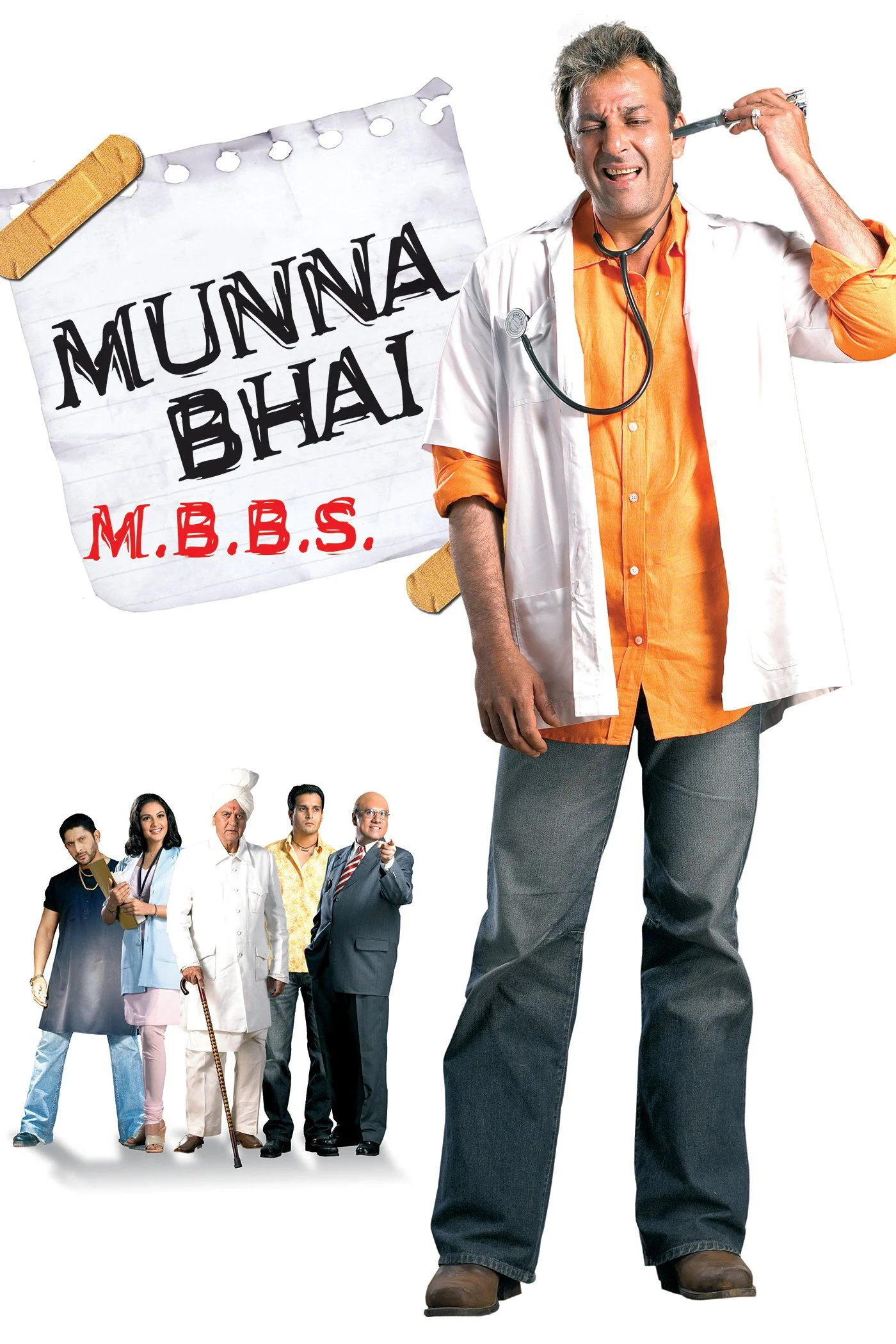
Table of Contents
Quick Facts
Munna Bhai M.B.B.S., released on 19 December 2003, is the film that made a nation hug. Rajkumar Hirani’s directorial debut — starring Sanjay Dutt as a lovable Mumbai don who cons his way into medical college to please his father — took a ridiculous premise and turned it into one of the most beloved Hindi films ever made. It is riotously funny, unexpectedly moving, and built around a philosophy so simple it became a cultural catchphrase: the Jaadu ki Jhappi, the magic hug.
Streaming on ZEE5, the film remains Hirani’s warmest and most human work. It gave us Circuit, one of Hindi cinema’s all-time great sidekicks, Boman Irani’s gloriously pompous Dr. Asthana, and a hero who heals people not with medicine but with kindness. It is also poignantly special as the final film of Sunil Dutt, who plays Munna’s father with heartbreaking tenderness.
Plot
Murli Prasad Sharma, aka Munna Bhai (Sanjay Dutt), is a good-hearted Mumbai gangster who has spent years pretending to be a doctor to keep his elderly father happy. When the truth comes out and his father is humiliated, Munna decides to become a real doctor — by cheating his way into a prestigious medical college with the help of his loyal sidekick Circuit (Arshad Warsi). Once inside, he turns the hospital upside down with his street-smart compassion.
Munna’s methods horrify the dean, Dr. Asthana (Boman Irani), a man who believes in discipline over empathy. But the patients adore Munna — his hugs, his humour, his refusal to treat people like case numbers. The film’s emotional core is the relationship between Munna and his father (Sunil Dutt), and the slow thawing of Dr. Asthana, whose own humanity is buried under decades of rigidity. The famous “chamatkar” sequences and the climactic confrontation between Munna’s heart and Asthana’s rules are pure Hirani.
What makes the plot work is that the film never mocks its own premise. Munna’s journey from fraud to healer is played straight — the comedy comes from the situations, never from contempt for the characters. By the end, when the hospital itself starts dispensing Jaadu ki Jhappis, you believe it completely.
Performance
Sanjay Dutt gives the performance of his career as Munna — gruff, goofy and golden-hearted, he makes you laugh in one scene and tear up in the next without ever breaking character. It is the role he was born to play. Arshad Warsi is sensational as Circuit, the loyal, fast-talking sidekick who steals every scene he is in; their chemistry is the film’s beating heart and one of the great comic partnerships in Hindi cinema.
Boman Irani is magnificent as Dr. Asthana — pompous, wounded and ultimately human, he gives the film its dramatic spine. Gracy Singh is sweet and grounded as Dr. Suman, and Sunil Dutt, in his final screen appearance, is deeply moving as Munna’s father; knowing it was his last film adds a layer of poignancy to every scene he shares with his real-life son.
Screenplay and Direction
Rajkumar Hirani’s debut announced one of Hindi cinema’s most distinctive voices — a filmmaker who could blend broad comedy with genuine social commentary without either feeling forced. The screenplay is a marvel of construction: every gag pays off, every emotional beat is earned, and the film’s message about compassion in medicine emerges from the story rather than being imposed on it. The famous one-liners (“M bole to,” “Jaadu ki Jhappi”) entered the national vocabulary because they grew organically out of character.
Hirani directs with warmth and precision, balancing the film’s many tones — slapstick, romance, family drama, institutional satire — with a confidence that belies a first-timer. If the film has a soft spot, it is the slightly idealised view of how quickly institutions change; but the film’s heart is so true that you forgive it gladly. This is populist filmmaking with a conscience.
Music
Anu Malik’s songs fit the film like a glove — “M Bole To” and “Dekhle Aankhon Mein” are full of Munna’s swagger, while the romantic numbers give the film its softer moments. Sanjay Wandrekar’s background score deserves special mention for underlining the film’s emotional shifts without ever overwhelming them.
Visually, the film keeps things warm and lived-in — the hospital feels real rather than glossy, and Hirani’s unfussy camera style keeps the focus exactly where it belongs: on the faces of his wonderful cast.
Themes
Munna Bhai M.B.B.S. is about the healing power of human connection — the radical idea that kindness is itself a form of medicine. It takes aim at institutional coldness, at a system that treats patients as problems rather than people, and argues that empathy is not the enemy of professionalism but its foundation. The Jaadu ki Jhappi is more than a catchphrase; it is the film’s thesis in two words: that a hug can do what a prescription cannot. It is also, quietly, about fathers and sons — about the lies we tell to protect the people we love, and the truths that set us free.
Conclusion
Munna Bhai M.B.B.S. is a modern classic — one of the funniest and most big-hearted films Hindi cinema has produced. Sanjay Dutt and Arshad Warsi’s partnership, Boman Irani’s brilliance, Hirani’s warm direction and a message that never preaches combine into pure joy. Watch it for the laughs, stay for the tears, and leave wanting to hug someone. M bole to — this one is a must-watch.
Watch the official trailer: