
Rang De Basanti (2006) – Movie Info, Cast, Trailer & Where to Watch
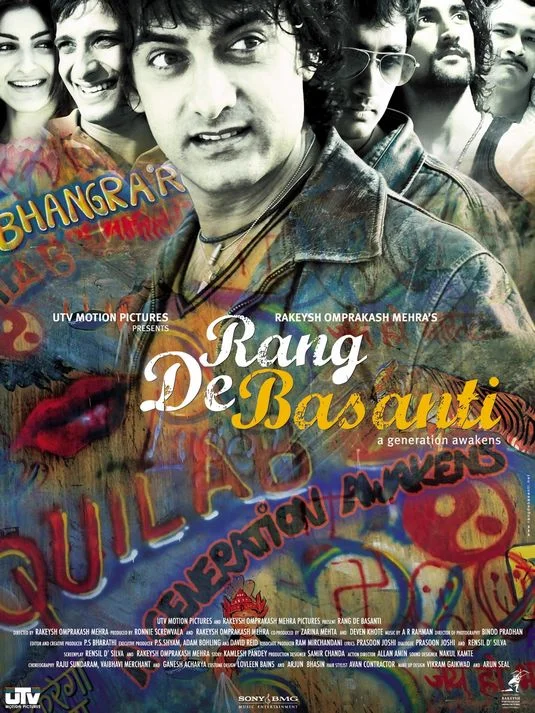
Table of Contents
Quick Facts
Rang De Basanti is a 2006 Hindi historical drama directed by Rakeysh Omprakash Mehra, starring Aamir Khan, Siddharth, Sharman Joshi, Kunal Kapoor, Atul Kulkarni and Soha Ali Khan. Released on 26 January 2006, it landed like a thunderclap: a film that took the casual cynicism of a generation of young Indians and turned it into a call to arms. Few Hindi films before or since have asked their audience so directly — what would you do for your country?
The film was chosen as India’s official entry to the Academy Awards, earned a BAFTA nomination for Best Foreign Language Film, won the National Film Award for Best Popular Film, and holds a place in IMDb’s Top 250 of all time. Two decades on, it remains the definitive film about young India waking up — and it is currently streaming on JioHotstar and Prime Video.
Plot
Sue (Alice Patten), a young British filmmaker, arrives in Delhi to make a documentary based on her grandfather’s diaries — he had served in the British administration during the Indian freedom struggle of the 1920s. To play the young revolutionaries in her film-within-a-film, she casts five carefree Delhi University students: Daljeet “DJ” (Aamir Khan), the Punjabi prankster; Karan (Siddharth), the brooding rich kid; Sukhi (Sharman Joshi), the clown; Aslam (Kunal Kapoor), the quiet one; and Laxman Pandey (Atul Kulkarni), an earnest activist. Sonia (Soha Ali Khan) completes the circle.
Mehra braids two timelines together. In Sue’s film, the youngsters play Bhagat Singh, Chandrashekhar Azad, Rajguru, Ashfaqullah Khan, Ramprasad Bismil and Durga Vohra — revolutionaries who died young for a free India. At first it is just a lark. Then the death of their friend, an idealistic young Air Force pilot played by R. Madhavan, in a crash the establishment blames on pilot error rather than its own corruption, detonates something in them. The line between the freedom fighters they portray and the citizens they are begins to dissolve.
The second half follows their transformation from performers to participants, as they take their protest from the streets to a radio station. The film does not flinch from where this road leads. It asks whether their rage is justified, and whether the system leaves any other door open — and it trusts the audience enough to sit with the discomfort of the answers.
Performance
Aamir Khan gives one of the most enjoyable performances of his career as DJ — loud, irreverent, and masking a fierce idealism underneath the jokes. His giddiness in the early scenes makes the later ones hit twice as hard. Around him, Siddharth, in his Hindi debut, brings wounded intensity to Karan; Sharman Joshi is heartbreakingly funny as Sukhi; Kunal Kapoor and Atul Kulkarni round out a group that feels like real friends, bickering and teasing.
The supporting cast is a roll call of character actors at the top of their game. Atul Kulkarni’s Laxman Pandey — the odd one out who must shed his certainties — delivers the film’s conscience speech. R. Madhavan does more with a few scenes as the pilot than many leads do in entire films. And Waheeda Rehman’s dignity as his mother, accepting his folded uniform, is the film’s emotional anchor.
Screenplay and Direction
Mehra’s great gamble is the parallel narrative, and he pulls it off with a confidence that still surprises. The 1920s sequences — shot in warm sepia tones by cinematographer Binod Pradhan — feel mythic without ever feeling like costume drama, while the present-day Delhi scenes crackle with handheld energy. The two timelines bleed into each other, until history feels like something happening now rather than something learned in school.
At 167 minutes the film is long, and a few stretches sag — the romance beats are perfunctory and the second half’s political turn can feel rushed. But the conviction of the filmmaking carries it through. The montage sequences have a propulsive rhythm, and the climax is staged with a grim inevitability that lands like a punch.
Music
A. R. Rahman’s soundtrack is nothing short of a phenomenon. The title track, roared by Daler Mehndi, became an anthem; “Khalbali” captured the restlessness of a generation; “Masti Ki Paathshala” bottled the chaos of campus life; “Luka Chuppi” turned separation into a lullaby; and “Tu Bin Bataye” remains one of Rahman’s most tender melodies. Prasoon Joshi’s lyrics, with rap verses by Blaaze, gave the album its bilingual swagger.
What elevates the score is how inseparable it is from the film’s identity — these songs do not interrupt the story, they are the story’s bloodstream. Twenty years later, play any of these tracks in a room full of Indians and the room will sing along. That is not just good music; that is cultural property.
Themes
At its core, Rang De Basanti is about the death of apathy. Its candlelight-vigil scene leaked out of the screen and into real life, inspiring actual protests against corruption in the years that followed. The film argues that patriotism is not waving a flag at a cricket match but holding your own country to account — and it makes that argument with rage and humour. Its central question, would you die for what you believe, is uncomfortable precisely because it refuses to answer it for you.
Conclusion
Rang De Basanti is the rare mainstream film that changed the conversation around it. Electrifying, flawed, and utterly sincere, it remains the gold standard for politically engaged Hindi cinema — a film that trusted young Indians to care, and discovered they already did. If you have never seen it, the surprise is not that it is a classic but how urgently it still speaks.
Watch the official trailer: