
Vedha
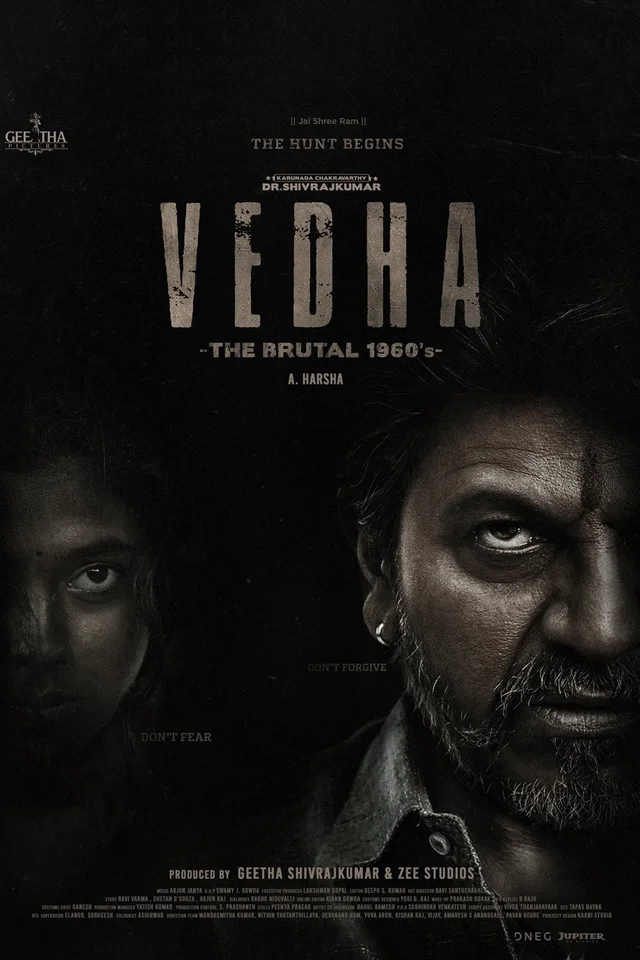
Table of Contents
Quick Facts
Vedha is a Kannada period action drama directed by A. Harsha, starring Shivarajkumar, Ganavi Laxman, Umashree and Aditi Sagar. Released on 23 December 2022, it was announced as the Century Star’s milestone 125th film and his maiden home production under Geeta Pictures, made in association with Zee Studios. Brutal, stylish and unapologetically old-school, the film divided critics but gave Shivanna’s fans exactly the ferocious star vehicle they had been waiting for.
The film is now streaming on ZEE5. Set largely in the 1960s, it is a revenge saga about a father and daughter on a killing spree — and it does not flinch from the violence its premise demands. Love it or argue with it, Vedha is impossible to ignore.
Plot
The story unfolds in the 1960s. Vedha (Shivarajkumar), a man with a haunted past, is on the run with his young daughter Kanaka (Aditi Sagar) — and the two of them are leaving a trail of bodies behind them. A determined police officer, Rama (Veena Ponnappa), is hot on their trail, always arriving moments too late, always one step behind the carnage.
Through flashbacks we learn what forged Vedha into an instrument of vengeance: the brutal wrongs done to his wife Pushpa (Ganavi Laxman) and the assault on his daughter, crimes committed by powerful men who believed their position placed them above consequence. With the system offering no justice, Vedha takes justice into his own hands — and Kanaka, rather than being a passive victim, stands beside him.
The film plays out as a cat-and-mouse chase between hunter and hunted, with Rama slowly uncovering the truth about who Vedha really is and what was done to his family. The question driving the narrative is not whether Vedha will be caught, but whether the audience — and Rama — will decide he deserves to be.
Performance
Shivarajkumar is the film’s beating, bloodied heart. As Vedha, he plays a man hollowed out by grief and filled with rage, and he brings a ferocity to the role that recalls his most intense work. There is a weariness in his eyes even in the film’s most violent moments — this is not a hero enjoying revenge, but a father who has run out of every other option. It is a committed, physical performance that carries the entire film.
Ganavi Laxman makes a strong impression as Pushpa, Vedha’s wife, in a role that demands both tenderness and steel. Aditi Sagar is striking as Kanaka, holding her own opposite Shivanna in emotionally demanding scenes. Umashree, as Shankri, Vedha’s loyal friend, brings warmth and gravitas, while Veena Ponnappa gives the pursuing cop Rama a dogged credibility. The ensemble serves the story well throughout.
Screenplay and Direction
A. Harsha, directing Shivarajkumar for the fourth time after Bhajarangi, Vajrakaya and Bhajarangi 2, leans fully into his strengths: mass moments, mythic framing of the hero, and unapologetic melodrama. The 1960s period setting is evocatively mounted — the costumes, the rural landscapes, the lived-in textures all sell the era. Harsha stages the action with real punch, and the film’s best stretches have a grim, propulsive energy.
The honest criticism, voiced by several reviewers, is that the film feels like familiar territory — the director’s earlier collaborations with Shivanna mined similar themes of divine-adjacent vengeance, and Vedha occasionally feels like old wine in a new bottle. The violence, too, is extreme enough to alienate some viewers. But Harsha knows his audience, and for those who buy into the premise, the craft on display is undeniable.
Music
Arjun Janya’s music gives the film much of its swagger. “Gillakko Shiva,” sung by Mangli, and “Pushpa Pushpa,” sung by Shivarajkumar himself, became popular upon release, while “Junjappa” provides a rousing mass number. Janya understands the assignment — his score underlines Vedha’s menace and sorrow in equal measure, and the background music during the action blocks hits hard.
Cinematographer Swamy J. Gowda deserves special mention for the film’s look. The period detailing, the dust-and-blood palette, the way the camera lingers on Shivanna’s weathered face — the film has a visual weight that elevates the material. The production design sells the 1960s setting convincingly on every level.
Themes
Vedha is, at its core, about what happens when justice systems fail the vulnerable. The film takes the sensitive issue of assault on women and children and asks whether vengeance can ever be righteous — then answers with a resounding, bloody yes. It is also a film about fatherhood pushed to its absolute limit: Vedha’s love for his daughter is the only soft thing left in him, and it is precisely what makes him dangerous. The film does not moralise so much as mythologise, which is both its power and its limitation.
Conclusion
Vedha is a brutal, old-school revenge drama powered by a ferocious Shivarajkumar and A. Harsha’s total commitment to mass cinema. It is excessively violent, narratively familiar, and unlikely to convert skeptics — but as a star vehicle, it delivers the highs its audience came for. The period mounting is impressive, the music lands, and Shivanna’s intensity is worth the ticket alone. Stream it on ZEE5 if you like your action raw and your heroes uncompromising.
Watch the official trailer: