
Jackie
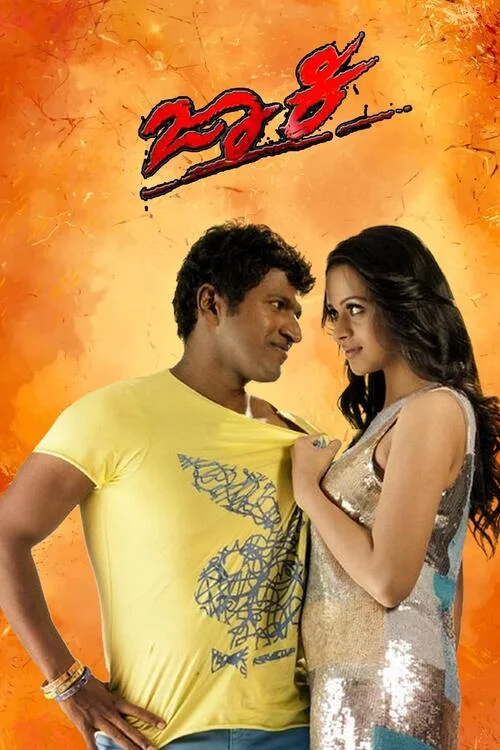
Table of Contents
Quick Facts
Jackie is a Kannada action drama written and directed by Duniya Soori, starring Puneeth Rajkumar and Bhavana. Released on 14 October 2010, it was a landmark film in every sense — a critical darling, the highest-grossing Kannada film of the year, and the winner of the Best Film award at the South Filmfare Awards. For Puneeth, it was the film that proved he could carry a director-driven, technically ambitious movie as effortlessly as a mass entertainer.
The film is now streaming on Sun NXT. Fifteen years on, Jackie is remembered as one of the trendsetting films of modern Kannada cinema — Soori’s rustic, hyper-stylised storytelling, Yogaraj Bhat’s razor-sharp dialogues and lyrics, and V. Harikrishna’s platinum-selling soundtrack combined into something that felt genuinely new. A 4K remastered version was re-released in theatres in March 2024 to mark Puneeth’s birth anniversary, and it still holds up.
Plot
Janakirama, better known as Jackie (Puneeth Rajkumar), is a motor-mouthed school dropout who survives on his wits and his gift of the gab. When a priest’s daughter, Yashodha (Harshika Poonacha), elopes with her lover, Jackie takes it upon himself to track her down and bring her back — a good deed that drags him into something far darker than he bargained for.
What Jackie uncovers is a human trafficking ring run by the ruthless Mithai Rama (Ravi Kale) and his men, with Yashodha caught in its web. As Jackie digs deeper, he crosses paths with the police — including a CID officer (Sampath Raj) working the same case from the other side — and finds himself suspected, chased and beaten, even as he tries to do the right thing. Along the way he rescues Lakshmi (Bhavana), an innocent young woman, and the two develop a prickly, funny, eventually tender bond.
The climax builds to a brutal confrontation in which Jackie, buried alive alongside Yashodha at one point, claws his way back to finish the fight and free the trafficked girls. It is a classic Soori ending — violent, cathartic, and laced with the director’s trademark dark humour.
Performance
Puneeth Rajkumar is electric as Jackie. The role plays directly to his strengths — the rapid-fire dialogue delivery, the physicality, the charm — but Soori also asks him to show fear, desperation and rage, and Puneeth delivers on every front. Watch the scenes where Jackie is out of his depth with the traffickers: the bravado cracks, and you see a scared young man improvising his way through. It is a star performance with genuine acting muscle behind it.
Bhavana brings freshness and spunk to Lakshmi, holding her own opposite Puneeth’s whirlwind energy. Harshika Poonacha is affecting as the troubled Yashodha. Rangayana Raghu, as the unforgettable “Meese” Bheemanna, steals every scene he is in, while Ravi Kale makes for a properly menacing villain. The ensemble is one of the film’s great strengths — even small roles feel lived-in.
Screenplay and Direction
Duniya Soori’s direction is the film’s true star. Coming off the raw realism of Duniya, Soori pivots here to a highly stylised, almost comic-book visual language — the film is famous for its extensive use of SnorriCam rigs for point-of-view shots in stunts and songs, a technique rarely seen in Indian cinema at the time. Every frame has texture: grime, sweat, neon, dust. His rustic sensibility turns even a simple chase into something visceral.
The screenplay balances its social-issue core (human trafficking) with out-and-out entertainment without trivialising either. Yogaraj Bhat’s dialogues are endlessly quotable — witty, earthy and perfectly pitched to Puneeth’s delivery. If there is a criticism, it is that the second half leans a little heavily on action at the expense of the story’s emotional threads. But as a piece of trendsetting mainstream filmmaking, Jackie remains a masterclass.
Music
V. Harikrishna’s soundtrack was a cultural event. The album celebrated a platinum disc, sold 20,000 CDs on its first day, and dominated the airwaves for months. “Ekka Raja Rani,” sung by Kailash Kher, and the title track “Jackie Jackie” — which cleverly reworks a portion of “Kannalle Eno” from Dr. Rajkumar’s Vasantha Geetha — became anthems. Yogaraj Bhat’s lyrics for all the songs are as sharp as his dialogues, and Harikrishna’s earthy, percussive arrangements matched Soori’s visuals beat for beat.
The film’s technical polish extends to its cinematography and stunt choreography, both of which were ahead of their time for Kannada cinema. The SnorriCam sequences in particular — strapping the camera to the actor’s body for disorienting POV shots — gave Jackie a kinetic energy that audiences had simply never seen before in a Kannada film.
Themes
Beneath the style, Jackie is about an ordinary nobody stumbling into extraordinary evil and refusing to look away. Janakirama has no training, no backing, no plan — just a loud mouth and a conscience that will not shut up. The film is also, quietly, about the trafficking of women and the systems that enable it, though Soori wisely keeps the message embedded in the entertainment rather than delivering lectures. At its heart, it is a film about courage being a decision, not a trait.
Conclusion
Jackie is one of those rare films that changed what Kannada mainstream cinema thought it could do — technically audacious, wildly entertaining and anchored by a career-defining Puneeth Rajkumar performance. Soori’s direction, Bhat’s writing and Harikrishna’s music form a holy trinity of craft that still feels fresh. Whether you are revisiting it on Sun NXT or discovering it for the first time, this is essential viewing — the film that proved Kannada cinema could out-style anyone.