
Aa Dinagalu
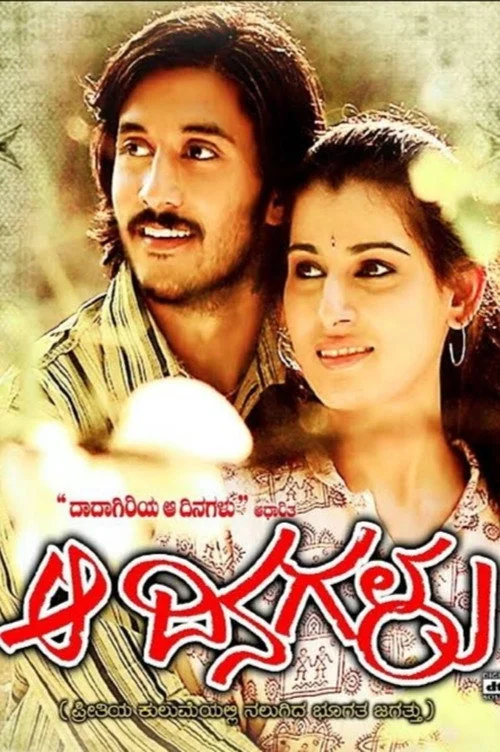
Table of Contents
Quick Facts
Aa Dinagalu is a Kannada crime drama directed by K. M. Chaitanya, starring Chethan Kumar, Archana, Sharath Lohitashwa and Ashish Vidyarthi. Released on 19 October 2007, it is based on Agni Shridhar’s non-fiction novel Daadaagiriya Dinagalu, a firsthand account of the Bangalore underworld of the 1970s and 80s. The film was that rare beast — a critically acclaimed gangster saga that also swept the awards, winning Best Film, Best Director and Best Supporting Actor at the Filmfare Awards South, plus three Karnataka State Film Awards.
The film is now streaming on ZEE5. With a screenplay by the legendary Girish Karnad and music by Ilaiyaraaja, Aa Dinagalu brought an almost documentary-like authenticity to the story of dons Kotwal Ramachandra and M. P. Jayaraj — names that still echo in Bangalore’s collective memory. It remains the gold standard for realistic crime cinema in Kannada.
Plot
Chetan (Chethan Kumar), the son of a wealthy businessman, is in love with Mallika (Archana), a dance teacher. His father, a powerful man who disapproves of the match, decides to end it the Bangalore way — by approaching Kotwal Ramachandra (Sharath Lohitashwa), the city’s most feared underworld don, to scare the lovers apart. It is a decision that sets off a chain of events nobody can control.
Furious at his father’s methods, Chetan does the unthinkable: he seeks the protection of Kotwal’s greatest rival, M. P. Jayaraj (Ashish Vidyarthi), a don who has just returned after ten years in jail to find his empire usurped. Through his childhood friend Sirdar, who works in Kotwal’s gang, Chetan is drawn into a conspiracy to eliminate Kotwal — with Atul Kulkarni’s Sridhar and others playing dangerous double games. The love story becomes a gang war, and Chetan finds himself in far deeper than he ever imagined.
Set against the backdrop of the Emergency era and the Bangalore of the 1980s — a city of knives, sickles and longs rather than startups — the film builds to a tense, violent climax where loyalties shift and survival is anything but guaranteed.
Performance
Sharath Lohitashwa is the film’s towering presence as Kotwal Ramachandra. It is a genuinely frightening performance — controlled, intelligent menace rather than scenery-chewing — and it deservedly won him the Filmfare Award for Best Supporting Actor. He makes Kotwal feel like a real person who happens to be a monster, which is far scarier than any caricature.
Chethan Kumar holds his own as Chetan, charting the character’s journey from privileged lover to a young man way out of his depth with conviction. Ashish Vidyarthi brings weight and world-weariness to Jayaraj, the dethroned don. Archana is dignified as Mallika, and Atul Kulkarni — always a class act — adds layers to his morally ambiguous role. Girish Karnad himself appears in the cast, a nice touch from the film’s screenwriter.
Screenplay and Direction
K. M. Chaitanya’s direction is a model of restraint. Working from Agni Shridhar’s novel — written by a man who lived in that underworld — and Girish Karnad’s screenplay, Chaitanya refuses to glamourise the gangster life. The violence is brutal and businesslike, the dons are paranoid businessmen rather than folk heroes, and the police are mostly bystanders waiting to see who wins. It is a remarkably adult approach, and it won Chaitanya the Filmfare for Best Director.
The period recreation of 1980s Bangalore is meticulous without being showy, and the narrative structure — weaving Chetan’s love story into the larger gang war — keeps the human stakes visible even as the body count rises. If the film has a flaw, it is that its very authenticity can make it feel clinical at times; but for viewers who value realism over romanticised gangster mythology, that is exactly the point.
Music
Ilaiyaraaja’s score is characteristically masterful. The maestro understands that a film like this needs music that deepens tension rather than distracts from it, and his background score does exactly that — brooding, minimal, and always in service of the story. The songs, including the “Aa Dinagalu” duet, carry his unmistakable melodic signature.
Cinematographer H. C. Venugopal’s gritty, naturalistic visuals are equally crucial to the film’s impact. The Bangalore he photographs feels real and lived-in — crowded streets, modest homes, the everyday settings where extraordinary violence erupts. Together, the music and cinematography create an atmosphere of constant, low-grade dread.
Themes
Aa Dinagalu is, at its core, about power — who has it, how it is taken, and what it costs. The film draws a straight line from the Emergency-era nexus of politicians and gangsters to the personal tragedy of a young couple caught in the crossfire. It is also a story about fathers and sons: Chetan’s father’s attempt to control his son’s life through the underworld backfires spectacularly, a neat encapsulation of how power corrupts even its wielders. Above all, the film insists on demythologising the don — these are not heroes, just men with knives and short tempers.
Conclusion
Aa Dinagalu is Kannada cinema’s most authentic gangster film — meticulously researched, superbly acted and directed with rare discipline. Sharath Lohitashwa’s Kotwal is an all-time great screen villain, and the Agni Shridhar-Girish Karnad-Chaitanya combination gives the film a literary weight few crime dramas achieve. If you want to understand the real Bangalore underworld story rather than its cinematic myths, start here. Streaming now on ZEE5.
Watch the official trailer: