
Sardar 2
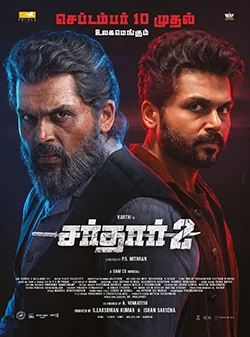
Table of Contents
Quick Facts
Sardar 2 is the sequel to P. S. Mithran’s 2022 spy thriller Sardar, with Karthi returning in his acclaimed dual role as the legendary spy Sardar Chandra Bose and his son, RAW agent Vijay Prakash. Released in theatres on 10 September 2026 and produced by Prince Pictures and IVY Entertainment, the film pits father and son against a new international threat — a biochemical weapon, a shadowy underworld figure called Black Dagger, and a conspiracy rooted in one of Sardar’s own past missions.
The film moved swiftly to streaming: Prime Video premiered it on 1 October 2026, barely three weeks after its theatrical release, in five languages — Tamil, Telugu, Hindi, Malayalam and Kannada. Certified U/A 16+, it is the rare Tamil spy franchise that takes its espionage seriously while keeping one eye firmly on entertainment. Whether you caught it in cinemas or are discovering it now at home, this is a sequel that understands exactly what made the original work.
Plot
Vijay Prakash, Chandra Bose’s son, now works with RAW in a deliberately low-profile unit — a man trying to serve quietly in the shadow of a legendary father. His careful equilibrium shatters when information surfaces about one of Sardar’s earlier missions, a chapter of the past that was supposed to stay buried. The trailer opens on that past: a young Chandra Bose in his trainee days, a mission he believed completed successfully, and collateral damage — a tragedy that claimed thousands of lives — that has haunted him ever since.
Years later, the old wounds reopen. An international underworld figure known as Black Dagger, played by S. J. Suryah, is moving to unleash a biochemical weapon called Doku, and activating it requires three access keys hidden long ago by former agents. Father and son are forced out of their separate exiles and onto the same mission, following a trail of historical and technical clues — with the help of a doctor — across Chennai, Hyderabad, Bangkok and beyond, racing to stop the weapon before it can be deployed.
Mithran structures the film as a collision of timelines: flashbacks excavate Sardar’s past and the origins of his legend, while the present-day hunt for the keys keeps the pressure relentless. Old allies return — Rajisha Vijayan’s Indhrani, Balaji Sakthivel — and new players enter the field, including Malavika Mohanan’s Agent Zara and Ashika Ranganath’s Faiza. The question driving everything is the one the first film asked too: what does a spy owe the past, and what does the past demand in return?
Performance
Karthi remains one of Tamil cinema’s most reliable leading men, and the dual role gives him exactly the kind of showcase he excels at. As the elder Chandra Bose, he carries the weight of a man who has lived with his mistakes for decades; as Vijay Prakash, he plays the younger man’s hunger to step out of his father’s shadow with an edge of vulnerability. The scenes where father and son finally share the frame have the charge the whole franchise has been building toward.
S. J. Suryah makes for a formidable Black Dagger — theatrical, menacing, clearly relishing a villain written with international scale. Malavika Mohanan brings steel to Agent Zara, Ashika Ranganath holds her own as Faiza, and Rajisha Vijayan’s return as Indhrani provides welcome continuity. Yogi Babu supplies the humour, while veterans Nassar, Achyuth Kumar, Babu Antony and Balaji Sakthivel anchor the supporting cast with seasoned ease.
Screenplay and Direction
P. S. Mithran, who directed the original, clearly relishes returning to this world. The story — credited to Mithran with Rathna Kumar, Ashameera Aiyappan and Vignesh Muniyandi, and the screenplay by Nambi — is more ambitious than the first film’s, juggling past and present timelines, a globe-trotting key hunt and a genuinely unusual thematic core. George C. Williams’ cinematography gives the film a sleek, international sheen, and the action — choreographed by Dhilip Subbarayan and Chethan D’Souza — has real scale without losing clarity.
What distinguishes Sardar 2 from the average spy sequel is its willingness to let the mission matter beyond the explosions. Mithran has always been a director interested in the idea inside the action film, and here the idea — about medicine, resistance and the weapons we build against ourselves — gives the set pieces a weight they wouldn’t otherwise have. The pacing occasionally strains under the film’s ambitions, but the craft on display is consistently high.
Music
Sam C. S. composes the score, with OfRo also contributing to the music, and the soundtrack is built for tension. The background score drives the key-hunt sequences with pulsing, modern textures, while the quieter passages around Chandra Bose’s past get a more mournful treatment. It is music designed to keep a thriller’s engine running — propulsive when the film moves, brooding when it remembers.
The songs serve the film’s commercial needs without derailing its momentum, and the score’s standout contribution is thematic: a recurring motif that ties the elder Sardar’s guilt to the present-day stakes, so that the music itself carries the film’s central idea of a past that refuses to stay buried.
Themes
Sardar 2’s most distinctive idea is also its most unexpected: the film weaves the dangers of antibiotic overuse and growing bacterial resistance into the fabric of a spy thriller. The biochemical weapon at the story’s centre is not just a plot device but a metaphor — for the ways in which humanity’s own tools, misused, become weapons turned against it. Around that core, the film explores familiar but well-handled territory: the debts fathers pass to sons, the cost of missions measured in civilian lives, and the question of whether a spy can ever truly retire from his own history.
Conclusion
Sardar 2 is a worthy sequel — bigger in scale than the original, anchored by Karthi’s excellent dual performance, and elevated by a genuinely interesting idea at its centre. It doesn’t reinvent the spy thriller, but it executes it with craft, conviction and a strong ensemble. Now streaming on Prime Video in five languages, it makes for an ideal weekend watch: intelligent enough to respect its audience, entertaining enough to never test their patience.