
I
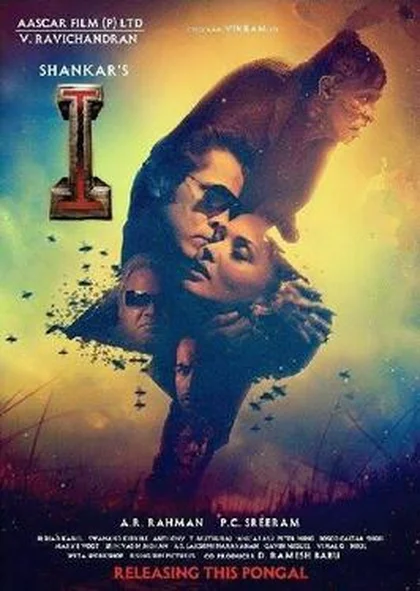
Table of Contents
Quick Facts
I is a Tamil romantic action thriller directed by S. Shankar, starring Vikram, Amy Jackson, Suresh Gopi and Upen Patel. Released on 14 January 2015 to coincide with Pongal, it was one of the most ambitious Indian films ever attempted — filming lasted two years and eight months, spanned China, and involved prosthetic make-up from Peter Jackson’s Weta Workshop. It became a massive commercial success and won Vikram the Filmfare Award for Best Actor in Tamil.
The film is now streaming on Prime Video. What makes it unforgettable is Vikram’s physical transformation: in a single film he plays a bulky bodybuilder, a glamorous supermodel, a deformed hunchback and a ferocious beast-like creature — and he reportedly went bald and put himself through extreme physical strain to pull it off. This is an actor’s daredevil show wrapped in Shankar’s trademark spectacle.
Plot
Lingesan is an ambitious bodybuilder from Chennai whose only dream is to win the Mr India title. He is also hopelessly in love with Diya, a beautiful supermodel who barely knows he exists. When Diya’s career is sabotaged by her scheming co-star John, she replaces him with Lingesan for a high-profile commercial shoot in China. Lingesan sacrifices his bodybuilding dreams to help her, undergoes a radical makeover by stylist Osma Jasmine, and is rebranded as “Lee” — a sensation in the fashion world. His meteoric rise as a supermodel makes him powerful enemies: John, whose career collapses; Osma, whose romantic advances he rejects; Indrakumar, an industrialist whose losses he causes; and Ravi, the bodybuilder he defeated.
The four conspire to destroy him. Days before his wedding to Diya, Lingesan’s body begins to deform horrifically — hair falling out, teeth crumbling, his frame twisting. His trusted family doctor, Dr Vasudevan, diagnoses an incurable genetic disorder, and Lingesan fakes his death to spare Diya. But the truth is darker: he has been injected with an engineered virus, the “I” virus, and Vasudevan himself is part of the conspiracy, driven by a twisted obsession with Diya.
Now a deformed outcast, Lingesan kidnaps Diya to keep her safe and executes a chilling campaign of poetic revenge — each tormentor is punished in a way that mirrors his own cruelty, without ever being killed. With his vengeance complete, he reveals his disfigured self to Diya, whose love for him has not wavered, and begins a long road to recovery through stem-cell therapy and sheer will, on his way back to the man he was.
Performance
Vikram gives the performance of a lifetime as Lingesan. The physical commitment alone is staggering — bulking up for the bodybuilder portions, then slimming down, going bald, and spending hours in prosthetics for the hunchback and beast get-ups. But it is the emotional performance underneath the make-up that elevates the film: the shy bodybuilder’s devotion, the supermodel’s joy, and the deformed man’s anguish all feel lived-in. Few Indian actors have ever taken their body to such extremes for a role, and the Filmfare Award was richly deserved.
Amy Jackson is perfectly cast as Diya — she genuinely looks the supermodel part, which the role demands, and handles both the glamour and the emotional portions well. Suresh Gopi is a cold, controlled villain as Dr Vasudevan, a man whose respectable exterior hides something rotten. Santhanam provides comic relief as Lingesan’s loyal friend Babu, and Upen Patel makes a convincing model-turned-villain as John.
Screenplay and Direction
Shankar directs on a scale no other Indian filmmaker of his time dared to attempt. The film is told in a nonlinear narrative, cutting between Lingesan’s present as the disfigured avenger and his past as the rising star, and the structure keeps the mystery of the “I” virus alive for much of the runtime. The portions inspired by The Hunchback of Notre Dame and Beauty and the Beast give the story a dark fairy-tale quality — this is, at heart, a story about what love looks like when beauty is stripped away.
The technical ambition is the film’s real marvel. The action sequences shot in China, the prosthetic transformations designed with Weta Workshop, the production design by T. Muthuraj — every frame shows where the enormous budget went. If there is a criticism, it is that the film occasionally drowns its emotion in spectacle, and the long runtime tests patience in places. But when the revenge sequences arrive, staged with twisted ingenuity, the wait feels worth it.
Music
A. R. Rahman, working with Shankar for the tenth time, composed the soundtrack and background score, and it is one of his most eclectic Tamil albums. “Mersalayitten” is a pulsating dance number, “Ennodu Nee Irundhaal” is a haunting romantic melody shot with breathtaking visuals, and “Aila Aila” is pure fun. The music launch itself was a grand event attended by Rajinikanth and Arnold Schwarzenegger — a sign of the film’s scale. The background score swells through the transformation and revenge sequences, giving them the operatic weight Shankar wanted.
The cinematography by P. C. Sreeram is gorgeous — the Chinese locations glow, the modelling-world portions shimmer with glamour, and the deformed-Lingesan portions are shot with a sympathy that keeps the audience on his side. The visual contrast between beauty and deformity is the film’s central image, and Sreeram renders it beautifully.
Themes
I is about beauty, vanity and what lies beneath. Lingesan rises because of his looks and is destroyed by the same obsession with appearance; his enemies are all people who value surfaces — a jealous model, a vain stylist, a humiliated rival. The film asks whether love can survive when the beautiful body is gone, and answers with Diya’s unwavering devotion. It is also a revenge story with a difference: Lingesan refuses to kill, choosing instead punishments that force each villain to live with a disfigured reflection — a twisted but moral code that makes him a hero rather than a monster.
Conclusion
I is a landmark of Tamil spectacle cinema — flawed in its indulgence but unmatched in ambition, carried by Vikram’s career-defining physical performance and Shankar’s grand vision. It grossed around two hundred and forty crores worldwide, becoming Vikram’s highest-grossing film until Ponniyin Selvan: I. For anyone who loves big-screen scale, prosthetic transformations and a revenge story with a fairy-tale heart, this remains one of the most audacious films Indian cinema has ever produced.
Watch the official trailer: