
Enna Vilai
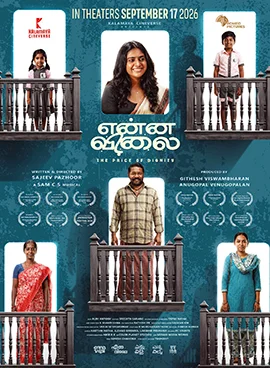
Table of Contents
Quick Facts
What is the price of honesty? Enna Vilai — the title translates roughly to “what is the price” — poses that question through the story of Thavasi Muthu, a poor Rameswaram fisherman whose life is upended by a single stroke of apparent fortune. Written and directed by Sajeev Pazhoor in his Tamil directorial debut, the film released in theatres on 17 September 2026 and arrived on Netflix on 15 October 2026, where it is now streaming in five languages.
Pazhoor is best known as the writer of the acclaimed screenplay of Thondimuthalum Driksakshiyum, and Enna Vilai marks his reunion with that film’s breakout star, Nimisha Sajayan — this time as Advocate Kanchana, the lawyer who takes up Thavasi’s case. With Karunaas in the central role and music by Sam C.S., this is a small, socially rooted legal drama that found only a modest audience in theatres but may yet find its true viewership on streaming.
Plot
Thavasi Muthu (Karunaas) lives a hard, honest life in Rameswaram with his family. He is a fisherman of the poorest kind — a man who dives into the waters for the coins that temple visitors toss in as offerings — and his world is small, dignified and barely holding together. Then one day he finds a gold pendant washed ashore. It should be the luckiest moment of his life. He does the honest thing and surrenders it to the police.
Honesty, it turns out, is the worst possible strategy. A corrupt officer pockets a stone from the pendant and then accuses Thavasi himself of theft, turning the victim of the system into its accused. What follows is a grinding legal battle: a poor man with no resources against a machinery that has already decided he is guilty. Into this walks Advocate Kanchana (Nimisha Sajayan), who takes up Thavasi’s case and becomes his voice in a courtroom — and a society — stacked against him. The film follows the case to its conclusion, asking at every step what justice costs, and who pays for it.
Performance
Karunaas carries the film, and it is a performance built on restraint. Thavasi is not a hero in the cinematic sense — he is bewildered, outmatched, often silent — and Karunaas plays him without vanity, letting the character’s dignity emerge through smallness rather than speeches. It is the kind of role that can easily tip into caricature, the noble poor man, but Karunaas keeps Thavasi specific and human: a father, a diver, a man who did the right thing and cannot understand why it is destroying him.
Nimisha Sajayan, reuniting with Pazhoor nine years after her acting debut in Thondimuthalum Driksakshiyum, brings steel and warmth to Advocate Kanchana. The role could have been a mere mouthpiece for the film’s arguments; Sajayan makes her a person — principled, sharp, visibly moved by her client’s plight. The supporting cast is deep and lived-in: Vijayalakshmi Veeramani, Kamalesh Jagan, Mohan Raman, Kavithalaya Krishnan, Nizhalgal Ravi and Poornima Bhagyaraj all contribute to the film’s strong sense of place, and the Rameswaram milieu feels populated by real people rather than plot functions.
Screenplay and Direction
Sajeev Pazhoor’s writing has always been interested in ordinary people caught in systems larger than themselves, and Enna Vilai is cut from exactly that cloth. As a first-time Tamil director, he shows a documentarian’s eye for texture: the film’s Rameswaram — its temple crowds, its shoreline economy, its police stations and courtrooms — feels observed rather than constructed. Cinematographer Alby Antony and editor Sreejith Sarang keep the visual language unshowy, which suits a story whose power comes from accumulation rather than incident.
If the film has a weakness, it is one critics have noted: the storytelling can feel schematic, the villains a touch too villainous, the courtroom beats familiar to anyone who has seen the genre. But Pazhoor’s sincerity is never in doubt, and the central situation — a man punished for his honesty — is strong enough to carry the film through its rougher patches. This is a director whose instincts are humane; the craft will catch up.
Music
Sam C.S. provides the score and music, and his work here is appropriately understated. A legal drama about a poor fisherman does not need bombast; it needs a score that can sit with Thavasi’s quiet despair and Kanchana’s gathering resolve, and Sam C.S. delivers exactly that — music that supports the performances without competing with them. The songs released ahead of the film lean into the coastal setting and the film’s melancholic register.
The background score’s best moments come in the courtroom sequences, where it tightens almost imperceptibly around the arguments, and in the shoreline scenes, where it lets the sound of the place — water, wind, temple bells — do half the work. It is functional, sensitive scoring for a film that needs it.
Themes
Enna Vilai is about the asymmetry of justice. Thavasi’s crime is honesty; the system’s crime is everything else. The film’s title asks what honesty costs, and its answer is unsparing: for a poor man, the price of doing the right thing can be everything he has. The corrupt officer who steals from the pendant and then accuses Thavasi is not an aberration in the film’s worldview but its representative — power protecting itself, as it always does.
But the film is not cynical. Advocate Kanchana’s presence is its counter-argument: that the system can also produce people who fight it, that dignity is worth defending even when the odds are hopeless. The class politics are explicit but not crude — this is a film that understands poverty as a daily condition, not a plot point, and that makes Thavasi’s ordeal feel like something that happens to real people rather than characters.
Conclusion
Enna Vilai did not set theatres alight — reviews were mixed, and its theatrical run was brief. But it is exactly the kind of film that streaming was made for: small, sincere, socially engaged, and carried by two fine central performances. Karunaas gives the role of his career, Nimisha Sajayan confirms her range, and Sajeev Pazhoor announces himself as a director with something to say about the world as it is.
The film is now streaming on Netflix, where it arrived on 15 October 2026 in Tamil, Hindi, Telugu, Kannada and Malayalam. If you missed it in theatres — and most people did — this is your chance to catch one of the year’s most earnest Tamil dramas from your couch.