
Yezhu Kadal Yezhu Malai
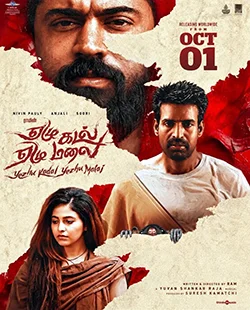
Table of Contents
Quick Facts
Few Tamil films have taken as long a road to the screen as Yezhu Kadal Yezhu Malai. Director Ram — one of Tamil cinema’s most fiercely individual auteurs, the man behind Peranbu and Thanga Meengal — began shooting this fantasy adventure in the windswept ruins of Dhanushkodi in 2021, wrapped by April 2022, and then watched the film spend more than four years in post-production and distribution limbo. It premiered at the International Film Festival Rotterdam in 2024, competing in the festival’s VPRO Big Screen competition, before finally arriving in theatres worldwide on 1 October 2026.
That is a journey worth noting, because the film itself is about the weight of time. Nivin Pauly plays an immortal man who has lived for more than 8,000 years, opposite Soori as a 32-year-old ordinary man whose chance encounter with him on a train sets the story in motion. It marks Nivin Pauly’s return to Tamil cinema as a lead after Richie (2017), and his first collaboration with Ram — two artists known for refusing the easy path. With music by Yuvan Shankar Raja, produced by Suresh Kamatchi for V House Productions and distributed in Kerala by Dulquer Salmaan’s Wayfarer Films, this is arthouse ambition mounted at serious scale.
Plot
The premise is disarmingly simple and almost mythic in shape. On a moving train, an ordinary man — Soori’s character, 32 years old, the kind of man whose worries run no deeper than providing for his family — meets a stranger who calmly informs him that he has lived for more than eight thousand years. The immortal, played by Nivin Pauly, has spent millennia searching for his lost love, watching her die and be reborn across countless generations. As the train moves through the night, he begins to recount his story: a sprawling, fable-like journey across centuries, through different lands and different lives, in relentless pursuit of the one soul that completes him.
Anjali plays a mystical woman whose presence proves crucial to the story’s progression — the immortal’s eternal beloved, glimpsed across eras. What begins as a curious conversation between two passengers widens into something much stranger: a tale that travels through thriller, mystery, fantasy, romance, humour, action and emotional drama without ever quite settling into one. The trailer’s most quoted moment says it best: when Soori asks where the immortal was in 1441, and whether that means BC or AD, you realise this is a film that wants you laughing and wondering in the same breath. How much of the immortal’s story is real, and how much is the ordinary man’s awakening, is for the film to reveal.
Performance
Everything about the film rests on Nivin Pauly’s shoulders, and it is a remarkable piece of casting. He must play a man who has lived 8,000 years — carrying the exhaustion, the wit and the terrible accumulated knowledge of someone for whom empires are passing seasons — and from the promotional material he seems to be relishing the different shades of the role. Early preview responses singled out his performance and, notably, his combination scenes with Soori, where humour and emotional exchange play off each other. Playing an immortal against an ordinary man is a delicate balancing act; the trailer suggests Nivin has found the register, alternately playful and haunted.
Soori, meanwhile, does what Soori does best and then some. His character is the audience’s way in — practical, sceptical, funny — and his comic timing in the trailer is razor sharp. When the immortal asks where he was in 1441, Soori’s deadpan “Is it 1441 BC or 1441 AD?” lands beautifully; when asked whether he was present in the Amazon forests, his reply — “Sir, I haven’t even ordered anything from Amazon” — is pure Soori, and it works because the film’s vastness needs his smallness as a counterweight. Anjali’s role, though less revealed in the promotions, is clearly pivotal rather than ornamental.
Screenplay and Direction
Ram is not a director who makes genre films in the conventional sense; he absorbs genres into his own worldview. Yezhu Kadal Yezhu Malai is, by his own past standards, unusually ambitious — a fantasy that reaches across centuries, staged with the visual resources of a commercial epic, yet built around the quietest of situations: two men talking on a train. Cinematographer N. K. Ekambaram and production designer Umesh J. Kumar give the millennia-spanning story a grounded, elemental texture, while editor Mathi V. S. has the considerable task of holding together a narrative that leaps across time.
The film’s long gestation — shot in 2021–22, premiered at Rotterdam in 2024, released theatrically only in 2026 — speaks to the difficulty of mounting something this unusual. That it survived the journey at all is a testament to the faith of producer Suresh Kamatchi and to Ram’s standing. Critics who caught the festival cut described it as Ram’s most experimental work: a film that uses its structure to mirror the way ancient stories were told, and that keeps circling the same questions about love, time and memory. This is not a film that holds your hand; it asks you to surrender to its rhythms.
Music
Yuvan Shankar Raja composes the score and songs, with additional music by Santhosh Dhayanidhi — and the music carries a particular burden here. A story about an 8,000-year-old man needs a soundscape that can suggest the weight of centuries, and the released material leans into that ambition. The trailer’s theme, composed and produced by Santhosh Dhayanidhi, was crafted specifically for the promotional cut and signals the film’s blend of the epic and the intimate. Lyrics come from Madhan Karky and Mathi Pugazhendhi.
Yuvan and Ram have a history of collaborations that aim for the profound rather than the popular, and this score appears to continue that tradition — music as atmosphere and memory rather than mere accompaniment. For a film whose central character has outlived every song ever written, the composers’ challenge is a delicious one: how do you score eternity?
Themes
At its heart, Yezhu Kadal Yezhu Malai is a meditation on what time does to love and memory. The trailer articulates the central idea in a single line: when fifty or sixty years of memories can burden a human being, imagine the weight carried by a man who has lived for 8,000. The immortal’s endless search for his beloved is romantic on the surface and quietly devastating underneath — love not as a single lifetime’s story but as a condition of existence, renewed and lost across generations. The film also plays with storytelling itself: the immortal’s tale-within-a-tale structure suggests Ram is interested in how narratives, like people, are reborn in new forms.
There is a democratic impulse in the premise too. The immortal needs the ordinary man — the train encounter matters because eternity means nothing without someone to witness it. The film asks its 32-year-old everyman, and by extension its audience, to look up from the immediate anxieties of survival and consider compassion, destiny and the value of all living things on a vaster scale. It is a big ask, and a very Ram-like one.
Conclusion
Yezhu Kadal Yezhu Malai is not a film for everyone, and it was never meant to be. It is a slow-brewed, festival-travelled fantasy from one of Tamil cinema’s most uncompromising directors, built around a genuinely original premise and a daring central performance. The long wait — from the Dhanushkodi shoot in 2021 to the October 2026 release — has only added to its mystique. Reviews and audience reactions will no doubt be divided, as they always are with Ram’s work; what cannot be denied is the singularity of the attempt.
The film released in theatres worldwide on 1 October 2026 with a U/A certificate, and is playing in its theatrical window. No streaming platform has been announced yet. For viewers who like their Tamil cinema ambitious, strange and willing to fail interestingly rather than succeed safely, this is essential viewing.