
Lucia (2013) – Movie Info, Cast, Trailer & Where to Watch
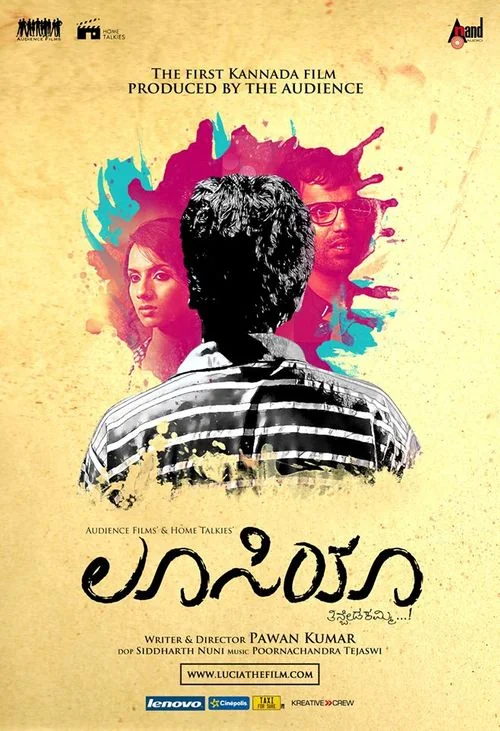
Table of Contents
Quick Facts
Before Lucia, the idea that ordinary people could fund a Kannada feature film through a blog post sounded like fantasy. Then, in April 2012, director Pawan Kumar put up a proposal on his blog, Project Lucia, asking strangers to back it, and within 27 days, 110 investors had pledged ₹50 lakh. The result premiered at the London Indian Film Festival on 20 July 2013, won the Best Film Audience Choice award, made the shortlist for India’s Oscar submission, and released across India on 6 September 2013 under PVR’s Director’s Rare banner. It did not just succeed; it detonated.
A psychological thriller about lucid dreaming, shot on a Canon 5D on a micro-budget, Lucia is routinely called the film that launched the “new wave” of Kannada cinema, proof that a daring idea could find an audience without stars or studios. It was remade in Tamil as Enakkul Oruvan in 2015 and returned to theatres for a celebrated tenth-anniversary re-release in 2023. It is currently streaming on Sun NXT.
Plot
The film opens with a jolt: policemen are investigating why a patient lies in a coma, while television debates rage about whether he should be allowed to die. Then we meet Nikki, played by Sathish Ninasam, a “torch-shiner” in a rundown Bengaluru theatre, a young man sharing a shack with four roommates and suffering from crippling insomnia. One sleepless night, a peddler offers him Lucia, a pill that lets you dream the life you want. Nikki takes it, and his nights transform. In his black-and-white dreams, he is Nikhil, a celebrated film star with everything his waking life denies him.
The film cuts between Nikki’s colour reality and Nikhil’s monochrome dream-life, and the two worlds begin to contaminate each other. People from his real life reappear in his dreams in altered roles: his theatre owner Shankranna, played by Achyuth Kumar, becomes his manager; his simple fiancée Shwetha, played by Sruthi Hariharan, becomes his glamorous girlfriend. But the drug has a catch: stop taking Lucia, and the dreams curdle into nightmares. As Nikhil’s dream-life spirals into paranoia, Nikki’s waking life fractures too, and the line between the two Nikkis grows terrifyingly thin.
Without spoiling the famous climax, Lucia folds its two realities together in a way that forces you to re-examine everything in a single bravura stretch. The coma from the opening scene turns out to be the key to the whole puzzle, and the final revelations reframe the story as something far sadder and stranger than a cautionary tale about drugs. It is an ending that has fuelled a decade of debate.
Performance
Sathish Ninasam, a theatre actor making his debut as a leading man after years of supporting roles, does something remarkable: he creates two distinct people who are unmistakably the same man. Torch-shiner Nikki is all shambling sweetness, while star Nikhil is vain and slowly unravelling, and Ninasam separates them with nothing more than posture, voice and attitude. It remains one of the great debut lead performances in Kannada cinema.
Sruthi Hariharan brings warmth to Shwetha in both incarnations, and her chemistry with Ninasam grounds the film’s wildest flights. Achyuth Kumar, as Shankranna, gives the film its soul: his relationship with Nikki, openly modelled on the projectionist and the boy in Cinema Paradiso, is the story’s emotional core, and his ease on camera is a masterclass in underplaying.
Screenplay and Direction
Pawan Kumar’s screenplay is a high-wire act that never looks down. The non-linear structure, parallel editing between colour reality and black-and-white dream, fourth-wall breaks, nested perspectives, could easily have collapsed into confusion, but the editing, by Pawan with Sanath and Suresh, has such rhythmic precision that you are never lost, only tantalised. The script is sneakily ambitious, folding in the pharmaceutical industry, the ethics of euthanasia and the nature of stardom without ever stalling the thriller.
Honest criticism exists: some reviewers felt the romantic stretches sag, and the film’s ideas occasionally outrun its dramatisation. But these are footnotes. Pawan Kumar did not just make a clever film; he invented, out of necessity, a new way of making films in Kannada, proving the audience, not the studio, could be the producer. The crowdfunding model and the indie ecosystem behind the decade’s best Kannada films all trace back to this one stubborn, brilliant gamble.
Music
The soundtrack, by debutant Poornachandra Tejaswi, who also wrote most lyrics with Yogaraj Bhat, was a phenomenon. “Thinbeda Kammi,” with its delirious wordplay, and the foot-tapping “Jamma Jamma,” sung by Naveen Sajju, became massive hits. The background score, by Tejaswi with Monish Kumar and Santhosh Narayanan, is just as impressive, shifting textures between the two worlds until you can almost hear the boundary dissolving.
Then there is the cinematography. Siddhartha Nuni shot Lucia on a Canon 5D, a still camera, and the result is among the most visually inventive Kannada films ever made: the harsh flat light of Nikki’s waking life against the noir monochrome of his dreams, the inventive angles, the documentary immediacy of the theatre scenes. That a film shot for the price of a luxury car looks this rich is the ultimate rebuke to anyone who says good cinema needs big money.
Themes
Lucia is, on the surface, about a dream drug, but its real subject is desire, and the suspicion that getting everything you want might be worse than wanting it. Nikki’s dream-life gives him fame, love and luxury, and it still curdles, because the film understands that dreams, like films, satisfy only when you cannot control them. Beneath runs a sharp critique of an industry and society that sells escape, from pills to cinema tickets, and a moving question about what a life is for. Rare is the thriller this entertaining and this philosophical at once.
Conclusion
Lucia is not just a great Kannada film; it is a historically important one, the crowdfunded dream that proved a new cinema possible and inspired a generation to make it. It is streaming on Sun NXT. Clear an evening, silence your phone, and let Pawan Kumar show you what ₹50 lakh and absolute conviction can do.
Watch the official trailer: