
Thithi (2015) – Movie Info, Cast, Trailer & Where to Watch
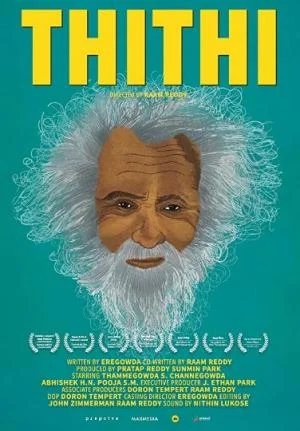
Table of Contents
Quick Facts
There is a special thrill in a film that could not exist anywhere else, and Thithi is one of those rare, rooted miracles. Made by a 25-year-old first-time director with non-professional actors from the villages of Mandya district, this small Kannada film premiered at Locarno in August 2015 and won the Golden Leopard in the Filmmakers of the Present category plus the First Feature award. Back home it took the National Film Award for Best Kannada Feature, charmed everyone from Francis Ford Coppola to Anurag Kashyap, and released theatrically in Karnataka on 6 May 2016.
The premise could not be simpler: cantankerous 101-year-old Century Gowda dies, and over the eleven days leading to his thithi, the final funeral ceremony, three generations of his male descendants each chase what they want most. What Raam Reddy finds in that frame is a whole world, funny, bawdy, melancholic, and so observant of rural life that it feels overheard rather than watched. It streams on Netflix, and it is one of the great Indian debuts of the last decade.
Plot
The film opens with Century Gowda himself, all 101 years of him, holding court at the village bus stop doing what he loves: loudly teasing passersby. Moments later he collapses and dies, just like that, and Nodekoppalu absorbs the news with the matter-of-factness of people for whom death is a neighbour. He leaves behind three generations of men, and the film follows each through the eleven days until the thithi, their stories braiding together with the ease of village gossip.
The eldest son, Gadappa, is a bearded free spirit who drifts through fields and toddy shops, puffing beedis and pointedly unbothered by property papers. His son Thamanna is Gadappa’s opposite: a scheming, blustering materialist racing to get Century Gowda’s five acres transferred into his name before grasping relatives stake a claim. And Thamanna’s teenage son Abhi cares nothing for land; he is busy pursuing Kaveri, a spirited young shepherdess, with the reckless confidence only adolescence allows.
Nothing unfolds like a conventional plot, and that is the point. Thamanna’s land-grabbing schemes keep colliding with village bureaucracy and his own temper. Gadappa’s wanderings intersect with other people’s business in ways funnier and sadder than he intends. Abhi’s romance stumbles toward its own awkward truth. When the threads converge at the thithi ceremony, with the whole village gathered, the resolutions feel earned rather than engineered: small, human, quietly moving. The film’s great trick is making you laugh at these men without ever looking down on them.
Performance
The miracle of Thithi is its cast. Channegowda, Thammegowda S., Abhishek H. N., and Pooja S. M. had never acted before, yet their naturalism is what trained actors spend careers chasing. Channegowda’s Gadappa is the film’s soul: every shambling step feels discovered rather than performed, and his indifference to the property frenzy becomes a kind of philosophy. Thammegowda is magnificent as the blustering schemer Thamanna, and Abhishek brings exactly the right mix of swagger and vulnerability to Abhi.
Even Century Gowda, played by Singrigowda in minutes of screen time, becomes iconic: that opening stretch at the bus stop tells you everything about the man whose absence drives the film, and his framed photograph watches the rest like a mischievous ghost. Around the leads, the villagers of Nodekoppalu, all non-actors, fill every frame with unselfconscious life. It never feels like a set. It feels like a village that generously agreed to be filmed.
Screenplay and Direction
Reddy’s method was unusual: he and co-writer Eregowda, who is from the region depicted, cast their characters first and built the screenplay around the real people they found. That shows in every scene. Conversations overlap and meander like real talk, jokes land sideways, and drama emerges from behaviour rather than plot machinery. For a debutant, Reddy’s tonal control is extraordinary: consistently funny without ever becoming a comedy, with observations about greed, lust, and family that cut deeper for arriving with a smile.
The craft choices are bold in restraint. There are no songs and, remarkably, no background score at all; instead, sound designer Nithin Lukose builds the film’s music from the village itself, birdsong, sheep, bicycle bells, a film song leaking from a phone ringtone. Cinematographer Doron Tempert, Reddy’s Prague film-school classmate, shoots in unshowy wide frames that let life happen at the edges, refusing to prettify the landscape into a postcard. The result trusts its audience completely, and earns it in every scene.
Music
Here is one of Thithi’s most famous distinctions: no music director, no songs, not even a background score. A deliberate choice, not a budget compromise. The village’s own soundscape carries the emotional weight, and Lukose’s intricate design layers bleating sheep, clattering vessels, and murmuring crowds into something as expressive as any score. The few snatches of recognisable music, a ringtone here, a bus conductor’s tape there, arrive as found objects from real life, funnier and more poignant than any composed cue.
If the film has a visual music, it is Tempert’s cinematography. His camera rarely pushes in, preferring patient wide shots of courtyards and fields, and the effect is cumulative: by the final ceremony, Nodekoppalu feels lived in, not visited. In an industry where rural stories are so often drenched in syrupy scores and golden-hour prettiness, Thithi’s dry, clear-eyed gaze was genuinely radical, and remains its most influential legacy.
Themes
Under the laughter, Thithi is about what death sets in motion: the scramble for inheritance, the performance of grief, the way a family’s appetites surface when the patriarch is gone. Each generation wants something different, land, freedom, love, and the film watches those desires collide with wry, non-judgmental affection. It is also about a changing rural India, where old customs like the thithi persist even as the young dream of other lives, and where the women, Kaveri especially, prove sharper than any of the men chasing them.
Conclusion
Thithi succeeds on every level it attempts: festival triumph, National Award winner, and above all a deeply entertaining, humane film that never condescends to its characters or audience. It streams on Netflix, so there is no excuse left. Watch it for the laughs, stay for the aching tenderness underneath, and join the long list of viewers, including some very famous filmmakers, who call it a modern classic.
Watch the official trailer: