
Dilwale Dulhania Le Jayenge
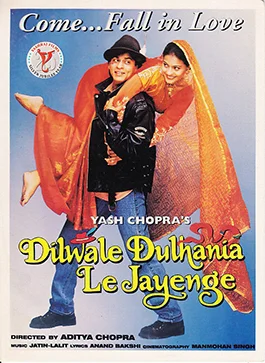
Table of Contents
Quick Facts
Dilwale Dulhania Le Jayenge is the film that made an entire generation believe in love the Hindi-film way. Directed by a then 23-year-old Aditya Chopra, released on 20 October 1995, and starring Shah Rukh Khan and Kajol at the very height of their spark, DDLJ did not just become a blockbuster — it became a permanent fixture of Indian cultural life. It is the longest-running film in Indian cinema history, playing continuously at Mumbai’s Maratha Mandir for decades, and three decades later it still feels like a warm evening you never want to end.
The film is streaming on Netflix, and it remains the benchmark against which every Hindi romance is measured. It turned Raj and Simran into household names, made the Swiss countryside feel like a second home to Indian audiences, and gave us a love story built not on rebellion but on winning over the people who matter — especially the formidable Bauji.
Plot
Raj Malhotra (Shah Rukh Khan) is a carefree London boy who has never failed an exam and never taken anything seriously; Simran Singh (Kajol) is a disciplined, duty-bound girl raised to obey every word of her strict father. They miss each other on a European trip, meet by accident, and slowly fall in love across the railway platforms and mustard fields of their journey — but Simran is already promised to the son of her father’s old friend back in Punjab.
Here is where DDLJ quietly broke the mould. Instead of eloping, Raj follows Simran to her family’s Punjab home and decides to win over her father, Baldev Singh (Amrish Puri) — the stern patriarch whose one word, “Ja, Simran, ja,” at the film’s climax has become one of the most quoted moments in Hindi cinema. The final act is a masterclass in sustained tension: a wedding that must not happen, a train that must not be missed, and a father whose heart finally melts in the most famous slow-motion run ever filmed.
What keeps the story alive is how it balances romance with respect. Raj’s charm never becomes arrogance toward tradition, and Simran’s obedience never becomes passivity. The film argues that true love doesn’t run away from family — it finds a way to bring everyone along.
Performance
Shah Rukh Khan as Raj is the performance that crowned him the undisputed King of Romance. He is mischievous without being annoying, earnest without being preachy, and in the Punjab portions he adds a sincerity that lifts the whole film. The “palat” moment on the train — when he asks Simran to look back — is acting economy at its finest. Kajol matches him beat for beat, bringing a fierce emotional honesty to Simran; her eyes carry the film’s longing, and her chemistry with SRK remains the gold standard.
Amrish Puri gives one of Hindi cinema’s great patriarch performances as Baldev Singh — stern, intimidating, but never a caricature; when he softens, you believe it completely. Farida Jalal as Simran’s mother brings warmth and quiet rebellion of her own, and Anupam Kher as Raj’s liberal father is pure comic joy, the perfect counterweight to the Singh household’s rigidity.
Screenplay and Direction
Aditya Chopra’s debut is staggering in its confidence. He takes the classic elopement story and flips its emotional engine: the conflict is not between lovers and the world, but between love and duty — and both sides are treated with respect. The European leg is shot with a tourist’s delight, the Punjab leg with a homesick ache, and the climactic train sequence remains one of the most perfectly staged finales in commercial cinema. Every beat lands exactly when it should.
The dialogue is quotable to this day — from “bade bade deshon mein aisi chhoti chhoti baatein hoti rehti hain” to the immortal “ja Simran ja.” If the film has a soft spot, it is the slightly idealised middle; but the craft is so assured, and the emotions so honestly earned, that picking holes feels beside the point. This is popular filmmaking at its absolute peak.
Music
Jatin–Lalit composed one of the greatest Hindi film soundtracks of all time. “Tujhe Dekha To,” “Mere Khwabon Mein,” “Ruk Ja O Dil Deewane,” “Ho Gaya Hai Tujhko To Pyaar Sajna” — the album has no filler, and Lata Mangeshkar and Kumar Sanu sing like their hearts might burst. The songs are woven into the story rather than stopping it, each one marking a precise emotional shift. Three decades on, the soundtrack plays at every Indian wedding worth its name.
The film looks timeless too — the Swiss locations shot with postcard beauty, the Punjab mustard fields glowing amber, and that final train-platform framing that has been imitated a thousand times and never bettered.
Themes
DDLJ is about the great Indian negotiation between individual desire and family duty — and it refuses to treat that negotiation as a battle with a villain. Tradition is given dignity; rebellion is given heart. The film also captures the diaspora experience with unusual tenderness: London Punjabis dreaming of Punjab weddings, of roots that tug even when life is comfortable abroad. At its core, it says the most romantic thing of all: love is not complete until it earns the blessing of the people you love.
Conclusion
Dilwale Dulhania Le Jayenge is not just a great romance — it is the romance, the one every subsequent Hindi love story answers to. SRK and Kajol’s chemistry, Jatin–Lalit’s immortal music, and Aditya Chopra’s note-perfect direction combine into three hours of pure, honest emotion. If you have never seen it, watch it to understand what all the fuss is about. If you have, you already know why you keep going back. Palat — and watch it again.
Watch the official trailer: