
Dil Chahta Hai
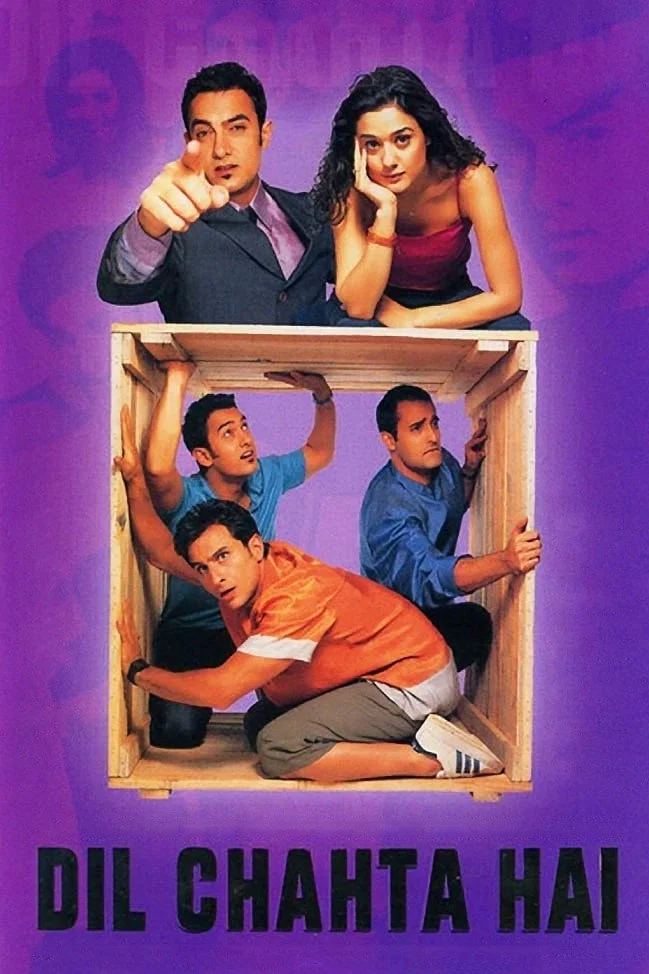
Table of Contents
Quick Facts
Dil Chahta Hai, released on 10 August 2001, is the film that taught Hindi cinema how to be cool. A 27-year-old Farhan Akhtar’s directorial debut, starring Aamir Khan, Saif Ali Khan and Akshaye Khanna as three friends drifting through love and growing up, it arrived like a breath of fresh sea air. No villains, no melodramatic mothers, no revenge — just three young men, a Goa trip, and the messy business of becoming adults. It changed the grammar of the Hindi coming-of-age film forever.
Streaming on Netflix, the film feels as fresh today as it did in 2001 — maybe fresher, because everything it predicted about urban Indian youth culture came true. It is witty, stylish and quietly moving, with a soundtrack that defined a generation and a friendship that every viewer recognised as their own.
Plot
Akash (Aamir Khan) is a commitment-phobe who treats love as a joke; Sameer (Saif Ali Khan) is a romantic who keeps falling for the wrong women; Sid (Akshaye Khanna) is the sensitive artist of the trio. After a Goa holiday, their lives scatter: Akash is drawn to the vivacious Shalini (Preity Zinta) in Sydney, Sameer stumbles into a relationship with Pooja, and Sid falls for Tara (Dimple Kapadia), an older, divorced woman — a romance his friends cannot accept. The friendship fractures under the strain.
The beauty of the film is how it treats each strand with equal seriousness. Akash’s slow realisation that he actually loves Shalini is played with wonderful restraint; Sid’s doomed, dignified love for Tara is the film’s emotional core, handled with a maturity rare in commercial cinema. The friends’ reunion is not forced or sentimental — it arrives the way real reconciliations do, quietly and a little awkwardly, and lands all the harder for it.
There is no villain to defeat and no grand climax — just three people learning that growing up means holding two truths at once: that you can love your friends and still need to walk your own path. The final scenes, with the trio reunited but changed, are quietly perfect.
Performance
Aamir Khan is effortlessly charming as Akash, nailing the character’s transformation from flippant bachelor to a man capable of real feeling — the Sydney scenes are among his most likeable work. Saif Ali Khan is a revelation as Sameer, delivering the film’s biggest laughs with impeccable comic timing while keeping the character’s romantic sincerity intact. It remains one of his career-best performances.
Akshaye Khanna gives the film’s most soulful performance as Sid — understated, wounded, and quietly magnetic. Dimple Kapadia brings grace and melancholy to Tara, and Preity Zinta is sparkling as Shalini. The ensemble clicks so naturally that the friendship feels documented rather than performed.
Screenplay and Direction
Farhan Akhtar’s debut is a landmark in Hindi film direction — naturalistic dialogue, a sync-sound intimacy, and a refusal to underline emotions that was radical in 2001. He writes young urban Indians as they actually speak, joke and fight, and he stages scenes (the Goa trip, the opera sequence, the final reunion) with a visual flair that never feels showy. The screenplay’s structure — three parallel love stories braided through one friendship — is elegant and unfussy.
The film’s influence is impossible to overstate: it opened the door for the entire wave of urban multiplex cinema that followed. If it has a flaw, it is that its world is glossy and privileged — but within that world, its emotional honesty is complete. Twenty-five years on, it remains the definitive Hindi film about friendship.
Music
Shankar–Ehsaan–Loy announced themselves as a major force with this soundtrack. “Dil Chahta Hai,” “Koi Kahe Kehta Rahe,” “Tanhayee,” “Jaane Kyun” — the album is a perfect blend of rock energy and melodic warmth, and Javed Akhtar’s lyrics capture the film’s spirit of youthful longing. “Tanhayee,” in particular, is one of the great Hindi songs of heartbreak.
Ravi K. Chandran’s cinematography gave the film its sun-drenched, aspirational look — Goa, Sydney and Mumbai all glow, and the visual style (natural light, real locations) was as influential as the story itself.
Themes
Dil Chahta Hai is about the painful, necessary business of growing up — learning that friendship is not the same as agreement, that love requires vulnerability, and that adulthood means making peace with other people’s choices. Sid’s storyline, in particular, is a quiet rebuke to judgmental notions of love. The film’s great insight is that friendships, like people, have seasons — and that the truest ones survive the changing weather.
Conclusion
Dil Chahta Hai is a modern classic — the film that made Hindi cinema grow up with its audience. Funny, stylish and genuinely moving, it remains the gold standard for films about friendship. Watch it for the Goa trip, stay for the quiet wisdom, and marvel at how a 27-year-old first-time director got everything so right. Some films define a moment; this one defined a generation.
Watch the official trailer: