
Satluj
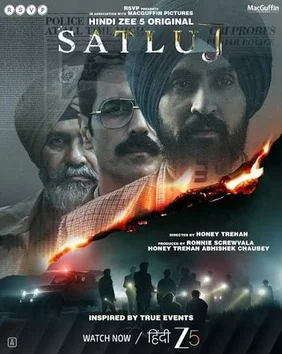
Table of Contents
Quick Facts
Plot
Satluj is the film that took nearly four years to reach an audience, and its journey is part of its story. Long known as Punjab ’95, Honey Trehan’s drama about human rights activist Jaswant Singh Khalra ran into censorship demands for more than a hundred cuts, lost its original title, and finally premiered uncut on ZEE5 Global on 3 July 2026 under its new name. What survived that journey is a quiet, stubborn film about one man’s refusal to look away.
Diljit Dosanjh plays Khalra, a bank director in Amritsar who begins investigating the disappearance of a colleague’s family member and uncovers a pattern of extrajudicial killings and secret cremations by Punjab Police during the insurgency years. As he gathers evidence of thousands of unclaimed bodies, the pressure on him and his family grows — surveillance, threats, and finally his own abduction. The film follows the investigation, not the legend, and that choice makes it hit harder.
Performance
Diljit Dosanjh gives the finest performance of his career here, and the praise it received on release was unanimous on that point. He plays Khalra without star flourishes: a soft-spoken, ordinary man whose courage looks less like heroism and more like duty repeated daily. Dosanjh has said the role took so much out of him that he needed a week to recover after filming, and that exhaustion is visible on screen in the best way — this is a man carrying weight, not wearing it.
Arjun Rampal is superb as the CBI officer Samudra Singh, a man trying to work inside a system that protects itself, while Suvinder Vicky and Kanwaljit Singh are chilling as the officers on the other side of that system. Geetika Vidya Ohlyan, as Khalra’s wife Paramjit, becomes the film’s moral centre in its second half, when the fight passes from her husband to her. It is an ensemble without a weak link.
Screenplay and Direction
Honey Trehan directs with restraint that feels almost radical for a film about such violent history. There is no background-score swell telling the audience when to be angry, no slow-motion martyrdom, and no easy villain monologue. The camera, by K. U. Mohanan, watches like a bystander — long takes, ordinary rooms, paperwork, cremation grounds — and lets the horror accumulate from facts rather than from style. A. Sreekar Prasad’s editing keeps the procedural thread tight across nearly three hours.
That restraint is also the film’s gamble. Viewers expecting a courtroom showdown or a rousing climax will find something slower and bleaker: a man doing the right thing, and paying for it, without the film ever promising that justice follows. Trehan trusts the audience to sit with that, and for most viewers that trust is repaid. The film’s power is cumulative, and it lingers long after the credits.
Music
Marc Marder’s background score is spare and ominous, growing more unsettling as Khalra’s investigation deepens. There are no songs to break the tension, and that absence is a decision: this is not a film that wants you to hum anything on the way home. The score works like dread — a low hum under ordinary scenes that tells you something is wrong before any character says it.
Sound, too, is used with care. The quiet of a home under surveillance, the noise of a police station, the silence after a threat — all of it is mixed to keep the audience inside Khalra’s world rather than above it. The music never comforts, and that is precisely why it works.
Themes
Satluj is a film about accountability: who counts the dead when the state itself is doing the killing, and what happens to the person who insists on counting. Khalra’s famous line in the film — that his fight is not against the police or the government but against people who crossed the limits of humanity for personal gain — frames the story as a moral argument, not a political one. That framing is why the film has been so fiercely debated, and why it was so hard to release.
It is also a film about memory. Khalra’s body was never found, and the film ends with that fact hanging in the air. Satluj argues that forgetting is the second crime, and that telling a story plainly, without compromise, is itself a form of justice. Few Hindi films of 2026 carry that kind of weight.
Conclusion
Satluj — long known as Punjab ’95, and rated 8.8 on IMDb under that title — is one of the most important Hindi films of 2026, and one of the bravest. It premiered on ZEE5 on 3 July 2026, was pulled from ZEE5 India days later amid the same pressures that delayed it for years, and remains available on ZEE5 Global. That troubled release history only underlines what the film is about.
Watch it not for entertainment but for reckoning. Diljit Dosanjh, Honey Trehan and the entire cast made a film that refused to be cut down to something safe, and audiences who find it will understand why it was worth the fight.