
Nayyi Navelli
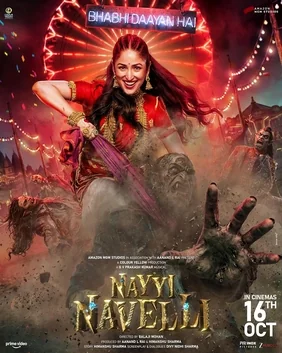
Table of Contents
Quick Facts
Plot
Nayyi Navelli opens with a premise that lands like a joke and refuses to leave: Yami Gautam Dhar plays a “shuddh desi daayan” — a pure, homegrown witch — at the centre of a family fantasy entertainer. Released on 16 October 2026, into the Dussehra weekend, the film plants its flag in India’s most beloved festive release window. The premise is deliberately rooted in Indian folklore rather than imported horror. No gothic castles, no pale Victorian ghosts — this is the daayan grandmothers warn children about, treated here with a wink instead of a scream.
The trailer sketches the story’s shape without giving away its spine. An ordinary family finds its life upended when the supernatural — in thoroughly desi form — walks through the front door. The comedy comes from the collision: sensible modern people applying everyday logic to a situation uninterested in obeying it. Adinath Kothare, Anurag Thakur, Sunita Rajwar, Sushmita Mukherjee and Mita Vashisht round out the household — a family that bickers, panics and somehow holds together while the impossible unfolds.
Performance
Everything runs through Yami Gautam Dhar, and the casting feels like the film’s smartest decision. She has built a reputation as one of Hindi cinema’s most dependable actors — intense, precise, uninterested in coasting. Playing a “shuddh desi daayan” asks her to do something new: menace with a sense of mischief, horror with comic timing. It is a tightrope part. Too scary and the family-entertainer brief collapses; too silly and the fantasy stops being believable. The trailer suggests she has found the middle of it — arch, amused, and clearly enjoying herself.
The supporting cast knows how to play Indian family chaos. Sunita Rajwar and Sushmita Mukherjee are the kind of veteran character actors who can steal a scene with a single exasperated look, and Mita Vashisht brings a formidable presence that the genre needs. Adinath Kothare, a strong performer in his own right, and Anurag Thakur complete the ensemble. In a horror-comedy the family are the audience’s stand-ins — the ones who scream, disbelieve and decide wrongly at exactly the wrong time — and this cast has the comic instincts to make it work.
Screenplay and Direction
Balaji Mohan directing a Hindi horror-comedy is an interesting match. His sensibility leans toward the playful and off-kilter — and a desi witch colliding with an ordinary family plays directly to that strength. The screenplay’s big structural decision is visible in the trailer: keep the fantasy rooted in family. The best horror-comedies are never really about the ghost or the witch; they are about the people reacting to them. The family here is not background — it is the subject, and the supernatural is the pressure that reveals who they are.
The genre is having a genuine moment in India. Audiences turn up in huge numbers for horror-comedy done well — and reject it fast when it feels lazy. The line between the two is craft: jokes that land, scares that are earned, and a story that does not mistake noise for energy. The Dussehra release date adds pressure — festive audiences arrive expecting entertainment, not homework — but it also adds opportunity. A film like this, in that window, with this cast, has every reason to connect if the writing holds.
Music
G. V. Prakash Kumar’s involvement is a quiet promise of quality. He has worked across Tamil and Hindi cinema with a versatility that suits a genre hybrid — he can write a rousing festive number, a spooky atmospheric cue and a comedy track without any of them sounding like the others. For a Dussehra release the soundtrack needs one song for the end credits while the audience is still laughing — and Prakash Kumar has the populist instincts to deliver it.
In horror-comedy, music does two jobs that fight each other. The horror needs the score to build dread — low strings, sudden stings, the classic grammar of a scare. The comedy needs the music to stay out of the way of the jokes. The skill lies in switching between the two without whiplash — or letting them collide: an ominous cue under a ridiculous situation is one of the genre’s oldest, funniest tricks. The trailer already flirts with this, treating the daayan’s appearances with mock-grandeur.
Themes
Underneath the comedy, Nayyi Navelli is playing with one of Indian folklore’s most loaded figures: the daayan. In folk tales the witch is punished, exorcised or destroyed. Reframing her as the centre of a family entertainer — a “shuddh desi daayan,” no less — is a small act of subversion. The film is, in its way, asking what happens when the monster gets to be the protagonist, and whether the stories we grew up fearing look different when told from the other side.
There is also the family at the heart of it. Festival releases in India are family occasions, and the film is built for exactly that audience: multiple generations under one roof, arguing, panicking, and ultimately sticking together. The supernatural here functions as a mirror — showing the family what it really is. Expect the daayan’s arrival to expose the household’s fault lines and then, in the genre’s time-honoured way, to help seal them up again.
Conclusion
Nayyi Navelli arrived on 16 October 2026 with genuine buzz behind it — ranked number two on IMDb’s most-anticipated Indian movies list, a Dussehra-weekend release, and Yami Gautam Dhar in a role unlike anything she has played. That combination does not come along often. The horror-comedy audience is among the most enthusiastic in Indian cinema — and the most demanding.
What it offers is straightforward: a festive entertainer built around a memorable central performance, a strong ensemble, and a premise that leans into Indian folklore. Balaji Mohan’s playful direction and Prakash Kumar’s music round out a package that knows exactly what it wants to be. If the jokes land and the scares earn their keep, this should be one of the season’s most enjoyable watches.