
Rudrabhishekam
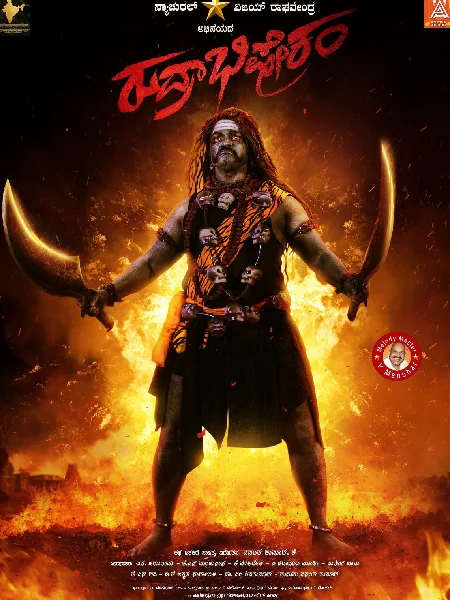
Table of Contents
Quick Facts
Plot
Rudrabhishekam is an action drama built around Veeragase, the vigorous folk art form of Karnataka, and the legend of Lord Veerabhadra that stands behind it. Vijay Raghavendra plays a dual role, father and son, in a story where tradition is not a backdrop but a living force: the drums, the dance and the devotion of Veeragase shape how the characters understand duty, anger and justice.
The film follows the son as he inherits not just his father’s name but his unfinished battles. Old rivalries, questions of honour and the weight of a folk tradition that demands everything from its performers come together in a story that moves between the performance ground and the village around it. It is a film about what a tradition costs the people who carry it, and what happens when the next generation has to decide whether to carry it at all.
What gives the story its shape is the way the folk world and the family world keep mirroring each other. A performance of Veeragase is, for its dancers, both devotion and display, and the film uses that double nature to ask what a performer owes his art and what he owes his family. The son’s journey is therefore not a simple rebellion or a simple inheritance, but a negotiation, and the film is at its most interesting when it lets that negotiation stay unresolved for a while.
Performance
Vijay Raghavendra takes on the challenge of two generations in one film, and he plays the difference between father and son with care: the father’s authority comes from years of performance and belief, while the son’s energy is younger, more questioning and quicker to anger. The contrast gives the film its emotional spine, and Raghavendra’s comfort with both the dramatic scenes and the physical demands of the role shows.
Priyanka Thimmesh, also in a dual role, matches him with a performance that gives the women of the story their own stake in the tradition, rather than leaving them on the sidelines. Bala Rajawadi and V. Manohar bring the authority of seasoned performers to the supporting cast, and the ensemble understands the world it is portraying, which matters in a film so rooted in a specific folk culture.
Screenplay and Direction
Director Vasanth Kumar K builds the film around the Veeragase tradition, and the screenplay treats the art form with respect rather than using it as decoration. The performance sequences are staged with energy, and the story lets the ritual world and the everyday world comment on each other: the same fierceness that makes a great Veeragase dancer can make a dangerous man, and the film knows it.
The direction is at its best when it stays close to the performers, letting the drums and the dance carry the emotion that dialogue cannot. The action sequences follow naturally from the story’s conflicts over honour and inheritance, and while the film follows familiar beats of the action drama, its folk setting gives those beats a texture that sets it apart from more generic entries in the genre.
The screenplay also trusts the audience to follow the folk world on its own terms, without long explanations of every ritual. That trust pays off in the performance scenes, which feel lived-in rather than staged for outsiders, and it gives the action a cultural weight that a more generic film would lack. The result is a drama that feels specific to Karnataka while telling a story any audience can follow.
Music
V. Manohar composes the music, and his work here is inseparable from the film’s folk heart. The Veeragase rhythms drive the most powerful sequences, and Manohar builds the score around percussion and traditional sounds that feel true to the world on screen, rather than pasting a standard action score over it.
The songs serve the story’s emotional turns, giving the father-son relationship and the romance their own musical space between the high-energy performance scenes. The audio, released through Anwika Audios, suits a film that wants its audience to feel the drums in their chest as much as follow the plot.
Themes
The central theme of Rudrabhishekam is inheritance: what a father passes to a son, and what a tradition demands from both. Veeragase is a fierce, devotional art, and the film uses it as a way to talk about anger itself, the anger of Veerabhadra, the anger of a wronged man, and the difference between anger that protects and anger that destroys.
Beneath the action, the film is also about belonging. The performers of Veeragase belong to a community with its own codes, and the son’s journey is about finding his place in that community without simply repeating his father’s mistakes. That tension between respect for tradition and the need to question it is the film’s most thoughtful thread.
There is also a quieter theme running beneath the drums: the idea that tradition survives only when each generation chooses it freely. A son who inherits a dance out of duty alone will perform it without soul, while a son who questions it and still returns gives it new life. The film honours both the old performers and the young questioners, and that balance is what makes its ending feel earned.
Conclusion
Rudrabhishekam stands out in the season’s Kannada releases for taking a folk tradition seriously and building a full-blooded action drama around it. Vijay Raghavendra’s dual performance and the Veeragase sequences give it an identity of its own.
For viewers who enjoy action dramas with a strong cultural root, this one is worth a theatrical watch. Go for the drums and the dance, and stay for a father-son story that understands the price of carrying a tradition forward.