
Rangasthalam
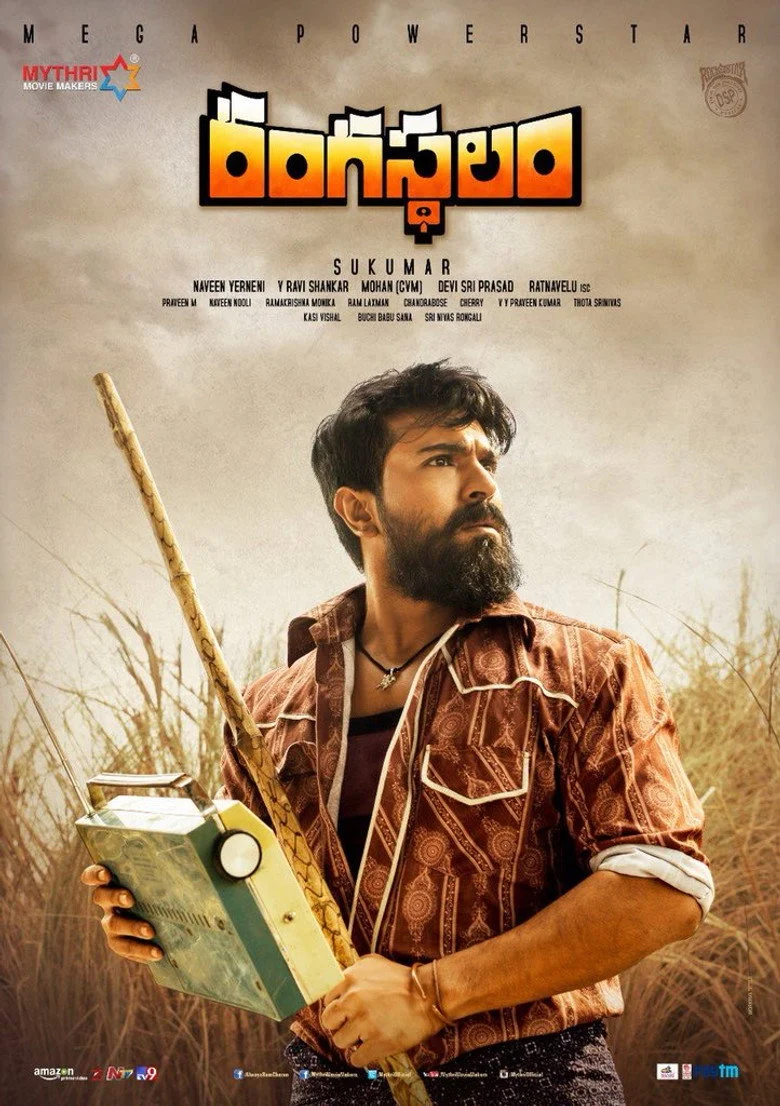
Table of Contents
Quick Facts
Rangasthalam is a Telugu period action drama directed by Sukumar, starring Ram Charan, Samantha Ruth Prabhu, Jagapathi Babu and Aadhi Pinisetty. Released on 30 March 2018 and set in a fictional village in the 1980s, it is the story of two brothers who take on a corrupt village president who has ruled for thirty years. It became one of the biggest Telugu hits of its time — made for around ₹60 crore, it grossed over ₹216 crore — and is widely regarded as Ram Charan’s finest performance and Sukumar’s most complete film.
The film won the National Film Award for Best Audiography and earned Sukumar his second Filmfare Award for Best Director – Telugu. It currently streams on Amazon Prime Video and JioHotstar.
Plot
In the village of Rangasthalam in the 1980s, Chittibabu (Ram Charan) is a cheerful, simple young man with a hearing impairment who earns his living supplying water to farmlands. He is devoted to his elder brother Kumar Babu (Aadhi Pinisetty), who returns from working abroad to find the village exactly as he left it — under the thumb of Phanindra Bhupathi (Jagapathi Babu), the president of the village’s co-operative society, who has held power for thirty years through intimidation and the quiet theft of farmers’ land and grain.
Kumar Babu decides to contest the society elections against Bhupathi, and Chittibabu — who cares for nothing but his brother’s safety — is pulled into a dangerous political war. Along the way there is Ramalakshmi (Samantha), the village girl who loves Chittibabu; Rangamma (Anasuya Bharadwaj), a fierce woman with her own grudge against the president; and a local MLA, Dakshina Murthy (Prakash Raj), whose allegiances keep shifting.
What begins as a straightforward fight between the brothers and the president grows darker and more complex, building to a climax with a genuine twist that reframes much of what came before. It is a long film, nearly three hours, but the story earns its length — every thread ties back into the central question of what loyalty costs.
Performance
Ram Charan delivers a career-best performance as Chittibabu. Playing a hearing-impaired character, he resists every temptation to overplay it — the performance is all in the eyes, the half-smile, the physicality of a man who hears the world differently. It is a complete transformation from his usual star persona, and the film’s most emotional moments belong entirely to him. Audiences who knew him only as an action star saw a genuine actor that day.
Samantha is excellent as Ramalakshmi, bringing earthiness and quiet strength to a role that could easily have been decorative. Jagapathi Babu is chilling as Bhupathi — urbane, smiling, utterly ruthless — and Aadhi Pinisetty gives the idealistic Kumar Babu real conviction. Anasuya Bharadwaj steals several scenes as Rangamma, and Prakash Raj adds his usual weight as the slippery MLA.
Screenplay and Direction
Sukumar, coming off the stylish Nannaku Prematho, went in the opposite direction here: raw, rustic and rooted. He built an entire village set in Hyderabad at a cost of around ₹5 crore and shot the film largely there, and the world feels utterly lived-in — the dusty lanes, the thatched roofs, the society office where so much of the drama plays out. It was also one of the first Indian films shot entirely on Red Helium 8K cameras, and the period texture is impeccable.
The screenplay is Sukumar at his most disciplined. He plants details early that pay off much later, keeps the political intrigue genuinely unpredictable, and structures the film around Chittibabu’s perspective so that the audience discovers the village’s rot the way he does. If there is a criticism, it is that the first hour takes its time settling in — but once Kumar Babu decides to fight, the film never lets go.
Music
Devi Sri Prasad composed one of the finest soundtracks of his career, with all lyrics by Chandrabose. The genius of it is how rooted it sounds — “Rangamma Mangamma” and “Jigelu Rani” feel like they could have been sung in a real 1980s village, while “Yentha Sakkagunnave” became a genuine chartbuster. The background score is equally strong, driving the tension in the election sequences and then pulling back for the film’s emotional moments.
Cinematographer R. Rathnavelu deserves equal billing: his earthy, sun-baked frames — all browns and golds — give the film its distinctive look, and the way he shoots Chittibabu’s world makes the village feel both beautiful and oppressive.
Themes
At its core, Rangasthalam is about power — how it is held, how it is stolen, and what it costs ordinary people. Bhupathi’s thirty-year rule is built on the co-operative society, an institution meant to serve farmers that he has turned into a machine for exploiting them. The film is quietly furious about this kind of everyday corruption, the kind that wears a smile and a white shirt.
But the film’s real subject is brotherhood. Chittibabu does not fight for ideology or justice; he fights because his brother is in danger. That simple, almost childlike devotion is what gives the film its emotional power — and what makes the climax, where loyalty and truth collide, so devastating. It is a film about how love can be both a person’s greatest strength and their greatest vulnerability.
Conclusion
Rangasthalam is a modern Telugu classic — a richly textured period drama with a gripping political plot, a career-defining performance from Ram Charan, and Sukumar’s sharpest direction. It is long, it is earthy, and it is utterly absorbing from the moment the brothers decide to fight back. If you have not seen it, it is streaming on Amazon Prime Video and JioHotstar, and it is absolutely worth your evening.
Watch the official trailer: