
Eega
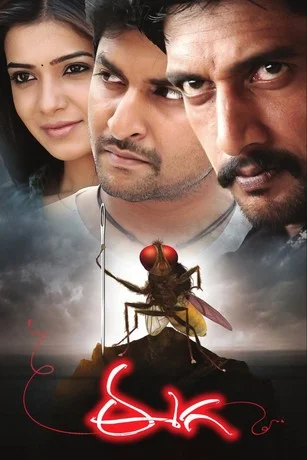
Table of Contents
Quick Facts
Eega is a Telugu fantasy action film directed by S. S. Rajamouli, starring Nani, Samantha Ruth Prabhu and Sudeep. Released on 6 July 2012, it is built on one of the wildest premises in Indian cinema: a murdered man is reborn as a housefly and sets out to take revenge on the powerful businessman who killed him. It sounds like a joke. In Rajamouli’s hands, it became one of the most inventive and beloved Telugu films ever made — a film that played at international festivals and made the world take notice of its director years before Baahubali.
Made simultaneously in Tamil as Naan Ee on a budget of around ₹26–40 crore, it went on to gross an estimated ₹125–130 crore and won the National Film Award for Best Special Effects. The film currently streams on aha, Netflix and JioHotstar.
Plot
Nani is a young man who makes fireworks for a living and has been hopelessly in love with his neighbour Bindu for two years. Bindu is a micro artist who runs Project 511, an NGO, and though she loves him back, she enjoys keeping him guessing. Their gentle romance is shattered when Sudeep, a wealthy and ruthless industrialist, becomes obsessed with Bindu, sees Nani as a rival, and has him murdered, staging it as an accident.
And then the film’s famous twist arrives: Nani is reincarnated as a housefly. What follows is a revenge story unlike any other — a fly versus a powerful man. The fly torments Sudeep with ingenious, infuriating tricks, communicates with Bindu, and gradually turns her into an ally in a war that is by turns hilarious and genuinely tense. The climax, where a tiny fly takes on a man with everything money can buy, is one of the most satisfying payoffs in Telugu cinema.
The whole thing is framed as a bedtime story a father tells his daughter, which gives the fantasy a warm, fairy-tale quality. It is a simple device, but it works: it tells you upfront that this is a fable, and invites you to just enjoy the ride.
Performance
Sudeep is the film’s live wire. Playing a villain who is gradually driven mad by a fly, he had to carry long stretches of the film essentially acting opposite nothing — and he is magnificent, shifting from suave menace to apoplectic rage with total commitment. It is one of the great villain performances in Telugu cinema, and he deservedly won a string of awards for it.
Nani and Samantha are lovely in the human half of the film; their romance is sweet and natural, which matters because the whole revenge plot only works if you care about what was lost. And then there is the real star: the fly. The visual effects team created a character with more personality than most human heroes get — brave, mischievous, heartbroken — and you will find yourself genuinely rooting for an insect by the interval.
Screenplay and Direction
This is the film where Rajamouli proved he could do anything. The idea came from his father, writer V. Vijayendra Prasad, who had joked for years about a fly taking revenge on a human — and Rajamouli took that throwaway joke and built a watertight screenplay around it. The logic of the fly’s world is worked out with obsessive care: how it sees, how it communicates, what it can and cannot do. Nothing feels arbitrary, which is why the fantasy never breaks.
The direction is playful and supremely confident. Rajamouli stages the fly’s attacks like miniature heist sequences, milks huge comedy from the premise without ever mocking it, and then lands the emotional beats — Nani’s death, Bindu’s grief — with real feeling. The visual effects, supervised by a team including Makuta VFX, were genuinely state of the art for Indian cinema in 2012 and still hold up remarkably well. It is mainstream filmmaking at its most imaginative.
Music
M. M. Keeravani’s soundtrack is full of charm. “Konchem Konchem” and “Nene Nani Ne” are lovely romantic numbers that carry the Nani-Bindu portions, and the background score does brilliant work selling the fly as a hero — giving a tiny insect a genuinely rousing theme. The music never overwhelms the film; it winks along with it.
Visually, K. K. Senthil Kumar’s cinematography deserves special mention. Shooting a film where your co-lead is a few millimetres tall required extraordinary macro work, and the film looks rich and textured throughout, from Bindu’s art-filled home to Sudeep’s gleaming corporate world.
Themes
Underneath the gimmick, Eega is a film about the refusal to be small. Nani in life was an ordinary, powerless young man; in death, as the tiniest of creatures, he becomes unstoppable. The film is really saying that willpower and love matter more than size, money or power — a classic underdog theme, delivered through the most unlikely underdog imaginable.
There is also a sly satire of power running through it. Sudeep has everything — wealth, influence, hired muscle — and he is brought to his knees by something he cannot buy, bully or kill. Watching a mighty industrialist lose a war of nerves to a housefly is not just funny; it is a gleeful reminder that arrogance is its own punishment.
Conclusion
Eega is a one-of-a-kind triumph — a film with a premise nobody else would have dared to attempt, executed with total conviction by S. S. Rajamouli. It is funny, thrilling, technically brilliant and surprisingly moving, and it remains the clearest early proof of the imagination that would later conquer world cinema with Baahubali and RRR. Whether you watch it on aha, Netflix or JioHotstar, this is one Telugu classic that absolutely lives up to its reputation.
Watch the official trailer: