
Sholay
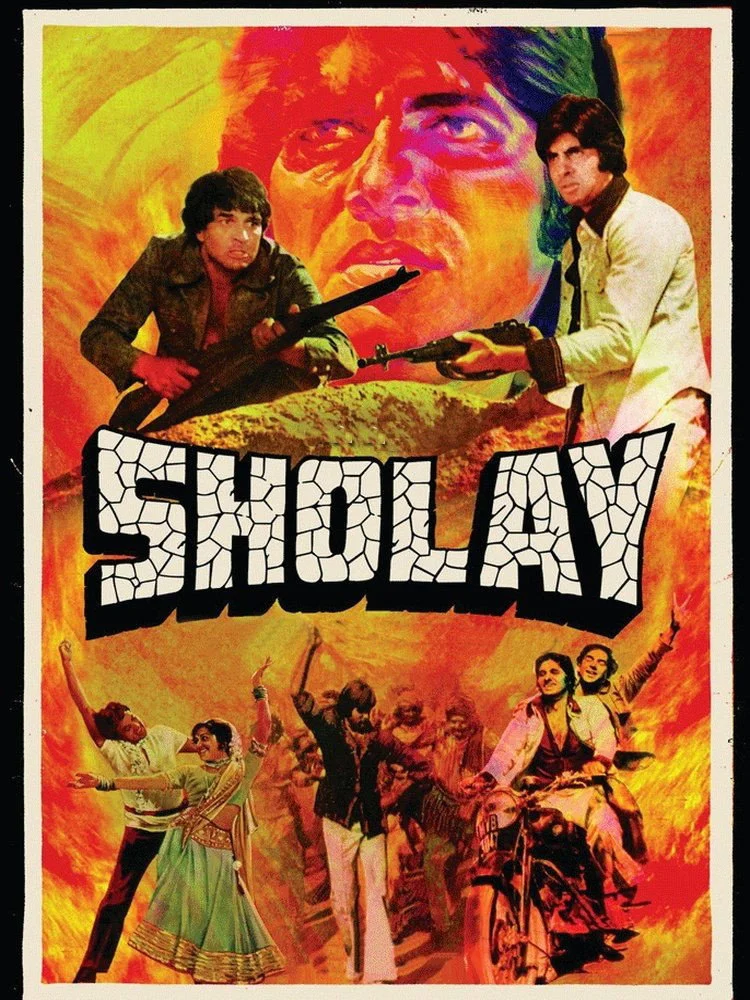
Table of Contents
Quick Facts
Sholay, released on 15 August 1975, is not merely a film — it is the shared language of Indian pop culture. Directed by Ramesh Sippy and written by the legendary duo Salim–Javed, this tale of two friends hired to protect a village from a ruthless dacoit opened to a lukewarm response and then went on to become one of the biggest blockbusters Indian cinema has ever seen. Fifty years on, its dialogues are quoted by people who were not born when it released, and its characters feel less like fiction and more like family.
The film is streaming on Amazon Prime Video (and free with ads on JioHotstar), and it remains the definitive Indian Western — part spaghetti Western, part masala epic, wholly its own thing. Jai and Veeru’s friendship is the gold standard of screen bromance, Gabbar Singh is the villain against whom all villains are measured, and Ramgarh is a village as real in our collective memory as any place on a map.
Plot
Thakur Baldev Singh (Sanjeev Kumar), an ex-policeman whose family was slaughtered by the dacoit Gabbar Singh, hires two small-time crooks — Jai (Amitabh Bachchan) and Veeru (Dharmendra) — to bring Gabbar to justice. The pair ride into the village of Ramgarh, and what begins as a job becomes a reckoning. Jai and Veeru charm the village, Veeru falls for the chatterbox tonga-driver Basanti (Hema Malini), Jai quietly loves the widowed Radha (Jaya Bachchan), and Gabbar (Amjad Khan) terrorises everyone from his rocky den.
The film builds toward one of the great finales in action cinema — the assault on Gabbar’s stronghold, the train robbery, the iconic moment when the Thakur, armless after Gabbar’s cruelty, faces his tormentor. And it carries one of the most famous twists in Indian film history: the coin. I won’t spoil how Jai’s coin flips land, but the emotional payoff is devastating and perfect, sealing the film’s reputation as an epic that also breaks your heart.
What makes the plot endure is its architecture — Salim–Javed’s screenplay is a masterclass in set-pieces connected by character. Every sequence, from the water-tank showdown to the “Mehbooba” ambush, exists to reveal who these people are. The film is over three hours long and almost no one notices.
Performance
Amitabh Bachchan’s Jai is the quiet anchor of the film — wry, understated, and quietly devastating in the final act, the performance that helped cement the Angry Young Man as Indian cinema’s defining star persona. Dharmendra’s Veeru is pure warmth and mischief, the comic heart who makes you laugh and then punches you in the gut. Their chemistry is legendary, and rightly so. Sanjeev Kumar, as the Thakur, gives a towering performance of grief and dignity with almost no melodrama.
Amjad Khan’s Gabbar Singh is one of the greatest villain performances ever put on screen — sinister, theatrical, and utterly original, from the rasping voice to the chilling “Kitne aadmi the.” Hema Malini’s Basanti is a comic treasure (“Basanti, in kutton ke saamne mat nachna”), and Jaya Bachchan does more with silence as Radha than most actors do with monologues. Every role is perfectly cast; there is not a weak link in the ensemble.
Screenplay and Direction
Salim–Javed’s screenplay is arguably the greatest ever written for an Indian film — tight, quotable, and structurally brilliant, with a villain introduction and a final act that filmmakers still study. Ramesh Sippy directs with a scale Indian cinema had rarely attempted: the rocky terrain, the horse chases, the train sequence that cost a fortune and justified every rupee. He took the Hollywood Western and gave it Indian soul without diluting either.
The pacing is relentless despite the runtime, and the film juggles comedy, romance, horror and tragedy without dropping a single thread. That it initially underperformed only adds to the legend — word of mouth turned it into a phenomenon, proving that audiences recognise greatness even when critics hesitate. The recent 4K “Final Cut” restoration has only sharpened its power.
Music
R. D. Burman’s score is monumental. “Yeh Dosti,” “Mehbooba Mehbooba,” “Holi Ke Din,” “Koi Haseena Jab Rooth Jaati Hai” — every song is iconic, and the background score’s tension is as famous as the songs themselves. The music never feels decorative; it drives the film forward, from the ominous Gabbar motif to the soaring friendship anthem that defines Jai and Veeru.
Visually, the film is stunning — the rugged landscapes of Ramgarh shot with a painter’s eye, the action choreographed with a visceral punch, and the famous frames (the tank, the sunset, the final confrontation) etched permanently into Indian visual memory.
Themes
Sholay is about loyalty, revenge and the cost of both. Jai and Veeru begin as mercenaries and end as brothers-in-arms; the Thakur’s quest for justice asks whether vengeance ever truly heals. Underneath the adventure runs a meditation on friendship as the highest virtue — Jai and Veeru’s bond transcends money, danger and death itself. It is also a film about the little guy standing up to tyranny, which is why Ramgarh’s courage still resonates in every generation.
Conclusion
Sholay is the Mount Everest of Hindi cinema — a film so complete, so beloved, that it defines the medium itself. Epic action, immortal comedy, heartbreaking drama, unforgettable music, and characters who walked off the screen into Indian folklore. If you have seen it, watch it again — the 50th-anniversary restoration is the perfect excuse. If you somehow haven’t, stop whatever you are doing. Kitne aadmi the, indeed.
Watch the official trailer: