
Dasavathaaram
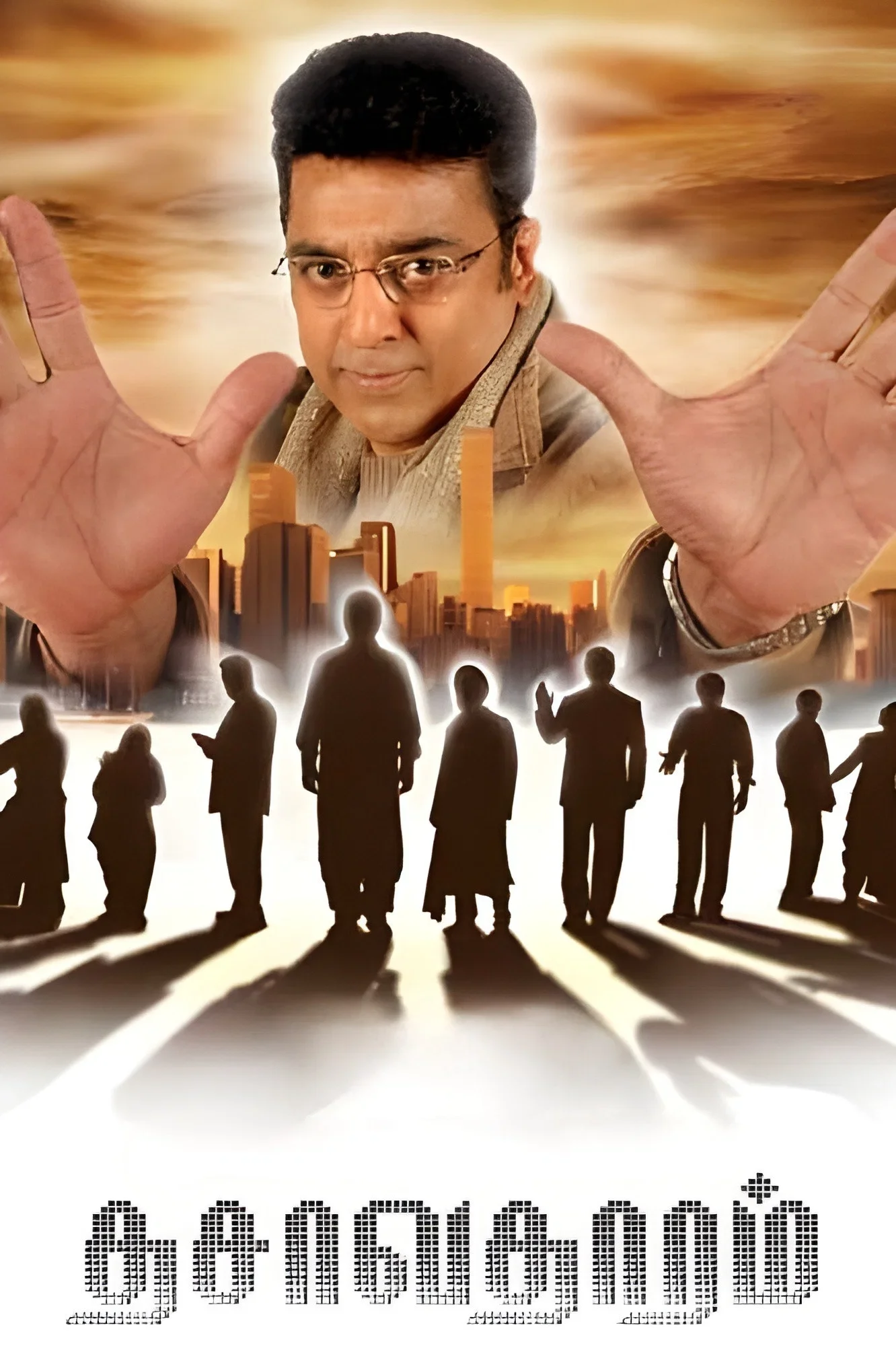
Table of Contents
Quick Facts
Dasavathaaram is a Tamil science-fiction action film directed by K. S. Ravikumar and written by Kamal Haasan, who plays ten different roles — from a 12th-century priest to the American President. Released on 13 June 2008, it was the most ambitious Tamil production of its time, a globe-spanning thriller about a stolen bio-weapon that builds to a climax during the 2004 Indian Ocean tsunami.
The film is now streaming on Sun NXT. Whatever its flaws, Dasavathaaram remains unmatched in Tamil cinema for sheer scale of ambition: no other film has asked so much of a single actor, or tried to fuse ancient history, modern science and disaster spectacle into one narrative.
Plot
In 12th-century Kanchipuram, the Vaishnavite priest Rangarajan Nambi is drowned for opposing the Chola king’s religious persecution — but not before he flings a sacred idol of Vishnu into the sea, setting in motion a chain of events across nine centuries. In the present day, scientist Govind Ramasamy discovers that his research has been weaponised into a deadly virus, and steals the vial to keep it from falling into the wrong hands.
What follows is a chase across America and India, as mercenaries, intelligence agents and fanatics all hunt the vial. Along the way we meet the other avatars: Balram Naidu, a blustering RAW officer; Krishnaveni Paati, a frail old woman; Shingen Narahazi, a Japanese martial arts master; Christian Fletcher, a ruthless ex-CIA mercenary; Khalifullah, a Muslim strongman; Vincent Poovaraghavan, a Dalit activist; Avatar, a pop singer; and even George W. Bush. The threads converge in Chennai on 26 December 2004, as the tsunami strikes — and the ancient idol, the modern virus and nine centuries of history collide in the film’s spectacular finale.
The film’s central idea — drawn from chaos theory, that a butterfly flapping its wings can cause a storm — is stated outright: small actions ripple across centuries. It is a big, heady concept for a commercial entertainer, and the film commits to it fully.
Performance
Kamal Haasan’s ten-role performance is a technical marvel. The prosthetics — designed with Hollywood expertise — transform him completely: the wheezing old Krishnaveni Paati, the swaggering Balram Naidu (a character so popular he later got his own spin-off plans), the menacing Fletcher. Each avatar has a distinct voice, walk and comic timing. That Kamal keeps them all dramatically coherent while also carrying the film’s emotional through-line as Govind is a feat no other Indian actor has attempted at this scale.
Asin is sincere as the Brahmin girl Andal who aids Govind, Mallika Sherawat brings glamour and surprising comic bite as the mercenary Jasmine, and Jaya Prada lends dignity to her role. Napoleon is imposing as the Chola king Kulothunga in the historical prologue. The supporting cast serves the spectacle well, but this is unmistakably a one-man show — by design.
Screenplay and Direction
Kamal Haasan’s screenplay is wildly ambitious — perhaps too ambitious. Juggling ten characters across two timelines and two continents, the narrative occasionally buckles under its own weight, and the middle portions sag with exposition. But K. S. Ravikumar, a veteran of commercial cinema, keeps the chase mechanics propulsive, and the film’s set-pieces — the 12th-century temple sequences, the tsunami climax — are staged with genuine scale.
The tsunami sequence deserves special mention: recreating the 2004 disaster as the backdrop for the climax was a bold choice, handled with surprising taste, and it gives the film an emotional gravity that pure spectacle could never achieve. The visual effects, cutting-edge for Tamil cinema in 2008, hold up remarkably well.
Music
In an unusual arrangement, Himesh Reshammiya composed the songs while Devi Sri Prasad handled the background score. The songs — including the rock number “Kallai Mattum” and the romantic “Oh… Ho…” — are catchy without distracting from the thriller momentum. DSP’s background score is the real star: propulsive during the chases, mournful in the historical portions, and thunderous in the climax.
The score’s fusion of traditional South Indian instrumentation with modern electronic textures mirrors the film’s own collision of ancient and modern.
Themes
Dasavathaaram is about the interconnectedness of all things — the butterfly effect made mythic. The ten avatars of Vishnu become ten avatars of one actor, suggesting that divinity and humanity, past and present, are all facets of a single continuum. Beneath the action, the film is a warning about science without conscience: Govind’s virus is the modern equivalent of the king’s religious violence — power divorced from responsibility. And in making the tsunami the climax, the film humbles all its human scheming before nature’s indifference.
Conclusion
Dasavathaaram is flawed but fascinating — a film that reaches further than any Tamil blockbuster before it and mostly manages to grasp what it reaches for. Kamal Haasan’s ten performances alone make it essential viewing, and the tsunami climax is genuinely moving. It may not be the tightest thriller ever made, but it is certainly one of the most audacious. For ambition alone, it deserves its place in Tamil cinema history.
No official trailer is available for this film on a studio or rights-holder channel, so no video is embedded here. We would rather leave the space empty than link to a fan-made upload.