
Vishwanath & Sons
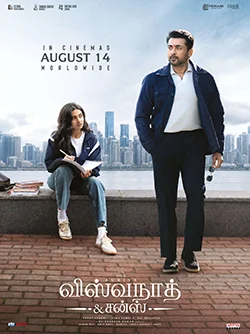
Table of Contents
Quick Facts
Plot
Sanjay Vishwanath is a successful international pistol shooter in his forties, a man who has built his life on discipline and achievement. When his young son is diagnosed with a serious illness and needs a bone marrow transplant, Sanjay’s ordered world is turned upside down.
His search for a donor takes him abroad, where he meets Maddy, a free-spirited young woman played by Mamitha Baiju. What begins as an unlikely friendship slowly grows into something deeper, forcing Sanjay to ask himself what happiness actually means when duty, love and ambition pull in different directions.
The shooting backdrop is more than a detail. Sanjay’s career as a pistol shooter mirrors his character: controlled, precise and used to performing under pressure, until life asks him to perform in a way no competition ever could.
Performance
Suriya gives one of his warmest performances in years. He plays Sanjay with a relaxed, vulnerable charm, letting the character’s humour and doubt show instead of hiding behind star mannerisms. It is a mature turn, and it suits him.
Mamitha Baiju matches him with fresh energy, and their chemistry carries the film’s romantic thread. Radhika Sarathkumar, Raveena Tandon and Nassar add weight to the family portions, making the world around the leads feel real.
Radhika Sarathkumar and Raveena Tandon bring a lived-in quality to the family scenes. Their presence gives the film its emotional grounding, and their scenes with Suriya are among its warmest.
Screenplay and Direction
Venky Atluri directs with a light, old-school touch. The first half is the stronger stretch, full of witty dialogue and charming family scenes, and the film is at its best when it simply lets its characters talk.
The second half slows down and leans on melodrama, and the writing never quite digs as deep as its premise promises. Atluri plays the age-gap romance safely, which keeps the film comfortable but stops it from becoming truly memorable.
Atluri’s strength is dialogue. The conversations in this film feel written by someone who enjoys how people actually talk, argue and make up, and those scenes carry the film through its slower stretches.
Music
G. V. Prakash Kumar’s music is gentle and melodic, perfectly matched to the film’s mood. The songs are soft and hummable, and the background score knows when to stay quiet and let a look or a pause do the work.
The score is one of the film’s quiet strengths. It never pushes the emotion, which is exactly what a story like this needs.
The songs also serve as breathing space in the film. They arrive when the story needs a pause, and GV Prakash’s melodies give the audience a moment to sit with the characters’ feelings.
Themes
At its heart, the film asks what a life well lived looks like. Sanjay has medals, money and respect, but the film suggests that none of those things matter as much as the people waiting for him at home.
It also treats its unusual romance with care, never turning it into a joke and never rushing it. The film’s message is simple: happiness is not a prize to be won, but a choice to be made, again and again.
The film also treats age and experience with respect. Sanjay is not a man trying to be young again; he is a man learning that maturity can mean changing his mind, and that is a rarer story than it should be.
Conclusion
Vishwanath & Sons is a warm, clean and thoroughly pleasant family entertainer. It may not break new ground, but it does its job with charm and sincerity.
For Suriya fans and family audiences, it is an easy, feel-good watch, and one of the most likeable Tamil films of 2026.
After its successful theatrical run, Vishwanath & Sons arrived on Netflix, where it has found a wide family audience. It is a gentle film, best watched with the family on a quiet evening.
What lingers after Vishwanath & Sons is its gentleness. In a year full of loud, violent blockbusters, here is a film that believes a conversation can be as dramatic as a fight, and a look can carry as much weight as a punch. Suriya’s restraint is the film’s quiet triumph, and Mamitha Baiju’s freshness gives it its spark. It is not a film that shouts for attention, but one that earns affection slowly, scene by scene, until you realise you have come to care deeply about people who felt like strangers an hour earlier.
Warm, gentle and well performed, Vishwanath & Sons is the kind of film Tamil cinema does best when it trusts its actors. It may be soft around the edges, but its heart is in the right place.