
Good Time
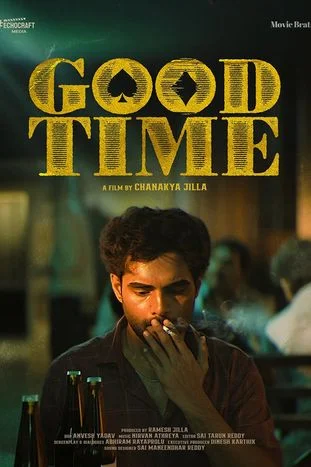
Table of Contents
Quick Facts
Plot
Good Time is a Gen-Z slice-of-life entertainer that unfolds over two roller-coaster days in the life of Jaani, a young cab driver in Hyderabad. Jaani, played by Nikhil Gajula, is a middle-class young man who wastes his earnings on betting and borrows money to buy expensive gifts for his girlfriend, Nischala, played by Anyuktha Nallani. It is a familiar pattern of living beyond one’s means to impress someone, and the film follows where that pattern leads when it finally catches up with him.
When Jaani’s lender, Ganga, demands repayment, Jaani and his mother face serious financial trouble. How they overcome these struggles, and how Rukmini, played by Soundharya Lahari, changes Jaani’s life, forms the rest of the story. Set in Alwal, a suburb of Hyderabad, the film stays close to the ground: its drama comes from money, pride, love and the small choices that turn a bad week into a crisis.
Performance
Nikhil Gajula makes an impressive debut as a lead hero with Good Time, playing Jaani with a natural, unforced energy. He is convincing both as the carefree young man spending money he does not have and as the son who has to face what his choices have done to his mother. It is a performance that works because it never tries too hard: Jaani feels like someone you might actually know.
Anyuktha Nallani makes a good debut as Nischala, while Soundharya Lahari brings warmth to Rukmini, the character who shifts Jaani’s perspective. Sunitha Manohar stands out as Jaani’s mother, giving the film its emotional anchor, and Hrithik Shetty, Dhanraj Vineeth and the supporting cast fill out Jaani’s world with believable, everyday characters.
Screenplay and Direction
Chanakya Jilla writes and directs Good Time from a place of personal experience, and that shows in the film’s best moments. The screenplay, with dialogues by Abhiram Rayaprolu, focuses on Gen-Z issues that rarely get honest treatment in Telugu cinema: gambling, spending beyond one’s means to impress a partner, and the slow weight of debt. The director’s biggest strength is realism: the Hyderabad setting, the cab-driver’s life, and the family scenes all feel observed rather than invented.
The film’s structure, two days of escalating trouble, keeps the pace tight, though the bike-racing climax has been noted as a weaker stretch. Where the film works best is in its quieter passages, especially the track involving Rukmini and the philosophy shared by her father, which gives Jaani’s story a reflective side. Chanakya Jilla directs with confidence for a film of this scale, and the cinematography gives the city a fresh, lived-in look.
Music
Nirvan Athreya composes the music for Good Time, and the soundtrack fits the film’s youthful, street-level energy. The song Palaate, sung by MC Hari with lyrics by Chaitanya Kondapi, captures the film’s playful side, while the background score carries the tension of Jaani’s financial spiral. The music never overwhelms the story; it works as part of Jaani’s world, the way songs on a cab radio or at a gathering would.
The score’s real job is emotional rather than spectacular. It has to make the audience feel both the fun of Jaani’s careless days and the anxiety when the bills come due, and Athreya handles that shift with a light touch. It is a soundtrack that supports the film’s slice-of-life ambitions rather than trying to turn it into something bigger than it is.
Themes
Good Time is about the gap between the life we show and the life we can afford. Jaani’s betting and borrowing are not presented as villainy; they are presented as a young man’s attempt to look successful, to impress a girlfriend, and to keep up with a world that rewards appearances. The film’s sympathy for Jaani makes its warning land harder: the problem is not that he is a bad person, but that small bad decisions compound.
The film also explores family as a safety net and a mirror. Jaani’s mother bears the consequences of his choices, and Rukmini’s presence forces him to see himself differently. The story suggests that growing up is less about one dramatic transformation and more about finally taking responsibility for the messes we make, and for the people who have to clean them up with us.
Conclusion
Good Time is a small, honest film that deserves more attention than it got. Nikhil Gajula’s natural debut, Chanakya Jilla’s realistic direction, and a story that speaks directly to young audiences make it a refreshing watch. It is not a big-screen spectacle, but it is a film that understands its characters and its city, and that understanding carries it a long way.
For viewers who like realistic, youth-focused dramas with humour and heart, Good Time is well worth seeking out. It is a reminder that the most relatable stories are often the smallest ones, told well. Watch it when it reaches streaming, or catch it in theatres while it runs.