
Ranabaali
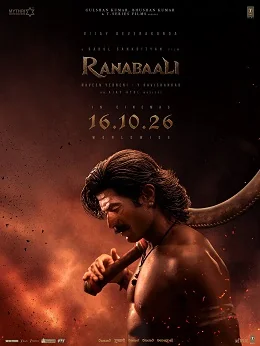
Table of Contents
Quick Facts
Plot
Ranabaali opens in a Rayalaseema village during the Great Madras Famine of the 1870s, when drought, hunger and British taxes have pushed ordinary people to the edge of survival. Into this harsh world comes Ranabaali, played by Vijay Deverakonda, a fierce young man whom the villagers look upon almost like a figure from an old folk tale. He is not a prince or a soldier by birth; he is a son of the soil who refuses to watch his people starve while grain is taken away and officers grow rich on their suffering.
The story follows Ranabaali as he takes up arms against the colonial administration, led by the ruthless Sir Theodore Hector, played by Arnold Vosloo. Alongside him stands Jayamma, played by Rashmika Mandanna, his wife and his emotional anchor, who carries the hopes of their family and village on her shoulders. As the rebellion grows, the film moves between large battle sequences and quieter moments at home, asking what it costs a man to become a legend, and what it costs the people who love him.
Performance
Vijay Deverakonda throws himself completely into the title role, and even the film’s critics agreed that his commitment is the strongest thing about it. He plays Ranabaali with a raw, physical energy, and the transformation in his look and body language is hard to miss. In the action scenes he is convincing as a warrior, and in the emotional scenes with Jayamma he shows a softer side that keeps the character human instead of turning him into a mere symbol of revolt.
Rashmika Mandanna gives Jayamma warmth and dignity, and her chemistry with Deverakonda, familiar to audiences from their earlier films together, gives the love story its heart. Arnold Vosloo makes for a cold, believable colonial villain, while Jason Shah and Easwari Rao add weight in supporting roles. The cast is not the problem here; the performers do their best with the material they are given, and the film rests on their shoulders from start to finish.
Screenplay and Direction
Rahul Sankrityan directs Ranabaali with clear ambition. He has picked a chapter of history that rarely appears in mainstream Telugu cinema, the famine that killed lakhs of people in the Madras Presidency, and he wants the audience to feel that suffering rather than simply watch a hero fight. The production values are grand, the village and the period detail look authentic, and some of the pre-interval and climax moments land with real force.
Where the film struggles, as reviewers repeatedly noted, is in its screenplay and pacing. The narration moves slowly in the first half, the second half turns predictable, and at nearly three hours the film feels longer than its story needs. The violence, too, is excessive for some viewers, and the editing could have been sharper. Sankrityan’s intentions are sincere and the final half hour has genuine power, but a tighter script would have made this a much stronger film.
Music
Ajay-Atul compose the music for Ranabaali, and their score aims for the same large scale as the visuals. The songs carry the flavour of the period setting, and the background score tries to lift the battle sequences and the emotional beats alike. In the film’s best moments, the music does add to the drama, especially in the mass sequences where the hero’s rise is meant to feel larger than life.
That said, the music divided opinion. Some critics found the score ineffective in places and felt it added to the sense of excess rather than sharpening the emotion. The songs have not become the film’s main talking point; the visuals and Deverakonda’s performance have. Still, for a period action drama of this size, the soundtrack does its job of keeping the scale feeling big, even when the story itself slows down.
Themes
At its heart, Ranabaali is about hunger as a weapon. The film shows how food grain became a tool of control during the famine, with officers walking over grain while villagers starved, and it asks the audience to remember a tragedy that history books often skip. Ranabaali’s rebellion is therefore not just about one village; it is about dignity, about refusing to accept that some lives matter less than others when food runs short.
The film also explores what it means to be called a savage by those in power. The British officers see Ranabaali as a wild threat, but the film presents him as a man shaped by loss and injustice. His marriage to Jayamma adds another layer: the responsibility of carrying a family forward while fighting a war he cannot win alone. These themes give the film a seriousness that sets it apart from a routine action entertainer, even if the telling is uneven.
Conclusion
Ranabaali is an ambitious period action drama that reaches for something bigger than a festival entertainer. Vijay Deverakonda’s committed performance, the grand production values, and a rarely told historical backdrop make it worth a watch for fans of large-scale Telugu cinema. The film looks and feels big, and its heart is in the right place.
At the same time, viewers should know what they are walking into: a long, violent film with a slow first half and a predictable second. If you go in for Deverakonda’s screen presence and the historical setting, there is plenty to admire. If you want a tight, fast-moving story, the film’s flaws will show. Either way, Ranabaali is a sincere attempt to bring a forgotten famine to the big screen, and that ambition alone makes it stand out in the Dasara season.