
Pushpa: The Rise
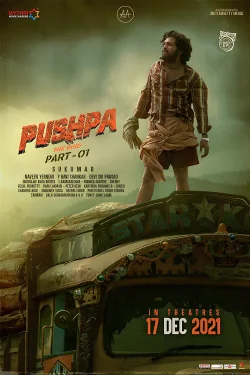
Table of Contents
Quick Facts
Pushpa: The Rise is a Telugu action drama written and directed by Sukumar, starring Allu Arjun in the title role alongside Rashmika Mandanna and Fahadh Faasil. Released on 17 December 2021, it is the first of a two-part saga — and the third collaboration between Sukumar and Allu Arjun after Arya and Arya 2. Set against the red sandalwood smuggling trade of Andhra Pradesh’s Seshachalam Hills, it turned a rooted crime story into a national phenomenon.
The film grossed an estimated ₹350–360 crore worldwide, finishing as the highest-grossing Indian film of 2021. Allu Arjun won the National Film Award for Best Actor — the first Telugu actor to win the honour — and Devi Sri Prasad won for Best Music Direction. A sequel, Pushpa 2: The Rule, followed in December 2024.
Plot
In the late 1990s, Pushpa Raju is a fiercely proud daily-wage labourer in the forests of Chittoor who starts out cutting red sandalwood with his friend Kesava. Under mid-level smuggler Konda Reddy, he rises fast — outsmarting DSP Govindappa at police checkpoints with ingenious smuggling tricks. Regional kingpin Mangalam Srinu takes notice, but success breeds jealousy: Konda Reddy’s younger brother Jaali Reddy sabotages a shipment to get Pushpa arrested, and Pushpa survives only by his wits.
Along the way, Pushpa falls in love with Srivalli, a local milk vendor. Their engagement is violently disrupted when Pushpa’s half-brother Mohan publicly denies him the family surname, exposing his illegitimate birth and injuring his mother Parvatamma. Humiliated, Pushpa quits Srinu’s network and sells directly to Murugan, an international buyer in Chennai. After exposing Srinu’s embezzlement to MP Siddhappa Naidu, Pushpa is handed control of the entire smuggling syndicate.
The final act brings a new enemy: Bhanwar Singh Shekhawat, a ruthless police officer who treats Pushpa as an inferior criminal and insults his lineage. On his wedding night, Pushpa turns the tables — luring Shekhawat aside, forcing him to strip to his underwear before stripping himself, declaring that Shekhawat’s authority lives only in his uniform while Pushpa’s self-respect is his own. Shekhawat burns Pushpa’s bribe money and vows revenge. When Srivalli asks if their struggles are over, Pushpa answers that the war has only just begun.
Performance
This is Allu Arjun’s film in every frame. He plays Pushpa Raju with a rough Chittoor accent, a bearded, weathered look, and body language that shifts between playful swagger and cold menace. It is a complete physical and emotional transformation — he made Pushpa’s defiance feel personal rather than performed. The National Film Award was richly deserved: a career-redefining turn.
Rashmika Mandanna brings warmth and earthiness to Srivalli, playing the village girl with a charm that never feels like a caricature — she learned a new dialect for the role too. Fahadh Faasil, making his Telugu debut, arrives late as Shekhawat but makes every minute count: a bald, moustached, genuinely frightening presence whose humiliation sets up the entire second part. Sunil is excellent as the two-faced Mangalam Srinu, and Samantha Ruth Prabhu’s special appearance in the “Oo Antava Oo Oo Antava” number became one of the most talked-about moments of the year.
Screenplay and Direction
Sukumar directs with the confidence of a filmmaker who did his homework. The subject — red sandalwood smuggling — came from real incidents he read about in Andhra Pradesh, and he even scouted the Nallamala Hills personally while developing what was briefly conceived as a web series. That research shows: the checkpoint tricks and the syndicate’s hierarchy feel lived-in and specific. He stages the elevation moments with patience, letting tension build before the release, and the interval block and the wedding-night confrontation are masterclasses in mass filmmaking.
At 179 minutes the screenplay is not without flab — critics at the time noted the loose plotting and some echoes of the KGF template. But the emotional engine — a man denied dignity fighting for it on every front — is strong enough to carry the runtime. Miroslaw Kuba Brozek’s cinematography gives the forests a raw, dusty texture, and Peter Hein’s action choreography keeps the set pieces inventive and grounded.
Music
Devi Sri Prasad’s album was a phenomenon in itself. “Srivalli” (sung by Sid Sriram) became a nationwide earworm, “Saami Saami” (Mounika) and “Daakko Daakko Meka” (Shivam) ruled the charts, and “Oo Antava Oo Oo Antava” (Indravathi Chouhan) was inescapable. The songs were hits long before the film released, and DSP’s background score — all swagger and percussion — became inseparable from Pushpa Raj’s walk. The National Film Award for Best Music Direction was no surprise, and Resul Pookutty’s sound design gives the action a thunderous quality built for theatres.
Visually, the film commits fully to its world: the Maredumilli forests and Ramoji Film City sets create a believable, dusty underworld, grounded by production design from Sukumar’s Rangasthalam team.
Themes
Above everything, Pushpa: The Rise is about dignity. Pushpa’s entire empire is a response to a wound — the illegitimate son who was denied his father’s name, publicly humiliated at his own engagement. His famous line “Thaggedhe Le” (roughly, “we won’t back down”) trended across the country because it captured that refusal to bend. The film also explores the corruption of everyone from police to politicians, and how power reshuffles loyalty.
There is a sharp thread about identity and class too: a coolie who builds an empire but is still measured by his birth. The love story with Srivalli gives the film its heart — she loves the man, not the kingpin, and that bond is the one thing money and power cannot buy.
Conclusion
Pushpa: The Rise took a regional crime story and turned it into a national event. Allu Arjun’s career-best performance, Sukumar’s rooted-yet-massy direction, a chart-topping Devi Sri Prasad album and Fahadh Faasil’s chilling late entry delivered the highest-grossing Indian film of 2021, with seven Filmfare Awards South and two National Film Awards to its name. Yes, it is long and the plotting occasionally meanders — but few star vehicles of the decade have connected this widely. It is currently streaming on Amazon Prime Video.
Watch the official trailer: