
Dia (2020) – Movie Info, Cast, Trailer & Where to Watch
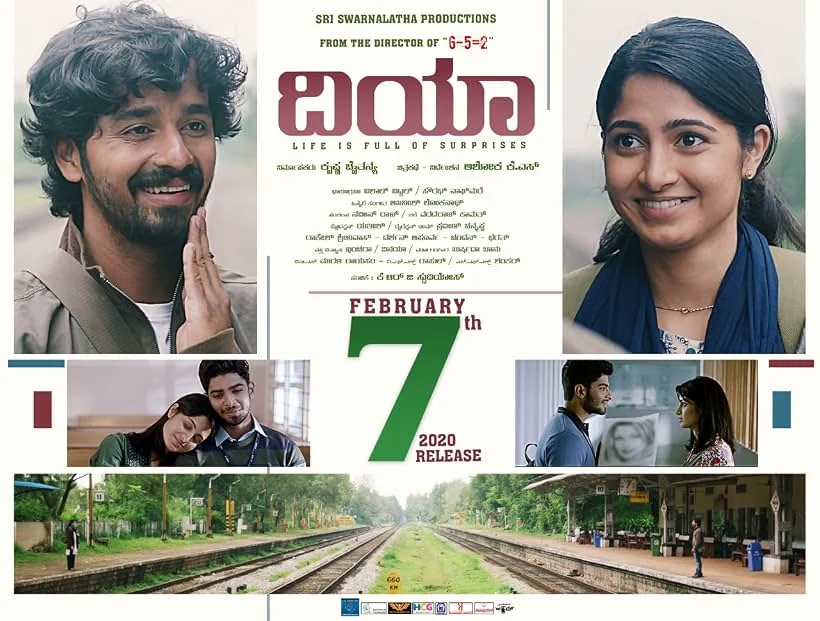
Table of Contents
Quick Facts
Few films have misled their audiences as beautifully as Dia. It arrived on 7 February 2020 looking for all the world like a gentle college romance, and audiences settled in for exactly that. What they got instead was one of the most devastating love stories in recent Kannada cinema — a sleeper hit whose theatrical run was cut short by the pandemic, only to find a second life when it re-released in 2021 and then on streaming. It has since been remade three times: in Telugu as Dear Megha (2021), in Hindi as Dear Dia (2022, with Pruthvi Ambaar reprising his role), and in Marathi as Sari (2023).
The debut of Kushee Ravi, the film that confirmed B. Ajaneesh Loknath as one of the finest composers working in Kannada cinema, and a calling card for director K. S. Ashoka — Dia did all of this without a single commercial song. Ajaneesh’s background score carries the entire emotional weight of the film, and the famous “Soul of Dia” theme, released afterwards, is worth hearing on its own.
Plot
Dia Swaroop, played by Kushee Ravi, is a shy, introverted biotechnology student in Bengaluru who has spent three years silently loving her senior Rohit, played by Dheekshith Shetty, without ever telling him. The film’s first stretch is a tender, almost wordless portrait of unrequited feeling — glances, near-misses, the small agony of loving someone from a distance.
Years later, working in Mumbai, Dia runs into Rohit again, and the story takes its first turn: they fall in love, and for a while the film lets you believe this is a straightforward romance. Then comes the accident. Rohit is left brain-dead, and Dia’s father, desperate to save his daughter from a life of grieving over a coma patient, has a friend lie to her that Rohit died. She believes it, and the grief breaks her. She spirals into depression and, in the film’s bleakest sequence, attempts to end her life at a railway crossing in Bengaluru.
She is saved by a phone call — Adi, played by Pruthvi Ambaar, the warm young man who recovered her stolen bag and kept calling. Against every instinct she has, Dia lets herself be loved again, and their relationship is one of the most genuinely sweet romances in recent memory. Then comes the twist the film is famous for: Rohit is alive. Dia returns to Mumbai and finds him waiting at her apartment — not dead at all, recovering, and still in love with her. He is the one who makes the selfless choice, telling her she belongs with Adi and stepping aside. Just when it seems the film will let its lovers be happy, the final blow lands: Adi, consumed by guilt over the death of his mother, Dr. Lakshmi, played by Pavithra Lokesh — he believes he failed her — takes his own life at the same railway crossing where Dia nearly died. She arrives calling his name. The film ends there, in silence.
Performance
Kushee Ravi’s debut is the kind of performance that makes you forget you are watching an actor. Dia speaks little, and Kushee plays her silence — the downcast eyes, the half-smiles, the way grief hollows her out — with extraordinary control. She won the SIIMA Critics Award for Best Actress, and nobody who saw the film was surprised.
Pruthvi Ambaar is the film’s warmth: Adi could have been a thankless rebound character, but Pruthvi makes him the person the whole film’s heart beats for. Dheekshith Shetty is quietly excellent as Rohit, dignified in a role that could have turned bitter, and Pavithra Lokesh brings real grace to Adi’s mother, Dr. Lakshmi “Lucky,” in a role that turns out to matter far more than it first appears.
Screenplay and Direction
K. S. Ashoka structures Dia like a trap: the first half is a familiar romance, the second half dismantles everything you thought you were watching. The railway crossing motif — the place where Dia nearly dies and where Adi finally does — is one of the boldest recurring images in recent Indian cinema, and the film never explains it; it just keeps returning to those tracks. The pacing is deliberate to the point of being meditative, which is either the film’s greatest strength or its biggest demand on the viewer, depending on your temperament.
The famous complaint is that the ending is cruel, and it is — deliberately so. But the cruelty has a logic. This is a film about what love costs and what it cannot save, and the last scene, with Dia screaming Adi’s name on those tracks, is one of the most seared-into-memory images Kannada cinema has produced. It does not flinch, and it does not offer comfort.
Music
Ajaneesh Loknath’s score is the film’s second script. With no commercial songs at all — a genuine rarity — the music has to do everything: the shyness of first love, the terror of loss, the slow thaw of new happiness, the final devastation. His themes are minimal and recurring, almost classical in construction, and they do the emotional heavy lifting that dialogue refuses to do. The “Soul of Dia” theme, released after the film, became something of a phenomenon on its own, and it is easy to hear why.
The visual style matches the restraint: Bengaluru and Mumbai rendered in soft, unshowy naturalism, the camera lingering on faces rather than spectacle. The film looks the way heartbreak feels — a little out of focus at the edges.
Themes
Dia is about love in all its asymmetry: the love that goes unspoken for three years, the love that survives a death that never happened, the love that steps aside, and the guilt that love cannot cure. Adi’s death is the film’s hardest thesis — that some wounds are not about romance at all, but about a son who could not forgive himself for his mother’s death.
Conclusion
It is not an easy watch, and it is not meant to be. But Dia is one of the defining Kannada films of its era — a romance that trusts its audience enough to break them. It is currently streaming on Amazon Prime Video. Keep tissues nearby.
Watch the official trailer: