
Thevar Magan
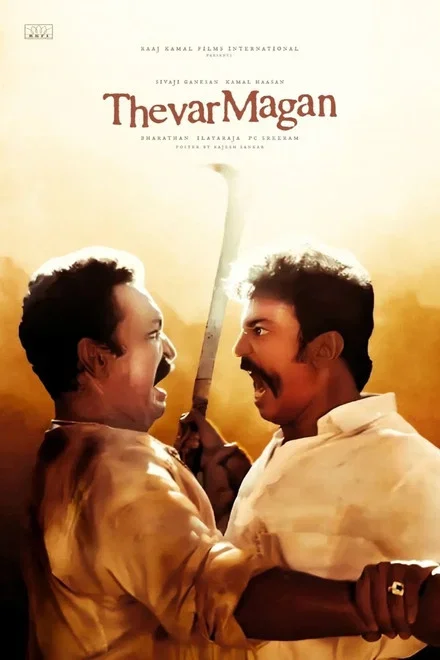
Table of Contents
Quick Facts
Thevar Magan is a Tamil action drama directed by Bharathan and written by Kamal Haasan, starring Sivaji Ganesan and Kamal Haasan as a village chieftain and the London-educated son who reluctantly inherits his throne. Released on 25 October 1992, it won the National Film Award for Best Supporting Actress for Revathi and was later remade in Hindi as Virasat. It is one of the defining village epics of Tamil cinema.
The film is not currently streaming on any major OTT platform. What makes it endure is its tragic architecture: a modern, educated man who wants nothing to do with feudal violence, pulled inch by inch into the very cycle he despises — until he becomes what he swore he would never be.
Plot
Sakthivel returns from London to his ancestral village in Theni, dreaming of opening a chain of restaurants with his girlfriend Bhanumathi. His father, Periya Thevar, is the village’s revered and feared chieftain, locked in a generations-old feud with the neighbouring village led by the ruthless Maya Thevar. Sakthi wants no part of it — he is a modern man, embarrassed by the caste pride and blood feuds of his homeland.
But the village has other plans. Maya Thevar’s provocations escalate; Periya Thevar’s health fails; and the mantle of leadership falls on Sakthi whether he wants it or not. His gentle wife Panchavarnam watches her husband transform. By the time Sakthi finally confronts Maya Thevar, he has lost his father, his dreams and his innocence — and the film’s devastating final act shows him embracing the violence he once condemned, not in triumph but in tragic resignation.
The story is often compared to The Godfather, and the comparison is fair: both are about the reluctant heir, the transfer of power sealed in blood, and the terrible cost of duty. But Thevar Magan is rooted specifically in the soil of southern Tamil Nadu — its feuds, its honour codes, its panchayats — which gives it an authenticity no adaptation could borrow.
Performance
Sivaji Ganesan, in one of his last great roles, is monumental as Periya Thevar. Frail in body but iron in will, he dominates every scene — the scene where he addresses the village assembly, voice trembling with age and authority, is a masterclass. Kamal Haasan matches him as Sakthivel, charting the character’s journey from amused outsider to broken chieftain with heartbreaking precision. Watch his face in the climax: there is no victory in it, only grief.
Revathi won the National Film Award for Best Supporting Actress as Panchavarnam, the village wife who understands her husband’s transformation better than he does himself. Gautami is effective as the modern Bhanu who represents the life Sakthi loses, and Nassar is terrifying as Maya Thevar — one of Tamil cinema’s great villains precisely because he feels so real.
Screenplay and Direction
Bharathan, the Malayalam master directing one of his few Tamil films, brings an earthy realism to every frame. The village feels genuinely lived-in — the dusty streets, the crowded panchayat meetings, the festivals — shot by P. C. Sreeram with a warmth that makes the violence, when it comes, feel like a violation. Kamal Haasan’s screenplay is tightly constructed, with each act raising the stakes until escape becomes impossible.
The film’s great strength is its refusal to romanticise the feudal world it depicts. Periya Thevar is admirable and appalling in equal measure; the film honours his code while showing exactly what it costs. That moral complexity is what elevates Thevar Magan above the many village-feud films it inspired.
Music
Ilaiyaraaja’s score is steeped in the folk traditions of southern Tamil Nadu. “Inji Iduppazhagi” became a massive hit, its earthy rhythm perfectly capturing the film’s rural energy, while “Potri Paadadi Penne” and the film’s background score lend the drama an epic, almost mythic weight. The music never decorates the film — it rises from its soil.
The use of traditional instruments — the thavil, the nadaswaram — in the score gives the village sequences an authenticity that a more orchestral approach would have destroyed.
Themes
Thevar Magan is about the prison of inheritance. Sakthivel’s tragedy is not that he is weak but that he is strong in the wrong way — his education, his modernity, his dreams are all useless against the weight of blood and soil. The film asks whether a man can ever truly escape the identity his birth assigns him, and answers with one of the bleakest endings in Tamil cinema: he cannot, and the attempt to escape only makes the capture more complete.
Conclusion
Thevar Magan is a towering achievement — two generations of Tamil acting royalty at their peak, a screenplay of Shakespearean gravity, and a director who understood that the most powerful tragedies are the ones where the hero’s downfall is also his duty. It set the template for the Tamil village epic and has never been surpassed in the genre. A monumental film.
No official trailer is available for this film on a studio or rights-holder channel, so no video is embedded here. We would rather leave the space empty than link to a fan-made upload.