
Bhaag Milkha Bhaag (2013) – Movie Info, Cast, Trailer & Where to Watch
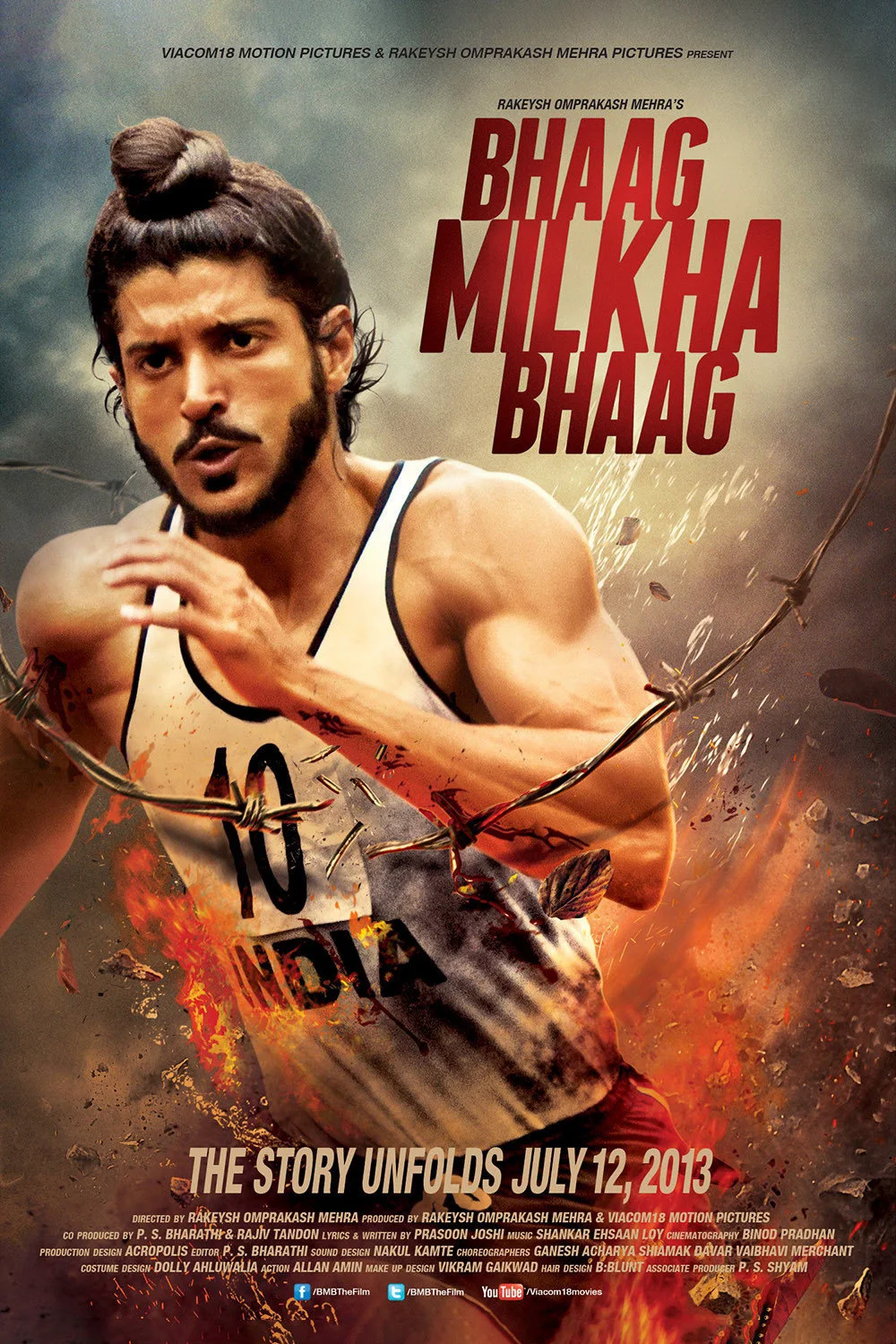
Table of Contents
Quick Facts
Bhaag Milkha Bhaag is a Hindi biographical sports drama directed by Rakeysh Omprakash Mehra, starring Farhan Akhtar, Sonam Kapoor, Divya Dutta, Pavan Malhotra and Prakash Raj. Released on 12 July 2013, it tells the true story of Milkha Singh — the “Flying Sikh” — the boy who watched his family massacred during Partition and became India’s greatest sprinter. Written by Prasoon Joshi, it is a film about running that is really about everything a man is running from.
The film was declared a “super hit” by Box Office India and became the 21st Indian film to cross ₹1 billion worldwide. Milkha Singh famously sold the film rights for a single rupee, with a share of profits going to his trust for needy sportspersons. It is now streaming on Disney+ Hotstar — and remains the benchmark against which every Indian sports biopic is measured.
Plot
The film opens in Rome, at the 1960 Olympics. Milkha Singh stands at the start of the 400 metres final, the world record holder, the favourite. His coach screams “Bhaag Milkha Bhaag!” — and suddenly Milkha is a boy again, in 1947, watching his parents cut down in the Partition riots. The memory breaks him. He finishes fourth.
From there the story runs backwards: the orphaned boy arriving alone in Delhi, surviving in refugee camps by stealing coal from trains, reuniting with his sister Isri, joining the Indian Army almost by accident — and being discovered when he wins a race whose prize is milk, eggs and exemption from drill. Coaches Gurdev Singh and later Veerapandian forge him into a champion, while a sweet romance with Biro is cut short by circumstance. The army discipline, the punishing training, the international medals — all of it haunted by ghosts he never outran.
The spine of the film is Milkha’s refusal to race in Pakistan — the country where his family was killed — until the Prime Minister himself intervenes. The climactic race in Lahore becomes far more than a sporting contest: it is the moment he finally stops running away from his past and starts running through it. The film earns its emotional finish honestly, and the final stretch genuinely quickens the pulse.
Performance
Farhan Akhtar gives a career-defining performance. He trained for over a year to build an athlete’s body and learn a sprinter’s form — but it is the interior work that stays with you. His Milkha is ferocious on the track and fragile off it: a man whose rage and grief fuel his speed. It won him the Filmfare Best Actor award, and it remains one of the great physical performances in Hindi cinema.
The ensemble is excellent. Divya Dutta is heartbreaking as Isri, the sister who is both Milkha’s anchor and a reminder of everything Partition stole — she won the Filmfare for Best Supporting Actress. Pavan Malhotra brings gruff warmth to coach Gurdev Singh, Prakash Raj is suitably steely as Veerapandian. Sonam Kapoor, in a special appearance as Biro, has limited screen time but makes the romance feel real. Even the smaller roles — Art Malik as the doomed father, Dalip Tahil as Nehru — are cast with care.
Screenplay and Direction
Rakeysh Omprakash Mehra, working from Prasoon Joshi’s screenplay, structures the film as a psychological excavation rather than a highlights reel. The flashback device — Rome as the wound the film keeps circling back to — gives the three-hour runtime its shape. Mehra stages the races with real kinetic energy rather than slow-motion clichés.
The film’s length is its main test — at over three hours, a few stretches in the middle sag, and the melodrama occasionally tips into excess. But Mehra’s conviction carries it through, and he never lets the sports-movie formula flatten the man. This is not a film about winning races; it is about what winning costs, and about a country trying to outrun its own history.
Music
Shankar–Ehsaan–Loy deliver one of the great Hindi soundtracks of the decade, with Prasoon Joshi’s lyrics doing double duty as emotional commentary. “Zinda” is the anthem — a roaring call to truly live that became the film’s signature. “Maston Ka Jhund” captures the joy of Milkha’s early victories, “Slow Motion Angreza” adds period charm, and “O Rangrez,” sung by Shreya Ghoshal, is achingly beautiful. “Mera Yaar” closes the album on a note of quiet friendship.
The background score weaves these themes through the drama so that the music feels like Milkha’s inner voice — the “Zinda” motif returns at exactly the moments he needs to remember why he runs. Few soundtracks are this inseparable from their film’s meaning, and it is no surprise the album dominated the charts through 2013.
Themes
At its core, Bhaag Milkha Bhaag is about trauma and what it takes to stop being defined by it. Milkha’s speed is born of terror — he learned to run to stay alive — and the film’s great insight is that the same gift can become a prison. It is also about Partition’s long shadow, about the army as a path to dignity for the dispossessed, and about the thin line between discipline and self-destruction. The title carries the film’s thesis: sometimes you have to run, and sometimes you have to stop.
Conclusion
Bhaag Milkha Bhaag is the rare sports biopic that earns its inspiration rather than manufacturing it. Farhan Akhtar’s towering performance, Mehra’s muscular direction, and a soundtrack for the ages make it essential viewing — not just for sports fans, but for anyone who wants to understand what Partition cost a generation. It runs long, but it never runs out of heart.
Watch the official trailer: