
Baahubali: The Beginning
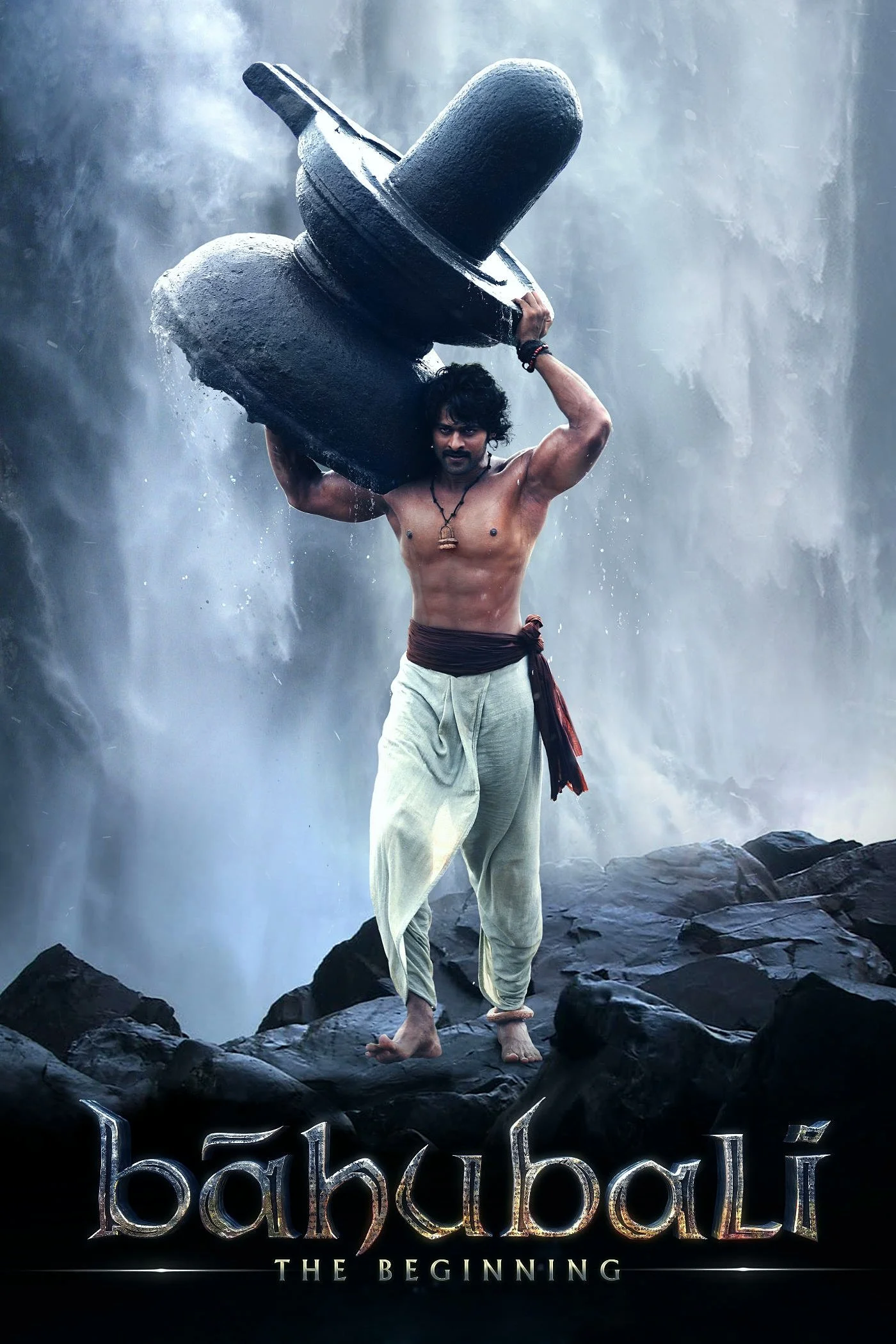
Table of Contents
Quick Facts
Baahubali: The Beginning is a Telugu epic action film directed by S. S. Rajamouli, starring Prabhas, Rana Daggubati, Anushka Shetty and Tamannaah Bhatia. Released on 10 July 2015, it was the most ambitious Indian film ever mounted at the time — and the one that finally proved a Telugu production could dream on a scale the whole country, and then the world, would pay attention to. It follows Shivudu, a restless young man raised in a remote village beneath a towering waterfall, who climbs toward a destiny he knows nothing about and stumbles into the buried history of the kingdom of Mahishmati.
The film became a genuine phenomenon, grossing over ₹600 crore worldwide and ending on Indian cinema’s most famous cliffhanger — why did Kattappa kill Baahubali? That single question kept the country talking for two years. It is now streaming on Netflix, SonyLIV and Disney+ Hotstar.
Plot
Shivudu has been raised by a tribal couple at the foot of a great waterfall, and all his life he has been obsessed with climbing it. When he finally scales the cliff, he meets Avanthika, a fierce warrior belonging to a rebel tribe whose mission is to rescue Devasena — a former queen of Mahishmati who has been held captive for twenty-five years under the tyrannical rule of King Bhallaladeva. Drawn to Avanthika and to the mystery of his own origins, Shivudu infiltrates Mahishmati, where the sight of the chained Devasena triggers something deep in his memory.
The film’s long middle flashback opens up the past. Decades earlier, Mahishmati was ruled by the wise queen mother Sivagami, who raised two cousins as her own: the noble and beloved Amarendra Baahubali, and the cruel, power-hungry Bhallaladeva. The rivalry between them for the throne — and for Sivagami’s favour — drives the palace intrigue, with the loyal slave-warrior Kattappa bound by oath to serve whoever sits on the throne. The war against the savage Kalakeya tribe gives both princes their stage, and Sivagami’s eventual choice of king sets the tragedy in motion.
In the present, Shivudu learns the truth: he is Mahendra Baahubali, the son of Amarendra, smuggled out of the kingdom as an infant. As he rallies the oppressed people of Mahishmati against Bhallaladeva, the film closes with Kattappa’s devastating confession — it was he who killed Baahubali. The story stops there, deliberately, leaving the audience hanging until the second part.
Performance
Prabhas carries the film in a demanding dual role, playing both the earthy, playful Shivudu and the regal Amarendra Baahubali, and he makes the two men feel distinct. The physical transformation was the talk of the industry — and the image of him hoisting the massive Shiva linga onto his shoulder at the waterfall became the film’s defining visual, a moment of pure mythic screen presence that needed no dialogue at all.
Rana Daggubati is a genuinely menacing Bhallaladeva, all coiled arrogance and cruelty, and he holds his own against Prabhas in their confrontations. But the film’s stealth weapon is Ramya Krishnan as Sivagami — commanding, steely and heartbreaking in equal measure, she walks away with nearly every scene she is in. Sathyaraj brings warmth and gravitas to Kattappa, the film’s emotional anchor, while Tamannaah Bhatia and Anushka Shetty give the rebellion its spirit and its sorrow respectively.
Screenplay and Direction
Rajamouli directs with the confidence of a man who storyboarded every frame in his head years before the cameras rolled. His great gift is clarity at scale: the Kalakeya war sequence, with its inventive formations and strategies, is staged so cleanly that you always know exactly what is happening even amid the chaos. He understands the grammar of the theatrical high — the slow build, the reveal, the eruption — better than any filmmaker of his generation, and the interval block is a masterclass in it.
The screenplay, from a story by Rajamouli’s father V. Vijayendra Prasad, is cleverly structured as two films in one: a romantic adventure in the first half and a palace intrigue epic in the second. The flashback is long, and the film does ask for patience, but the payoff — the emotional gut-punch of the final revelation — earns it. Produced by Shobu Yarlagadda and Prasad Devineni under Arka Media Works and shot simultaneously in Telugu and Tamil, it was a logistical mountain that the film never lets you see.
Music
M. M. Keeravani’s music is the film’s beating heart. The songs — particularly the soaring “Dheevara” sequence at the waterfall — are woven into the narrative rather than bolted on, and the background score does enormous heavy lifting in the battle scenes, giving the war a pulse and a sense of destiny. It is grand, unapologetic, old-school film scoring, and the film would be far less overwhelming without it.
Visually, the film was a leap for Indian cinema. Cinematographer K. K. Senthil Kumar gives Mahishmati a golden, mythic glow, production designer Sabu Cyril builds a kingdom that feels genuinely lived-in, and the visual effects — supervised by V. Srinivas Mohan — hold up remarkably well. For a film that cost a fraction of a Hollywood epic, the sense of scale is astonishing.
Themes
At its core, Baahubali is about dharma — the righteous path — set against raw ambition. Amarendra and Bhallaladeva are two answers to the same question of what a king should be: one who serves his people, and one who sees people as his property. Woven through it are the film’s twin emotional pillars, motherhood and loyalty: Sivagami’s impossible choices as a mother and a queen, and Kattappa’s tragic bondage to an oath that forces him to betray the man he loves.
Beyond the story, the film itself became a statement — the moment Telugu cinema stopped asking for permission and announced itself as a pan-Indian force. It drew on the Ramayana and Mahabharata the way those epics were always meant to be drawn on: not as references, but as living storytelling grammar.
Conclusion
Baahubali: The Beginning is a landmark — the rare event film that actually changed its industry. Rajamouli delivers spectacle with genuine emotion underneath, Prabhas becomes a mythic star before your eyes, and the cliffhanger remains one of the boldest bets any Indian filmmaker has ever made. Even knowing how the story continues, the first part stands on its own as a thrilling, big-hearted epic. If you have somehow never seen it, fix that immediately.
Watch the official trailer: