Kantara
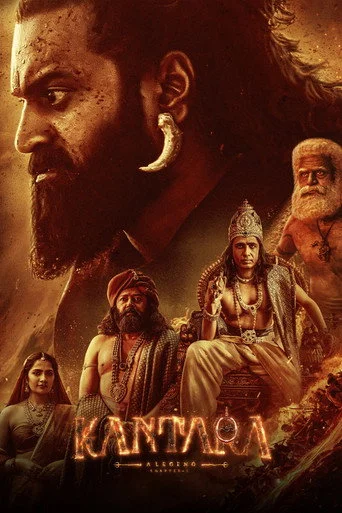
Table of Contents
Quick Facts
Kantara is a Kannada action-adventure thriller written, directed by and starring Rishab Shetty, alongside Sapthami Gowda and Kishore. Released on 30 September 2022 on a modest budget of around ₹16 crore, it became one of the great success stories in Indian cinema history — grossing over ₹400 crore worldwide, a twenty-five-fold return, entirely on the strength of word of mouth. It won Rishab Shetty the National Film Award for Best Actor and introduced millions of viewers to the Bhoota Kola spirit-worship tradition of coastal Karnataka. For more Kannada films and honest reviews, keep reading on One Movies.
The film is now streaming on Prime Video. Rooted, raw and spiritually electric, it is that rare blockbuster that feels like it erupted from the soil itself. Its climax — a twenty-minute possession sequence of shattering intensity — is one of the most extraordinary passages ever put on an Indian screen.
Plot
In the coastal woodlands of Karnataka, villagers live in uneasy coexistence with the forest — and with the Daivas, the guardian spirits worshipped through the Bhoota Kola ritual tradition. Generations ago, a king granted the tribal community forest land in exchange for the Daiva’s blessing. That fragile, sacred compact is about to break. Shiva, a carefree Kambala buffalo-race champion, is hot-headed and irreverent, dismissive of the very traditions his father died upholding. When a steely forest officer arrives to enforce government control over the woodlands, and the local landlord schemes to reclaim the tribal land for himself, Shiva finds himself at the centre of a three-way collision.
The film builds slowly and deliberately, immersing you in the village’s rhythms — the races, the rituals, the rivalries, the simmering resentments. Shiva clashes with the officer, spars with the landlord’s men, drifts through his days with a smirk. Then, in the final stretch, everything ignites at once. Pushed beyond his limits, Shiva undergoes a transformation that is part psychological breakdown, part divine possession, and the film’s last twenty minutes become something genuinely transcendent: the Daiva speaking through a man who spent the whole film refusing to listen.
It is the rare climax that justifies every unhurried minute that came before it. You do not watch the ending of Kantara so much as endure it, in the best possible sense.
Performance
Rishab Shetty gives one of the great multi-hyphenate performances in Indian cinema. As an actor he is feral and magnetic throughout, but the possession sequence alone — physically punishing, emotionally shattering, utterly without vanity — is a career-defining achievement that fully earned the National Award. That he also wrote and directed the film makes the accomplishment almost absurd; this is a triple-threat turn for the ages.
Kishore is superb as the forest officer — principled, unyielding, and crucially human rather than a cardboard antagonist. His scenes with Shiva have a genuine ideological charge because both men believe they are right. Sapthami Gowda brings warmth and quiet strength as Leela, the forest guard caught between duty and affection. The entire village ensemble feels authentic, which is what grounds the film’s more mystical passages in something real.
Screenplay and Direction
Rishab Shetty’s direction is confident and immersive in a way that suggests total ownership of the material — because the culture on screen is his own. He shoots the Kambala races with visceral, dust-in-your-teeth energy, the forest with mystical beauty, and the Bhoota Kola rituals with genuine reverence rather than exoticism. The pacing is deliberate, building like a gathering storm, and his patience pays off enormously: when the climax arrives, the emotional groundwork has been laid so carefully that the payoff feels inevitable rather than engineered.
The screenplay’s intelligence lies in its refusal to pick easy sides. The forest officer is not wrong. The landlord is not purely evil. Shiva is not purely heroic. Everyone is acting on legitimate claims — the state’s law, the landlord’s papers, the village’s sacred covenant — and the tragedy is that these truths cannot coexist. That moral complexity, wrapped inside a mass entertainer, is what elevates Kantara above its genre.
Music
B. Ajaneesh Loknath’s music and background score are phenomenal — percussive, otherworldly, and utterly inseparable from the film’s power. The Daiva themes get under your skin from the first hearing and become almost unbearably intense in the climax. The score won the National Film Award, and deservedly so; it is doing half the emotional work in the film’s final stretch. The sound design is equally extraordinary — the forest feels alive, breathing around the characters.
Cinematographer Arvind Kashyap captures coastal Karnataka with tender, golden warmth — the fields, the dusty lanes, the rain-soaked nights all glow with a lived-in beauty that makes the village feel like a place you have actually visited.
Themes
Kantara is about the collision between modernity and faith — between the state’s laws, written on paper, and the land’s older, deeper claims, written in ritual and blood. It asks who truly owns the forest: the government that maps it, the landlord who holds its deeds, or the community whose gods have guarded it for generations. The film does not offer easy answers; instead it stages the conflict with total seriousness and lets the audience sit with the discomfort. It is also, quietly, about sons and fathers — about inheriting traditions you thought you had outgrown, and discovering they were holding you up all along.
Conclusion
Kantara is a modern classic — rooted, raw and spiritually electrifying. Rishab Shetty delivers a once-in-a-generation achievement as writer, director and star, and the film’s journey from a ₹16 crore regional release to a ₹400 crore national phenomenon is the kind of story the industry tells itself for decades. The climax alone justifies the ticket; the moral seriousness underneath it justifies the acclaim. Essential viewing, and a reminder that the most powerful blockbusters are the ones that come from somewhere real.
Watch the official trailer: If this one held your interest, also see Sumaa The Flower and Thaytha.
Frequently Asked Questions
What was the budget of Kantara?
The budget of Kantara was ₹16 crore.
Where can I watch Kantara online?
You can watch Kantara online on Prime Video.
Who directed Kantara?
Kantara was directed by Rishab Shetty.
Who are the lead actors in Kantara?
Kantara stars Rishab Shetty, Sapthami Gowda, Kishore in the lead roles.