
Mayookha
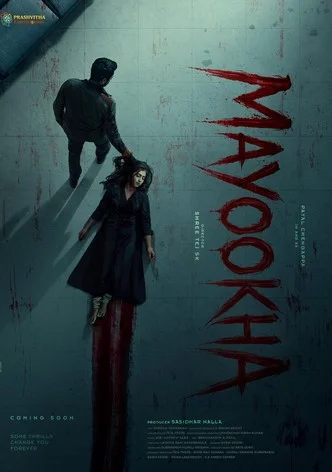
Table of Contents
Quick Facts
Plot
Mayookha is a psychological crime thriller built around an unsettling idea that has rarely been touched in Telugu cinema: phrogging, the disturbing possibility of someone secretly living inside another person’s home without their knowledge. Mayookha, played by Payal Chengappa, is a young bank professional whose life begins to unravel when mysterious happenings disturb her apartment at night. What starts as unease becomes fear, and fear becomes a question she cannot escape: is someone else living in her home?
Around Mayookha’s experience, the film builds a crime story involving SI Dev, played by Dev D, and the people in her building and her life: her father figure, neighbours, and a security guard, among others. The story revolves around the startling happenings in the life of a young and beautiful professional and how she deals with them, and the thriller keeps its central mystery close: the audience, like Mayookha, is never quite sure what is real and what is paranoia.
Performance
Payal Chengappa carries Mayookha in the titular role, and the part demands a wide range: fear, innocence, shyness and, eventually, resolve. She plays a middle-class young woman with variations in expression that sell the film’s central idea, because so much of the horror here is psychological rather than visual. If the audience does not believe Mayookha’s fear, the film does not work, and Chengappa’s performance is what makes that fear believable.
Dev D plays SI Dev with a strong screen presence, and Muralidhar Goud is effective as a father figure with limited but important screen time. Lavanya Rani, Charishma Dabbara, Aman Masud and the rest of the supporting cast fill out Mayookha’s world with characters who could each, in a thriller like this, be hiding something. That ambiguity is the point, and the cast plays it well.
Screenplay and Direction
Shree Tej SK, formerly known as Srikanth Kandragula of Cinema Bandi Productions, makes his directorial debut with Mayookha, and the concept itself is the film’s boldest choice. Phrogging is a genuinely disturbing premise, and the director has said he drew inspiration from Hollywood, Korean and Spanish thrillers, particularly in colour grading and visual style. The screenplay, written by Shree Tej with Chinthakindi Kiran Kumar, keeps the mystery tight and the apartment itself as a character: familiar, small, and suddenly unsafe.
The direction favours atmosphere over jump scares. The film’s visual presentation, with Hollywood and Korean-inspired colour grading, gives the apartment a cold, watchful quality, and the editing by Sharat J keeps the tension simmering rather than exploding. The trailer’s success, crossing 4.2 million views and reaching the YouTube Movies Trending Chart, suggests the premise connected with audiences before release, and the film’s direction justifies that curiosity.
Music
Sibi Mathew Alex composes the music for Mayookha, and his background score is one of the film’s standout technical assets. His eerie sonic textures and sudden crescendo cues amplify the jump scares and suspense effectively, without over-amplifying scenes that need quiet to work. In a psychological thriller, the score has to suggest a presence without showing one, and Alex’s work does exactly that: it makes silence feel threatening.
The director has praised Alex for weaving a tense, atmospheric soundscape that drives the emotional dread of the story. The music never becomes a distraction; it becomes the sound of Mayookha’s own anxiety, rising and falling with her sense of safety. It is a score that understands the genre, and it is a large part of why the film’s suspense holds.
Themes
Mayookha is about the loss of safety in the one place that is supposed to be safe. A home is where a person should be able to let their guard down, and the film’s horror comes from taking that away. The phrogging premise turns a private space into a public one without the owner’s knowledge, and that violation is more disturbing than any single act of violence, because it suggests that safety itself was an illusion.
The film also explores paranoia and perception. Mayookha cannot be sure whether what she experiences is real, and the film keeps the audience in that same uncertainty. That is the psychological core of the thriller: the fear is not only that someone is there, but that nobody will believe you if you say so. It is a story about being a young woman living alone, and about how easily that independence can be made to feel fragile.
Conclusion
Mayookha is a rare Telugu thriller with a genuinely original premise, and it mostly lives up to that premise. Payal Chengappa’s committed performance, Shree Tej SK’s atmospheric direction, and Sibi Mathew Alex’s tense score combine into a film that is unsettling in the right ways. It is not a horror film in the traditional sense, but a thriller that gets under the skin, and that distinction matters.
For viewers who like psychological thrillers, or who want to see Telugu cinema try a concept it has not tried before, Mayookha is a strong pick. Watch it in theatres, preferably with the sound up: this is a film where what you hear matters as much as what you see.