
Premada Oorali
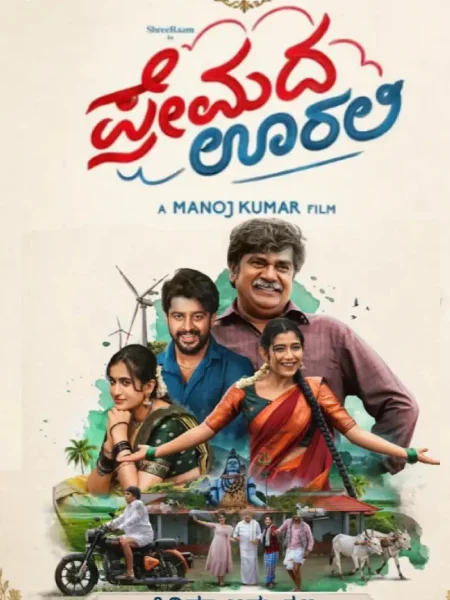
Table of Contents
Quick Facts
Plot
Premada Oorali is set in rural Karnataka in the 2020s, and its story is as simple and as complicated as village life itself. Naganna, played by Rangayana Raghu, raised his son Santu alone after losing his wife, and the two share a bond built on years of quiet sacrifice. Santu is content as a farmer, happy with the land and the life he knows. But when the question of his marriage arrives, as it always does in a village, it brings with it two women, two futures, and a whole community ready with opinions.
On one side is Vasantha, Santu’s childhood friend, who has loved him for as long as she can remember. On the other is Rukmini, an educated woman who has returned from the United States, and whom the family considers a suitable match. Between them stands Santu, a gentle man caught between affection, duty, and expectation. The film follows this triangle with patience, letting small moments, a glance, a hesitation, a family meal, carry the weight of decisions that will shape three lives.
Performance
Rangayana Raghu gives the film its soul as Naganna. He plays a father who has carried grief quietly for years, and his performance is full of the small, unspoken details that make a character feel real: the way he watches his son, the way he swallows his own worries so Santu does not have to carry them. It is the kind of performance that does not ask for applause, and that is exactly why it earns it. Raghu has long been one of Kannada cinema’s most reliable actors, and here he is at his finest.
Shree Raam plays Santu with a sincerity that suits the character perfectly. He is not a hero who conquers; he is a young man trying to be decent in a situation where decency alone cannot solve everything. Thapaswini Poonacha as Rukmini and Ramika Shivu as Vasantha give the two women distinct, fully human presences, and Govinde Gowda adds warmth to the ensemble. Nobody here is a villain, and that is the point: when everyone is trying their best, the drama becomes even more painful.
Screenplay and Direction
Manoj Kumar directs Premada Oorali with the confidence of a filmmaker who trusts his audience. He does not rush the story, and he does not decorate it with unnecessary twists. Instead, he lets the village breathe: the fields, the homes, the festivals, the long conversations that decide a family’s future. The film’s word-of-mouth success, which built slowly from its third week onwards, is a testament to this approach. Audiences discovered it gradually, told their friends, and kept coming back.
The screenplay’s greatest strength is its refusal to judge its characters. It presents the family’s reasoning, Vasantha’s heartbreak, and Rukmini’s position with equal fairness, and it allows the audience to sit with the discomfort of a choice that has no perfect answer. That balance is rare in romantic dramas, which usually pick a side early. Here, the writing respects every character, and the result is a film that feels honest rather than manufactured.
Music
Sunaad Gowtham’s music is woven into the fabric of the film rather than laid on top of it. This is a musical romantic family drama, and the songs carry the emotional rhythm of village life: love that grows quietly, festivals that bring people together, and moments of longing that words alone cannot express. The music never shouts; it hums underneath the story like a familiar tune from childhood, and that restraint suits the film perfectly.
What makes the soundtrack work is its sense of place. The melodies feel rooted in the soil of rural Karnataka, and they give the romance its texture. A lesser score would have pushed the audience towards tears at every turn; Gowtham’s music trusts the scenes to do that work themselves. It is a soundtrack that stays with you after the film ends, not because it is loud, but because it is true to the world it comes from.
Themes
At its heart, Premada Oorali is about marriage, and about who gets to decide what a good marriage looks like. Is it the family’s choice, made with tradition and security in mind? Or is it the heart’s choice, made by two people who grew up together? The film explores how family expectations shape young lives, and how a community’s judgement, especially of a woman’s past, can weigh heavier than any law. Rukmini’s story raises questions that many families would rather not ask out loud.
The film is also about women’s choices. Vasantha and Rukmini are not prizes to be won; they are women with their own hopes, fears, and dignity, and the film gives both of them the respect of a full inner life. In a story about a man’s marriage, it is quietly radical that the women emerge as the film’s moral centre. That is why audiences connected with it so deeply, and why a small film made on a budget of around two to three crore rupees grew into a hundred-crore success.
Conclusion
Premada Oorali is the sleeper hit of the year, and one of the most heartening success stories in recent Kannada cinema. From a slow start on 25 September 2026, it grew through word of mouth until it crossed one hundred crore rupees and overtook even the biggest Hindi releases as the biggest hit in Karnataka in 2026. That journey mirrors the film itself: quiet, patient, and ultimately impossible to ignore.
If you have not yet seen it, this is the film to catch in theatres. It is gentle without being weak, romantic without being sentimental, and honest about the hardest question a family can face. Premada Oorali proves that a small story, told with sincerity, can beat every blockbuster in the room.