
Nuvvu Naaku Nachav (2001) – Movie Info, Cast, Trailer & Where to Watch
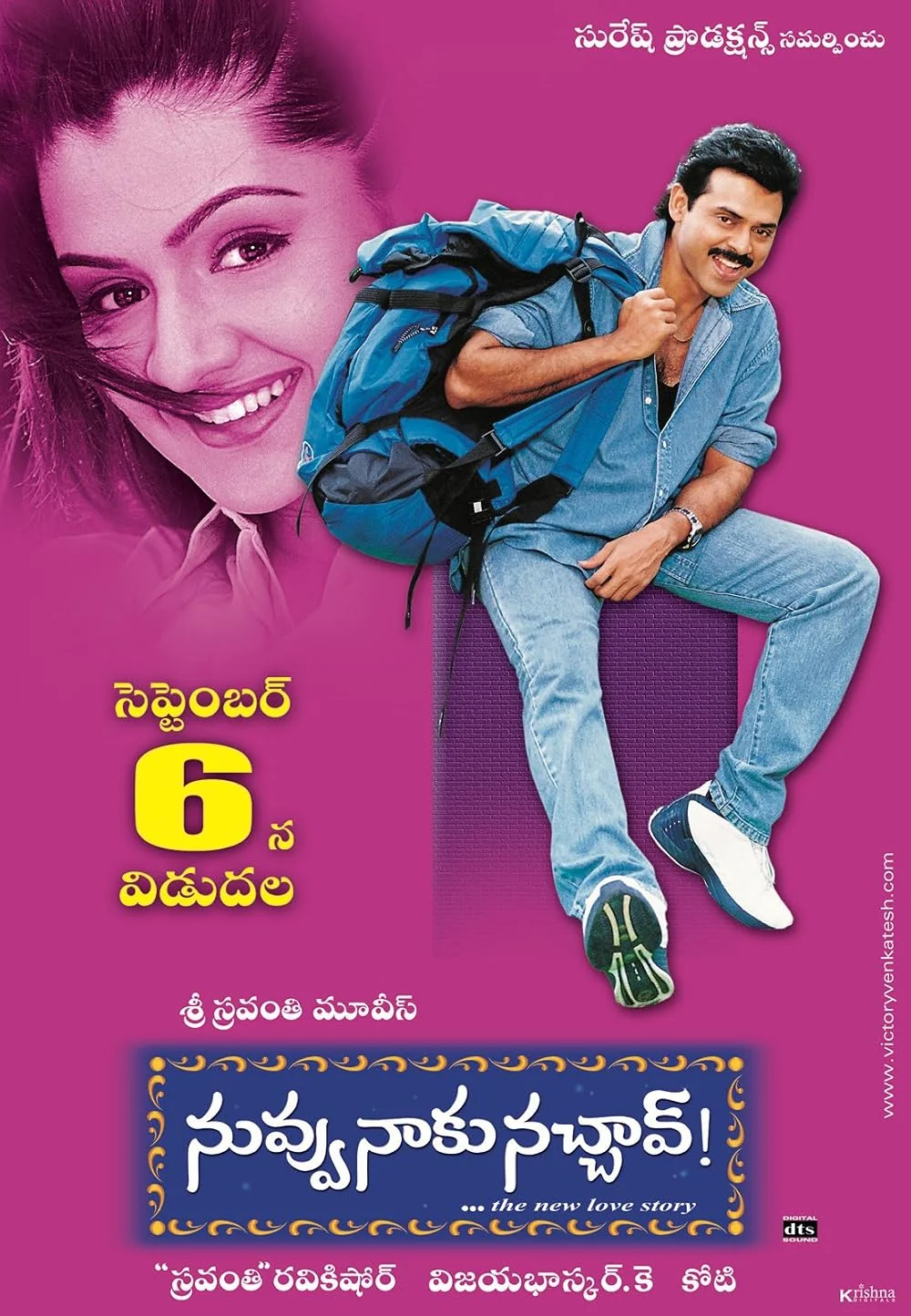
Table of Contents
Quick Facts
Nuvvu Naaku Nachav is a Telugu romantic comedy directed by K. Vijaya Bhaskar, starring Venkatesh alongside Aarthi Agarwal in her screen debut, with Prakash Raj as the formidable father nobody wants to cross. Released on 6 September 2001 and produced by Sravanthi Ravi Kishore, it grew into one of the biggest family hits of its year, running to packed houses on the strength of clean humour, hummable music and Venkatesh at his most effortlessly charming.
The film is currently streaming on Disney+ Hotstar. Warm, old-fashioned and endlessly rewatchable, it remains the gold standard of the early-2000s Telugu family entertainer — funny without ever turning crass, romantic without ever turning soppy, and the film that made Aarthi Agarwal an overnight star.
Plot
Venky (Venkatesh) is an easygoing young man with more charm than ambition, happily drifting through life while his father despairs of him ever settling down. When circumstances land him at the Hyderabad home of his father’s old friend, he walks straight into the orbit of Nandini (Aarthi Agarwal), the friend’s spirited, sharp-tongued daughter. She finds him insufferable on sight; he finds her impossible to ignore. What follows is the classic war of attrition — pranks, misunderstandings and corridor collisions — that both of them are clearly enjoying far more than they admit.
The real obstacle, though, is not Nandini’s temper but her father (Prakash Raj), a disciplinarian who runs his household like a military academy and has firm opinions about the kind of boy who deserves his daughter. Venky, with no job, no plan and no filter, is roughly the opposite of that boy. Around this central tug-of-war, director K. Vijaya Bhaskar arranges a full house of comic supporting players — each with their own small agenda — who keep the misunderstandings multiplying at exactly the wrong moments.
The film’s back half shifts gears gracefully from comedy to feeling, as Venky is forced to prove that his love is not another of his carefree whims. The climax, built around the father’s grudging reassessment of the boy he dismissed, lands because the film has earned it — every laugh in the first half was quietly building the affection that pays off in the second.
Performance
Venkatesh is the film’s beating heart, and this is one of the performances that explains why an entire generation calls him Victory Venkatesh. His Venky is lazy but never unlikeable, mischievous but never mean — and his comic timing, especially in the scenes where he is digging himself deeper with the father, is masterful. He makes effortlessness look easy, which is the hardest trick in commercial cinema.
Aarthi Agarwal, in her very first film, holds her own opposite him with remarkable confidence — sparky, expressive and completely natural in both the comedy and the emotional scenes. Prakash Raj, meanwhile, takes what could have been a cardboard strict-father role and gives it warmth and comic bluster in equal measure; his slow melt is one of the film’s great pleasures. The supporting cast — Brahmanandam, Ali, Sunil and Tanikella Bharani among them — keeps the laughs coming without ever hijacking the story.
Screenplay and Direction
K. Vijaya Bhaskar directs like a man who trusts his material. The screenplay is built the old-fashioned way: a strong central situation, characters with clear wants, and comedy that grows out of who people are rather than jokes grafted on top. The first half is a near-perfect farce of errors, and the second half earns its emotions honestly — when the father finally sees Venky clearly, it feels like a verdict the audience has been waiting to deliver.
If there is a criticism, it is that the film takes its time getting to the point — but that leisurely pacing is also its charm. This is a film that enjoys spending time with its people, and by the climax you realise you do too. Few Telugu comedies of the era balanced laughter and sentiment this deftly.
Music
Koti’s soundtrack is one of the film’s enduring assets. The breezy title song became an anthem for young romance in 2001, and the album as a whole — melodic, unpretentious, instantly hummable — fitted the film’s middle-class warmth like a glove. Two decades on, the songs still surface at family functions, which tells you everything about how deeply this film embedded itself.
The background score deserves its share of credit too: it knows exactly when to stay out of the comedy’s way and when to swell under the emotional beats. In the father’s change-of-heart scenes, the music does half the acting — and does it beautifully.
Themes
Beneath the laughter, Nuvvu Naaku Nachav is a film about fathers and the many languages their love speaks. Prakash Raj’s patriarch expresses affection as discipline, as rules, as fury — and the film’s gentlest insight is that Venky wins him over not by defeating him but by understanding him. It is also, quietly, a film about growing up: Venky’s journey from charming drifter to a man willing to be judged is the real love story here.
The film’s idea of romance is refreshingly old-school — no grand gestures, just daily proof. In an era of increasingly loud love stories, its faith in sincerity over spectacle feels almost radical now.
Conclusion
Nuvvu Naaku Nachav is that rare commercial film that pleased everyone it was made for — the youth got their romance, the families got their values, and everybody got their laughs. Venkatesh is delightful, Aarthi Agarwal announces herself, Prakash Raj steals scenes, and Koti’s music still hums along in the memory. Streaming now on Disney+ Hotstar, it is the perfect weekend rewatch — proof that the simplest stories, told with heart, outlast all the noise.