
Comrade Kalyan
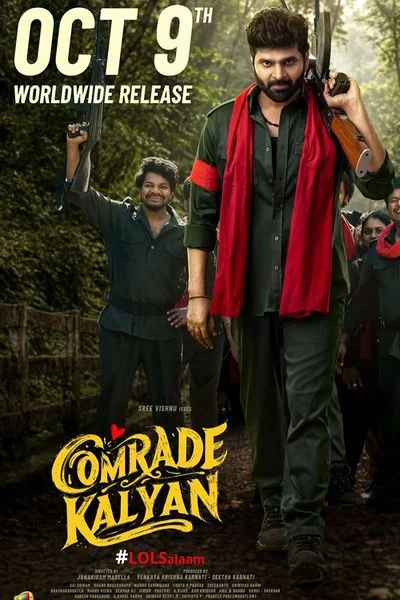
Table of Contents
Quick Facts
Plot
Comrade Kalyan is set in 1992, in a village on the Andhra-Odisha border where Naxalite activity was a part of daily life. Kalyan, played by Sree Vishnu, is an easygoing young man who runs a local theatre on lease, screening films of revolutionary hero R. Narayana Murthy, and living a carefree life with his mother, played by Radhika Sarathkumar. His world changes when Sitara, played by Mahima Nambiar, a young woman from Odisha, saves his mother and enters his life.
Kalyan falls for Sitara, but her family is burdened by a loan of five lakh rupees, and helping her means taking a dangerous step. To protect her from an unwanted marriage and to raise the money she needs, Kalyan is drawn into a Naxalite group, and soon finds himself caught between real revolutionaries and the police. What begins as a simple attempt to help the woman he loves turns into a comedy of errors, as Kalyan pretends to be something he is not, and the pretence keeps getting harder to maintain.
Performance
Sree Vishnu is in his element here, and reviewers agreed that his performance is the film’s biggest asset. His comic timing is effortless, and he plays Kalyan as a sincere, funny young man rather than a loud hero. His scenes with Satya, who plays his comic partner, form the heart of the film, and their chemistry keeps the humour fresh even when the story itself is familiar. Vishnu has built a reputation as one of Telugu cinema’s most dependable comedy actors, and this film adds to it.
Mahima Nambiar brings grace and warmth to Sitara, while Radhika Sarathkumar is a treat as Kalyan’s mother, a passionate fan of Balakrishna whose filmy enthusiasm gives the film some of its funniest moments. Shine Tom Chacko and Upendra Limaye add intensity as the men on either side of the conflict, and Satya and Sudarshan keep the comedy track lively. It is an ensemble that understands exactly what kind of film this is.
Screenplay and Direction
Director Janakiram Marella makes a clever choice: instead of treating Naxalism as a heavy, serious subject, he treats it as the backdrop for a comedy. The film never slips into dullness, and the fun segments are present in both halves. After a slightly shaky start, the film finds its footing with the heroine’s entry, and the second half keeps the laughs coming through the kidnapping twist and the police chase.
The writing is not perfect. Reviewers noted an uneven second half and inconsistent humour, and the film earned ratings around 2.5 to 3 out of 5 for that reason. But the film still emerged as a commercial success, earning around 17 crore at the box office, which shows that audiences connected with its light-hearted approach. Marella’s direction keeps the tone fun throughout, and that consistency is the film’s real achievement.
Music
Vijai Bulganin composes the music for Comrade Kalyan, and his background score is one of the film’s strengths. The score keeps the pacing snappy, matching the film’s mix of romance, comedy and sudden danger. The songs, where they appear, add to the period flavour of the early-1990s village setting without slowing the story down.
Bulganin’s music works hand in hand with the comedy: the lighter passages get a playful score, while the Naxalite portions get a tenser sound that reminds the audience of the stakes. It is not a soundtrack that dominates the film, but it supports it well, and reviewers singled out the background score as a plus point in an already entertaining film.
Themes
Comrade Kalyan is, at its heart, a film about an ordinary man pretending to be extraordinary. Kalyan is no revolutionary; he is a theatre owner who loves films about revolutionaries, and the joke of the film is that life forces him to live out the very stories he used to screen. The film gently pokes fun at hero worship, showing how cinema shapes the dreams of small-town youngsters.
The film also touches on love across cultural lines, as a Telugu boy falls for an Odia girl, and on the power of a mother’s influence, since Radhika’s character and her Balakrishna fandom shape much of Kalyan’s world. These themes are handled lightly, without lectures, which suits the film’s comic tone. The message, if there is one, is simple: good intentions can land you in very funny trouble.
Conclusion
Comrade Kalyan is a fun, light-hearted entertainer that knows exactly what it wants to be. Sree Vishnu’s effortless comedy, Satya’s supporting act, and a fresh take on a serious backdrop make it an enjoyable watch, and its box-office success shows that audiences agreed.
It is not a perfect film; the second half is uneven and the humour does not always land. But for viewers looking for a clean Telugu comedy with a difference, a 1990s village, a theatre owner, and a very reluctant revolutionary, Comrade Kalyan delivers plenty of laughs and a hero who is easy to root for.