
The Paradise
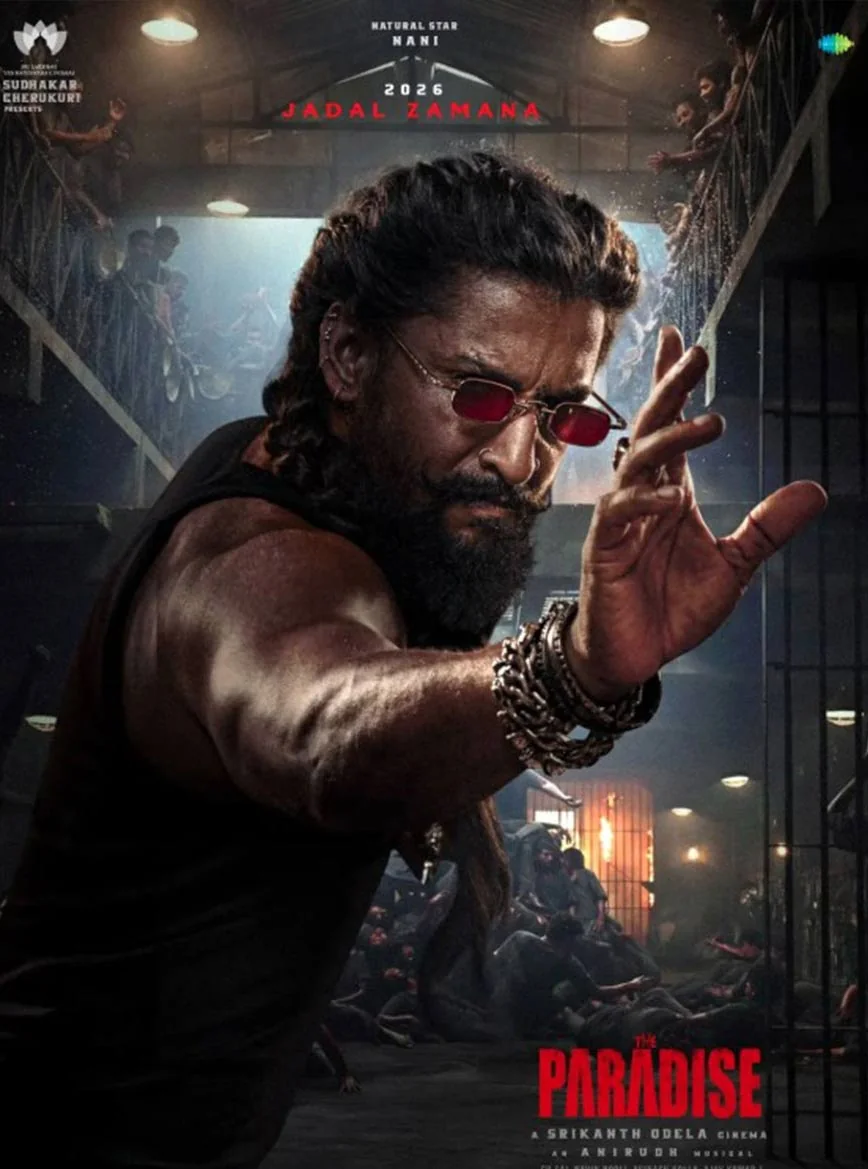
Table of Contents
Quick Facts
Plot
The Paradise is set in Secunderabad in the 1980s, in a slum inhabited by the Savaari, a marginalised nomadic tribe that lives without the most basic rights of citizenship. They have no voting cards, no identity papers, and no voice in the system. Above them stands Shikanja Maalik, played by Mohan Babu, a powerful landlord whose word is law in the settlement, and whose family has controlled the area for years.
Into this world returns Jadal, played by Nani, the son of Sammakka, played by Sonali Kulkarni, a woman who has stood up to the landlord alone. Fresh out of prison and burning with anger, Jadal becomes the unlikely leader of his people’s fight for recognition. His path collides with Vikram Malik, played by Raghav Juyal, Shikanja’s son, who wants to clear the slum and enter politics. Between them stands Subbu, played by Kayadu Lohar, and the film builds towards a bloody clash between greed and freedom.
Performance
Nani carries The Paradise on his shoulders, and his performance is the one thing almost every reviewer praised. He has physically transformed for Jadal, and he plays the character with an intensity that never lets up, whether he is fighting in the streets or standing up to the landlord’s men. It is a demanding, exhausting role, and Nani gives it everything, which is why the film’s action blocks and mass moments work as well as they do.
Mohan Babu brings his trademark authority to Shikanja Maalik, making the villain feel like a real feudal power rather than a cartoon. Kayadu Lohar and Sonali Kulkarni give the emotional core of the film its weight, as the love interest and the mother whose courage inspires her son. Raghav Juyal is effective as the hot-headed rival, and Sampoornesh Babu adds lighter moments as Jadal’s friend. The cast is strong; the film’s problems lie elsewhere.
Screenplay and Direction
Srikanth Odela, reuniting with Nani after Dasara, directs The Paradise on a massive scale. The slum set, built over months at Ramoji Film City, looks striking, and the world-building is detailed and raw. Odela clearly wants to make a film about people who fought for their country and then found they had no place in it, and that anger runs through every frame. The action sequences, especially the prison-set block, are staged with real ambition.
The weakness, as critics pointed out, is the screenplay and pacing. The story takes too long to settle, the emotional connection does not always land, and at nearly three hours the film feels stretched. The makers themselves admitted that post-production ran right up to release, which is also why the film famously arrived without a theatrical trailer. The vision is big and the craft is evident, but the writing needed more discipline to match the scale.
Music
Anirudh Ravichander composes the music for The Paradise, reuniting with Nani after Jersey and Gang Leader, and his work is one of the film’s clear strengths. The score gives the action its pulse and the emotional scenes their weight, and songs like “Aaya Sher” became hugely popular before release, crossing 200 million views. Anirudh’s sound suits the film’s dark, intense world, and it keeps the energy up even when the story slows.
The background score in particular was praised by reviewers, who felt it elevated the mass moments and the hero’s introduction. The folk-flavoured “Yeshanagula” adds a local texture that fits the Secunderabad setting. Music alone cannot fix a weak screenplay, but here it does a great deal of heavy lifting, and it is one of the main reasons the film still makes an impact in theatres despite its flaws.
Themes
The Paradise is, at its core, about identity: what it means to live in your own country without being counted as a citizen. The Savaari tribe’s fight for voting cards and papers is not an abstract idea in the film; it is about dignity, about being seen by a system that treats them as criminals and outsiders. Jadal’s rebellion grows out of that wound, and his mother’s lonely courage gives it a moral centre.
The film also explores the bond between a mother and son, and the price of violence as a path to justice. Jadal’s anger is understandable, but the film does not shy away from showing how brutal his world becomes. That tension, between the need to fight and the cost of fighting, is the film’s most interesting idea, even if the screenplay does not explore it as deeply as it could have.
Conclusion
The Paradise is a big, brutal, ambitious film that will divide audiences. Nani’s powerful performance, the striking world-building, and Anirudh Ravichander’s excellent music make it a memorable theatrical experience, especially for viewers who like intense action dramas. The scale alone is worth seeing on the big screen.
But viewers should go in with open eyes: the screenplay is uneven, the pacing drags in places, and the violence is strong, which is why the film carries an adults-only certificate. If you watch it for Nani and the world Odela has built, you will find plenty to admire. If you want a tightly written story, you may come away frustrated. Either way, it is one of the most talked-about Telugu films of 2026, and it is now streaming on Netflix for those who missed it in theatres.