
Reporting Live
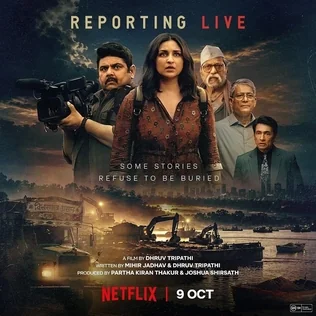
Table of Contents
Quick Facts
Plot
“Some stories refuse to be buried.” That is the tagline on the poster, and it is also the film’s entire thesis. Reporting Live, a Netflix original that premiered on 9 October 2026, follows an investigative journalist — played by Parineeti Chopra — who starts digging into illegal sand mining and discovers that the sand is the least of it. What begins as an environmental story widens into a nexus of money, muscle, and political protection, the kind of story where every source who talks suddenly stops talking.
The trailer sets up a classic pressure-cooker thriller: a reporter with more stubbornness than backup, a newsroom that wants the story but fears the cost, and a syndicate that has buried bigger problems than one journalist. The film’s tension comes not from chases but from erosion — of safety, of allies, of the line between reporting a story and becoming one. It is a thriller about the slow, grinding machinery of corruption, and the people foolish or brave enough to stand in front of it.
Performance
Parineeti Chopra anchors the film with a performance built on restraint. Investigative-journalist roles can easily tip into speechifying, but Chopra plays her reporter as a working professional first and a crusader second — tired, methodical, increasingly frightened, and unwilling to stop. It is the kind of grounded turn that makes the thriller mechanics believable: you believe the danger because you believe her fear.
The supporting cast is stacked with veterans who need no introduction to the craft of quiet menace. Amol Palekar, Shekhar Suman, Adil Hussain, and Nassar bring decades of authority to roles on various sides of the story’s moral divide, while Deven Bhojani provides crucial texture in the newsroom scenes. This is an ensemble that understands the genre’s first rule: in a film about power, the most frightening people are the ones who never raise their voices.
Screenplay and Direction
Dhruv Tripathi directs like a man who has done his homework. The procedural details feel right — the way sources are cultivated, the way a story is built document by document, the newsroom arguments about what can be proved versus what is merely known. The screenplay respects the audience’s intelligence, laying out the sand-mining racket’s mechanics without dumbing them down or drowning the drama in exposition.
Structurally, the film alternates between the investigation’s forward motion and the tightening noose around the journalist, and the cross-cutting keeps the second half genuinely tense. Tripathi’s visual approach is unshowy: handheld work in the field, static frames in the rooms where the real decisions get made. If the film has a weakness, it is a familiar one for the genre — the villains’ reach occasionally strains credibility. But the direction keeps the human stakes in focus, and that carries it through.
Music
Zubin Balaporia and Vijay Prakash handle the music, and their brief is clear: stay out of the way. This is not a film that needs songs, and wisely, it does not force them in. The score works in low pulses and uneasy silences — a drone under a late-night phone call, a held note as a document is opened — building dread the way good thriller scoring should: so gradually you only notice it when it stops.
What the music does well is characterise the two worlds of the film. The newsroom has a propulsive, deadline-driven energy; the world of the mining syndicate sounds heavier, slower, more oppressive. The contrast does real narrative work, marking the journalist’s crossings between safety and danger. In a genre where over-scoring is the default sin, Reporting Live’s restraint is one of its quiet strengths.
Themes
The film’s central theme is the cost of truth in a system designed to bury it. Illegal sand mining is the plot’s engine, but the real subject is impunity — the film’s most chilling suggestion is not that the powerful break the law, but that they have arranged matters so the law no longer quite applies to them. The journalist’s investigation is framed less as heroism than as stubbornness: she keeps going because stopping would mean accepting that arrangement.
There is also a sharp thread about the media itself — the tension between journalism as a business and journalism as a calling. The newsroom scenes ask uncomfortable questions about which stories get pursued and which get spiked, and who makes those calls. The poster’s tagline, “Some stories refuse to be buried,” turns out to be about more than the plot; it is a statement of faith in the idea that facts, pursued long enough, have a weight of their own.
Conclusion
Reporting Live is a solid, serious thriller that treats both its subject and its audience with respect. Parineeti Chopra delivers one of her most focused performances, the veteran ensemble is uniformly strong, and the direction keeps the procedural tension wound tight. It is not a film of twists and revelations so much as a film of pressure — and as a portrait of what investigative journalism actually costs, it rings true.
Premiered on Netflix on 9 October 2026, it is available to stream now, and it makes for a gripping evening’s viewing — the kind of film that sends you down a rabbit hole of real-world reading afterwards. For viewers who like their thrillers grounded, intelligent, and angry about the right things, this one is easy to recommend.